
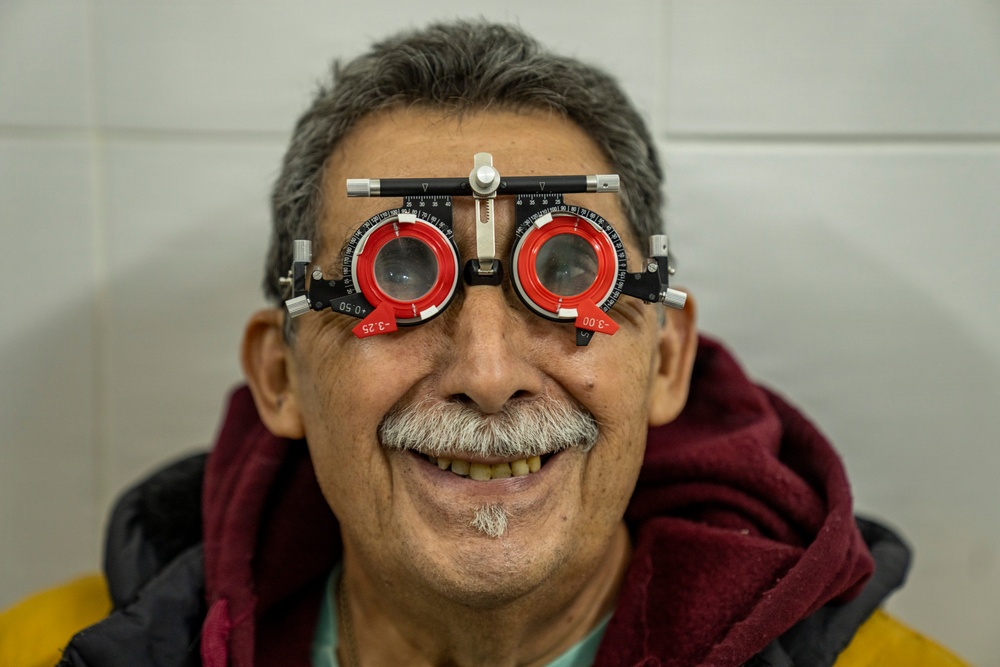
Photo By Andrea Jenkins | A patient smiles while being fitted with a trial frame during an eye exam during...... read more read more
 Subscribe
It’s 3 a.m., a 57-year-old man and his 84-year-old father quietly take their place in the growing line outside Unidad de Salud Familiar Rojas Cañada.
The father had already lost sight in one eye. Beside him stood his son, who had never visited an eye doctor. For both men, the arrival of AMISTAD 2026 meant access to specialty eye care that otherwise requires a referral to another facility, care that can be difficult to obtain because of travel, cost and wait times.
Hours after joining the line, they were welcomed inside. U.S. Air National Guard Col. Benjamin Uhl, an optometrist with the Iowa Air National Guard’s 185th Air Refueling Wing, examined both patients.
The son left with two pairs of glasses and a prescription for bifocals, the first vision correction of his life. His father received a comprehensive eye exam and a prescription for impact-resistant polycarbonate glasses to help preserve the vision in his only remaining eye.
“When someone only has one good eye, protecting that eye becomes even more important,” Uhl said. “Something as simple as the right pair of glasses can help preserve the vision they have.”
By midmorning, the growing crowd spilled beyond the waiting room, a visible sign of the community’s critical need and demand for specialty eye care during the two-week medical readiness mission.
Throughout the space sat patients, who had arrived before sunrise waiting for an opportunity that, for many, was a first: a comprehensive eye exam.
Just beyond the waiting room, in a small examination room, Uhl moves steadily from one patient to the next, diagnosing vision problems, screening for eye disease and prescribing glasses that will help many patients see clearly for the first time in years.
During AMISTAD 2026, the normally busy family health unit temporarily became one of Paraguay’s largest providers of specialty vision care, pairing U.S. optometrists with Paraguayan health professionals to expand access to services not available at the clinic.
For Uhl, the pace was unlike anything he’s ever experienced.
“This is by far the busiest mission I’ve ever been on,” Uhl said. “At my civilian practice, I’ll probably see about 35 patients in a full day. Here, we’re on pace to see close to 100.”
Uhl said, the higher volume will not change the standard of care he provides. Each patient received a comprehensive vision assessment, glaucoma screening and individualized recommendations based on their needs.
Among the patients, Uhl examined a woman, whose elevated eye pressure suggested glaucoma, a disease that often develops without symptoms until permanent vision loss has already occurred.
“Glaucoma doesn’t have symptoms,” Uhl said. “That’s what makes it so dangerous. If it’s untreated, it slowly damages the optic nerve and can eventually cause blindness.”
After reviewing her exam results, Uhl prescribed medication to lower the pressure in her eye and referred her for follow-up care through Paraguay’s health system.
Like most doctors in Paraguay, Clinic Director Dr. Cristina López said USF Rojas Cañada does not provide optometry services and must refer patients elsewhere for specialty eye care, creating barriers for many families.
“Having optometrists here changes everything,” López said. “Many of these patients would not have had this opportunity otherwise. They can receive an examination close to home, learn about problems they didn’t know they had and leave with a plan to protect their vision.”
While some patients required treatment for serious eye conditions, many simply needed corrective lenses. Those moments remain, for Uhl, the most rewarding part of every humanitarian mission.
“It’s always good to give people glasses,” he said. “People come in struggling to read, work or simply recognize faces, and sometimes all it takes is handing them the right pair of glasses. The impact is immediate.”
He soon discovered the reward wasn’t his alone to feel, after one of his patients revealed that after receiving glasses for the first time, playing soccer had become easier because he could finally see the ball clearly. Although Uhl serves as commander of the Iowa Air National Guard’s medical group, opportunities to practice clinically during military duty are limited. Missions like AMISTAD allow him to maintain expeditionary medical skills while also adapting to resource-constrained environments.
Without the automated equipment commonly found in U.S. clinics, Uhl relied more heavily on retinoscopy, a manual technique that estimates a patient’s prescription by observing how light reflects through the eye.
“It’s something I rarely have to use at home except with children,” Uhl said. “Here, I’ve gotten really good at it again because working without some of the technology makes you sharpen those fundamental skills.”
Those professional exchanges extended beyond the U.S. medical team and Paraguayan health professionals with university students and translators observed examinations throughout the clinic. They gained firsthand exposure to specialized eye care while helping bridge language barriers between providers and patients.
López said the collaboration strengthened both patient care and professional development. “Our staff learns from their experience, and they learn about our health system and our patients,” she said. “That exchange benefits everyone and helps us continue improving the care we provide.”
By the end of the mission, hundreds of patients received eye examinations at the Rojas Cañada alone. For many, the visit meant clearer vision. For others, it meant detecting potentially blinding disease before symptoms appeared. For Uhl, those outcomes define the mission’s lasting impact.
“We’re helping people see better today,” Uhl said. “But we’re also finding problems early, preserving sight and giving patients the opportunity to protect their vision for years to come.”
| Date Taken: | 06.23.2026 |
| Date Posted: | 07.02.2026 19:09 |
| Story ID: | 569331 |
| Location: | CAPIATA, PY |
| Web Views: | 60 |
| Downloads: | 0 |

This work, AMISTAD 2026 brings sight, hope to Paraguay, by Andrea Jenkins, identified by DVIDS, must comply with the restrictions shown on https://www.dvidshub.net/about/copyright.


No keywords found.




