
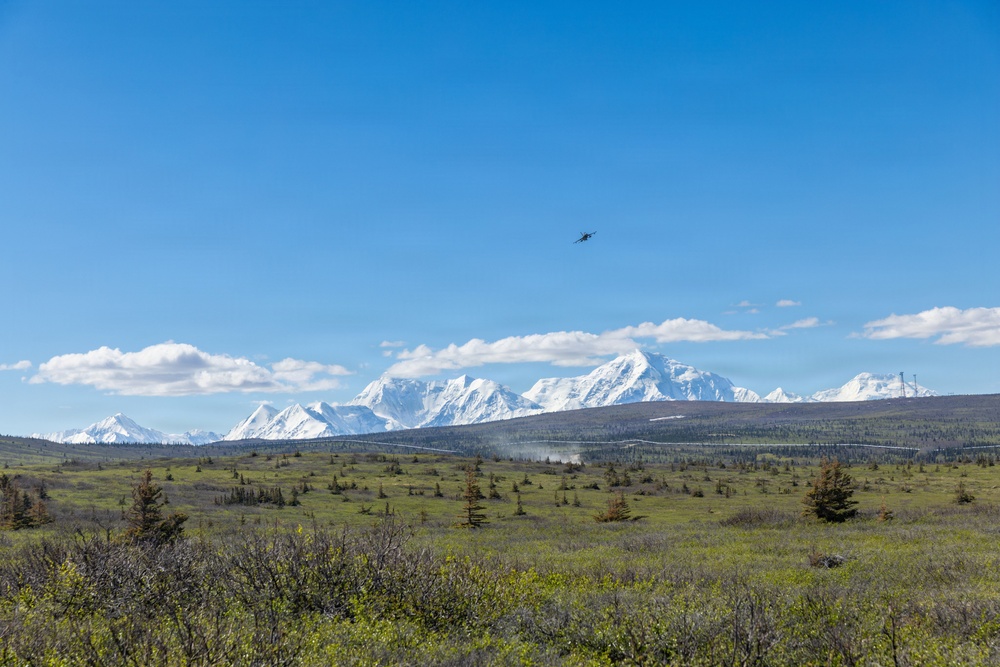
Photo By Sgt. Nicholas Riccio | An F-16 Fighting Falcon executes a show of force over a simulated enemy position...... read more read more
 Subscribe
EIELSON AIR FORCE BASE, Alaska — In the brisk Alaskan air, on a steep hillside overlooking the vast terrain, U.S. Army Special Forces soldiers, also known as Green Berets, assigned to 3rd Special Forces Group (Airborne) are preparing for one of the region’s most demanding combat training exercises: Red Flag-Alaska. For decades, Red Flag-Alaska has provided aircrews with the opportunity to train against realistic threats under contested conditions, building experience and confidence before facing real-world adversaries. Yet while fighter aircraft streak across the sky above the Joint Pacific Alaska Range Complex, another fight begins long before the first jet takes to the air.
Inside a nondescript room on Eielson Air Force Base, Green Berets huddled around maps, terrain imagery and mission graphics covering nearly every available table and wall space. Tactical communications equipment fills the corners of the room while planners refine timelines and routes. A briefing slide advances across a wall-mounted television, detailing the next day’s mission.
The ground force commander spoke with precision, pointing to a route displayed on the screen. It was a surprising shift. Moments earlier, the team had been smiling, joking and laughing with each other. Now, they were all business, shifted into attentive and deliberate professionals. Routes, contingencies and communications plans were discussed with the matter-of-fact tone of a team who had rehearsed the process countless times before.The mission is part of Operation Close Shave, the ground component executed by the Green Berets in support of the large scale combat operations exercise scenario.
While fighter aircraft may be the most visible element of Red Flag, they are rarely the spearhead of the operation, Green Berets shaping the battlefield before they leave the runway.
Before aircraft can operate freely in contested airspace, special operations forces, or SOF, work deep within contested or enemy territory to identify threats, gather intelligence and create conditions that allow the Joint Force to maneuver. An ODA, or Operational Detachment-Alpha, the foundational unit of action for U.S. Army Special Forces, provides commanders with the information required to help clear a path for the aircraft and paratroopers that follow.
A two-hour trip south, near Delta Junction, brings the ODA to a pothole-filled side road, Denali’s peak reaching out of the horizon like someone painted it onto the sky. Alaska’s natural beauty served as a somewhat dangerous distraction while in the OPFOR’s, or opposing force’s, territory; the simulated country borders indicated that we were well behind “enemy” lines.
A group of individuals on the roadside approached the lead vehicle, and I could see the driver become cautious before realizing these were our counterparts, operators and paratroopers from the Belgian 3 PARA (Regiment). From wary to relieved, we were all smiling as introductions were exchanged and the Belgians offered to show us the way to the “safe house.” Safe houses act as bases of operations for Special Forces operators; while not necessarily a house in many cases, they act as both a command center, shelter, cover, and concealment from enemy forces and civilian populations, respectively.
This particular safe house, The Alaska Flour Company is a real-world business and working farm that would function as the team’s base of operations for the next week, playing into their scenario simulated cover story as seasonal farm workers in the area; an effort to blend in with the local populace. Equipped with fake IDs and cover stories, the option to fight was only ever considered as a last remaining option.
The wooden structure housing the teams was not much more than a long, wide, dark, open corridor used for grain processing, the structure being colder inside than it was out. The Belgians had set up a barrel fire outside to warm our extremities from the frigid interior of the flour plant. One of them said something in Dutch that I didn’t understand and the others around the fire laughed as we gathered around and stoked the flames. It was a moment of relaxation and comfort before the long days ahead.
Hours later, vivid colors painted the Alaskan sky as the multinational team of special operators moved quietly along a riverbank, carrying the equipment they would need for days of reconnaissance.
The absence of darkness during the far north’s summer nights increased the risk of detection during their no-fail reconnaissance mission. Heavy animal activity in the form of large predator’s leftover meals served as constant reminders of the dangers posed by the wildlife surrounding them. With the high-risk environment in mind, the operators set up fallback positions, established communications with rear command elements and edged toward their objectives.
Using a mix of fieldcraft and technology, the teams split into two-man elements and traversed through thick woods toward the scenario’s air defense objectives.
Through the brush, a fenced-off compound emerged ahead, revealing large mockup integrated air defense systems depicting surface-to-air missile launchers, radars and other mobile air defense equipment. The mock missile launchers hidden among the trees represented exactly the type of threat Red Flag planners wanted the ODA, and their allied counterparts, to confront.
In the exercise scenario, a network of integrated air defense systems, radar sites and command-and-control nodes formed layered barriers, designated to deny access and maneuvering capability to coalition aircraft. These systems force pilots to contend with threats capable of detecting and engaging their aircraft long before they reach critical objectives.
Finding those threats is where special operations provide a critical advantage.
Small teams, specializing in operating in hostile, denied, and contested environments, infiltrate challenge areas to observe targets, evaluate and/or confirm intelligence and develop a comprehensive picture of the operational environment. The information they collect helps commanders distinguish between suspected targets and verified threats, reducing uncertainty before air assets are committed.
In an era increasingly defined by technological advantages such as satellites, drones and electronic sensors, it may be tempting to assume technology alone can provide every answer. However, modern battlefields remain environments of constant adaptation, where adversaries actively employ camouflage, deception, electronic warfare measures/countermeasures and other techniques designed to obscure themselves and their operations. A target detected by one sensor may prove to be a decoy when observed from the ground. Even the most advanced collection platforms can produce incomplete or conflicting information when confronted by a determined adversary. In the end, commanders often still rely on someone physically confirming at the target site and reporting accurate and timely information.
“The problem with satellite sensors is they have a harder time maintaining eyes on,” said a Special Forces soldier I was shadowing. “If we are able to get behind enemy lines and conduct an operation like this, there’s a constant ground sensor.”
For ODAs, fieldcraft, observation and direct confirmation remain indispensable tools. The ability to physically verify with eyes on a target provide Joint Forces commanders a level of certainty that technology alone cannot always deliver. In a contested environment, that assurance can mean the difference between a successful air campaign and aircraft flying into unknown threats.
“We are deep behind enemy territory trying to open the air corridor and allow conventional forces to parachute in and gain control of this area,” the Special Forces soldier said. “We’re here in support of the main effort, which is the joint force entry of the 11th Airborne Division, so they can jump in, get boots on the ground and begin taking control of key terrain or infrastructure.”
The ODAs remained concealed among moss-covered logs and dense vegetation bordering the clearing, quietly observing and transmitting information while remaining mindful of OPFOR operating in the area.
“No troop transport planes, C-17s or anything like that, can gain access to this airspace to conduct an air operation until these are taken out,” the Special Forces soldier declared. For the next several days, reconnaissance and observation remained the primary mission. Operators relied on their advanced knowledge of wilderness survival skills, keeping fire going, supplementing our field rations with food gathering and demonstrating basic shelter construction. Despite the constant sunlight, temperatures plunged into the low 30s overnight. Spending those frigid hours bundled in waterproof clothing without a heat source offered a glimpse into the conditions special operations personnel endure during real-world operations.
Although we had not yet encountered OPFOR, the implications of doing so remained at the front of my mind.
“… The risk is detection and compromise,” the Special Forces soldier explained. “A mission like this in real life is extremely dangerous.” After that, he impressed upon me, in no uncertain terms, just how perilous a task this can be. It was a sobering assessment, so I asked how operators mitigate that risk. “That’s why we do training like this,” he continued. “To figure out where our gaps are. Figure out where we need to improve. The only way you can infiltrate this deep, in my opinion, is by blending in, maintaining a very low signature and a very low pattern of life.”
During a quiet moment around 3 a.m., I found myself admiring the smoke-free portable carafe one operator had carried into the field. As coffee simmered in the perpetual daylight, I was reminded that even among highly trained professionals, caffeine remains less a luxury than a necessity.
It was much the same for the next few days – observing and reporting – though it was hardly monotonous in the beautiful Alaskan wilds, especially when broken up by the appearance of wandering wildlife in the distance.
Before I knew it, the day of the culminating event arrived, having moved to a mountainside near Fort Greely. I sat with another Special Forces soldier at an observation post overlooking an FLS, or field landing strip, which, although runway-sized, was more or less a stretch of dirt that had been flattened and cleared of the pervasive brush that blanketed the rolling terrain.
We could see opposing forces’ vehicles moving along the strip, ant sized from our nestled vantage point amongst the thick shrubbery adorning the mountainside. We crouched still while we waited for word on a strike mission, discussing the role of our Belgian counterparts.
“So they're going to be at the north end of the DZ [drop zone]. Their leadership right now is co-located with [ground force commander] out here at the MSS,” the other ODA team member said, referring to the mission support site. “But they're going to be at the north end of the DZ and they're going to try to take a sniper shot to take out a guy with a man-portable air defense. He's carrying an SA14. Going to try to find him… and then that way we can bring in CAS [combat air support] and we can facilitate close air support, and help enable the joint forcible entry by the 11th Airborne Division.”
Put simply, the mission was to remove the threat preventing Joint Force aircraft from entering the area of operations — a task that was certainly easier said than done. Less than an hour later, the answer arrived with the roar of an F-16 Fighting Falcon overhead as it rolled in on its targets.
With the air defense systems neutralized, the spread-out teams gathered on the sloping overlook to watch the dozens of transport aircraft – American C-130s and Belgian A400Ms – begin to drop paratroopers by the score along the FLS. The ground forces’ mission was complete. Fighter jets and transports successfully reached the objective, and as we listened to the crack of the infantry’s weapons ring out over the peaks, we began our hasty exfiltration back to our vehicles.
But the TACP, or tactical air control party, had one last surprise in store for the rest of the ODA. Confirming the transport craft had cleared the airspace, they radioed yet again, this time to the F-16s still circling the area and requested a “show of force.” While discussing what grid coordinates to give, one of the ODA members grinned and pointed. The unsuspecting range control contractors had been parked in their pickup trucks nearby for quite a while, breaking the illusion of the war game with their necessary presence. Still smiling, the TACP suggested, “How about them?”
Moments later, the F-16s screamed directly overhead of us, buzzing by the unsuspecting 4x4s, the frames of the trucks rattling as the contractors within suddenly jolted from their seats.
As we descended toward the mountain pond we had parked our vehicles next to, we found Alaska had one last pleasant surprise in store for us. Grazing across the small body of water, a herd of caribou had come into the open, looking up, and regarding us with vague interest. As Denali stretched its snowy peak in the background of the serene scene, I was struck by how the violence of a true combat mission in an environment like Alaska would be so surreal and at odds with the natural beauty around you. In the distance, the roar of jet engines was still audible, and as the ground forces’ role in Red Flag came to a conclusion, the forces in the air were now free to dominate the battlefield, the conditions for success already set by the operators on the ground.
| Date Taken: | 06.24.2026 |
| Date Posted: | 06.24.2026 14:35 |
| Story ID: | 568487 |
| Location: | EIELSON AIR FORCE BASE, ALASKA, US |
| Web Views: | 259 |
| Downloads: | 0 |

This work, Silent Professionals Set the Conditions for Red Flag Success, by SGT Nicholas Riccio, identified by DVIDS, must comply with the restrictions shown on https://www.dvidshub.net/about/copyright.


No keywords found.




