
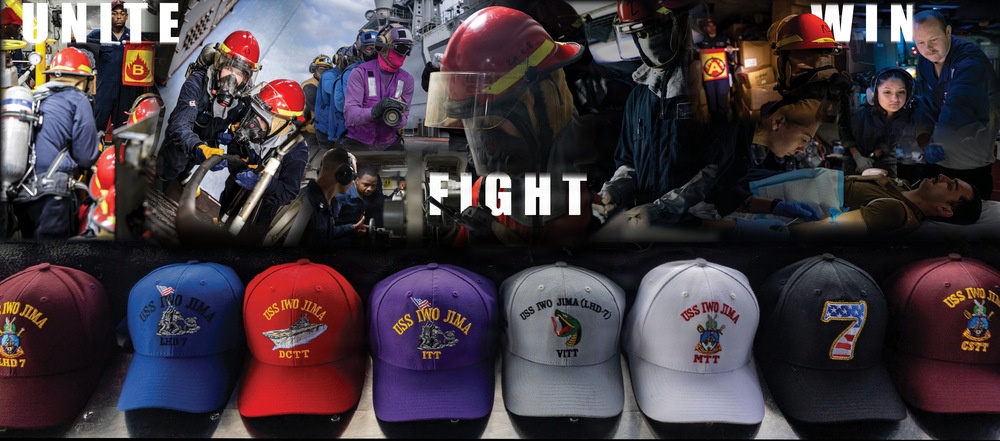
Photo By Petty Officer 3rd Class Logan Goins | Integrated training team covers are displayed aboard Wasp-class amphibious assault...... read more read more
 Subscribe
In today’s dynamic global environment, the U.S. Navy is often called upon first to respond to events due to its enduring presence around the world. As evidenced by worldwide events within the last year, the fleet remains at the tip of the spear, tasked with shaping the battlespace and delivering combat power at sea and ashore. As the Navy’s warriors operate at sea, they must innovate, train, and build capacity and capability aboard the Nation’s warships in order to respond to any environment, any time while keeping the ship in the fight.
To combat incidents that may arise aboard warships such as Wasp-class amphibious assault ship USS Iwo Jima (LHD 7), the Navy has designated the creation of specialized training teams to help prepare the crew. These training teams include damage control, anti-terrorism, medical, aviation, visual information, combat systems, seamanship, and engineering.
Each team owns and executes the functions of a highly-specialized warfare area designed to combat specific problems caused by internal or external factors. However, when preparing the crew for large-scale casualties, the team’s areas of expertise are forced to overlap, requiring one cohesive unit to tackle the problem. In order to combat the problem, Iwo Jima’s Sailors work together to form a unified team designed with one purpose, to unite, fight and win.
According to Commander, U.S. Surface Forces Atlantic instructions, Integrated Training Team (ITT) evolutions are ship-wide battle problems coordinated and executed by ship’s ITT to deliberately train units under stressful and fatigue-inducing conditions.
Lt. Cmdr. Chad Munk, Iwo Jima’s Training Officer and ITT Coodinator, plays a crucial role in planning and coordinating these evolutions aboard Iwo Jima. Munk credits these large evolutions, that follow a weekly drumbeat on deployment, as one of the most critical events that brings teams together. Iwo Jima’s strength is in the collective knowledge of the battlespace and response mechanisms baked into each warfare area—no single team soley holds the responsibility for fighting the entire fight.
“ITT brings all the teams together, so that we really know how we're going to respond to anything, because in any real situation, it's not going to be one team,” said Munk. “You do still need to focus on the individual teams. Having the individual teams allows them be the experts in their respective area instead of one training team that does everything.”
Munk believes it is important to train and focus on each team, starting with smaller drills and leading up to advanced evolutions that allow the training team to hone in and perfect their craft for more complex integrated training team scenarios.
One of the more robust teams in the ITT, the Damage Control Training Team (DCTT), is responsible for combating casualties that threaten the interior of the ship. Chief Yeoman Dominic Allen, a DCTT member, believes motivation and realistic training scenarios are crucial for being ready for the real thing.
“Training how you would fight if a real [casualty] were to happen is one of the most important things we do,” said Allen. “I’m very enthusiastic about running integrated training drills. You get to see how Sailors would react when multiple different things are thrown at them, which is what would happen in real-world scenerios.”
Running weekly ITT evolutions helps maintain ship’s readiness and resilience if a major casualty happened that sent the ship into general quarters. During general quarters, the casualties would involve most, if not all of, the ITT leadership and depend on their guidance to minimize the cost of the casualty and save lives while keeping the force in the fight.
“We do these trainings to resemble real world scenarios,” said Aviation Boatswain’s Mate (Handling) 1st Class Aaron Ford, an Aviation Training Team member. “We have to be quick on our feet to respond, we have to practice, learn, and train how we fight.”
ITT evolutions require exceptional teamwork and coordination among Sailors to train how they fight—a concept embodied in the Chief of Naval Operations Foundry, Fleet, Fight framework with its stated goal to “create a more lethal, efficient, and available force through enhanced training…”
Training the teams together weekly keeps Iwo Jima’s Sailors fresh, making integration second nature while also communicating the teams’ strengths and areas for improvement.
When things go wrong, it takes everyone working as one team to complete the mission. Preparation is key to Iwo Jima’s success against any possible casualty. As the seven training teams work together to solve a greater problem, an environment is created to ensure Sailors are ready to respond to any scenario that may come up in the real world.
“We bring them all together so that we can coordinate and find out [how] the teams play together and where they need to coordinate better,” said Munk.
“By exercising each warfare area all in one big scenario, we really, really get that team unity, for the whole ship to work together.”
| Date Taken: | 06.01.2026 |
| Date Posted: | 06.02.2026 00:52 |
| Story ID: | 566640 |
| Location: | ATLANTIC OCEAN |
| Web Views: | 224 |
| Downloads: | 0 |

This work, From the Foundry to the Fight: USS Iwo Jima’s Integrated Training Team, by PO3 Logan Goins, identified by DVIDS, must comply with the restrictions shown on https://www.dvidshub.net/about/copyright.


No keywords found.




