
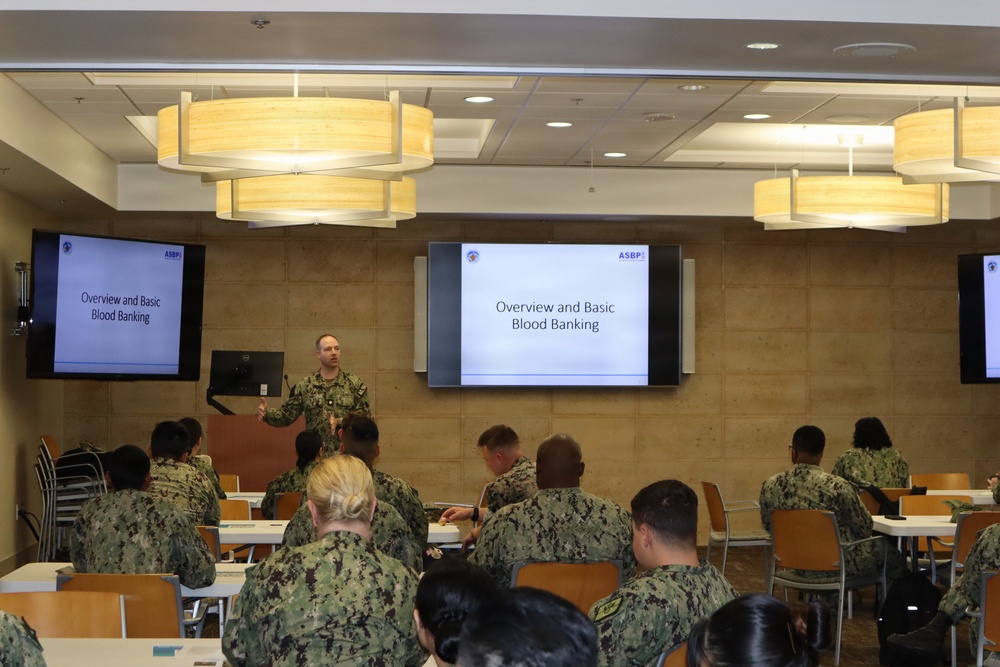
Photo By Curtis Hill | Lt. Cmdr. Jeff Hebert, laboratory department head for Naval Medical Center San Diego,...... read more read more
Naval Hospital Camp Pendleton hosted a two-day walking blood bank training event for Navy medical personnel across Marine Corps Base Camp Pendleton in the hospital galley meeting room May 11-12, 2026.
The training was scheduled and hosted by Lt. Gildas Noumen, the NHCP laboratory department head.
The lead trainer was Lt. Cmdr. Jeff Hebert, the laboratory department head for Naval Medical Center San Diego.
The training audience was comprised of hospital corpsmen, medical officers, dental officers, and medical service corps officers from Navy Medicine Readiness and Training Command Camp Pendleton, Expeditionary Medical Facility 150 Alpha, and various Marine Corps operational commands across the base.
Training in walking blood bank procedures is an important aspect of being medically ready to deploy in support of contingency operations.
“Expeditionary Medical Facilities operating as Role 3 hubs in combat zones must implement a comprehensive walking blood bank training program,” said Noumen. “This capability is a non-negotiable requirement for mitigating blood supply shortages, rapidly treating severe hemorrhage, and saving warfighters' lives during delayed medical evacuations or periods of contested logistics.”
Regardless of location, being trained and prepared to stand up a walking blood bank can be the difference between life and death.
“One patient can wipe out an entire blood supply,” Hebert said on the first day of training. “Establishing a walking blood bank will save lives.”
“Hemorrhage remains the primary cause of preventable battlefield fatalities, rapidly initiating the "lethal triad" of acidosis, hypothermia, and coagulopathy. Fresh whole blood sourced from a walking blood bank directly counters this cascade by providing a complete resuscitation fluid containing red blood cells, plasma, and active platelets,” said Noumen. “In down range operations where stored blood components are easily exhausted or resupply lines are severed, walking blood banks are a critical lifeline. To maximize survivability within the critical two-hour trauma window, trained personnel must be capable of screening donors and completing blood draws in under 28 minutes.”
The two-day training event included both classroom instruction and hands-on practical application.
“I liked the training because it got me to do stuff I hadn’t previously done as a phlebotomist,” said Seaman Joshua Allen, a corpsman assigned to EMF 150 Alpha. “I learned a lot of new things that will benefit me both here at the hospital and if I’m deployed.”
This evolution was an initial step, but ongoing training will be significant in maintaining skills.
“For a lot of these people, this is the first time they’ve had the opportunity to attempt phlebotomy for blood collection,” added Hebert. “Key elements are knowledge and rehearsal. The more they can practice here, the more prepared they are when they go forward.”
| Date Taken: | 05.12.2026 |
| Date Posted: | 05.12.2026 15:41 |
| Story ID: | 565066 |
| Location: | CAMP PENDLETON, CALIFORNIA, US |
| Web Views: | 146 |
| Downloads: | 0 |

This work, Navy medical personnel aboard MCB Camp Pendleton train on walking blood bank operations at NHCP, by Curtis Hill, identified by DVIDS, must comply with the restrictions shown on https://www.dvidshub.net/about/copyright.


No keywords found.





