
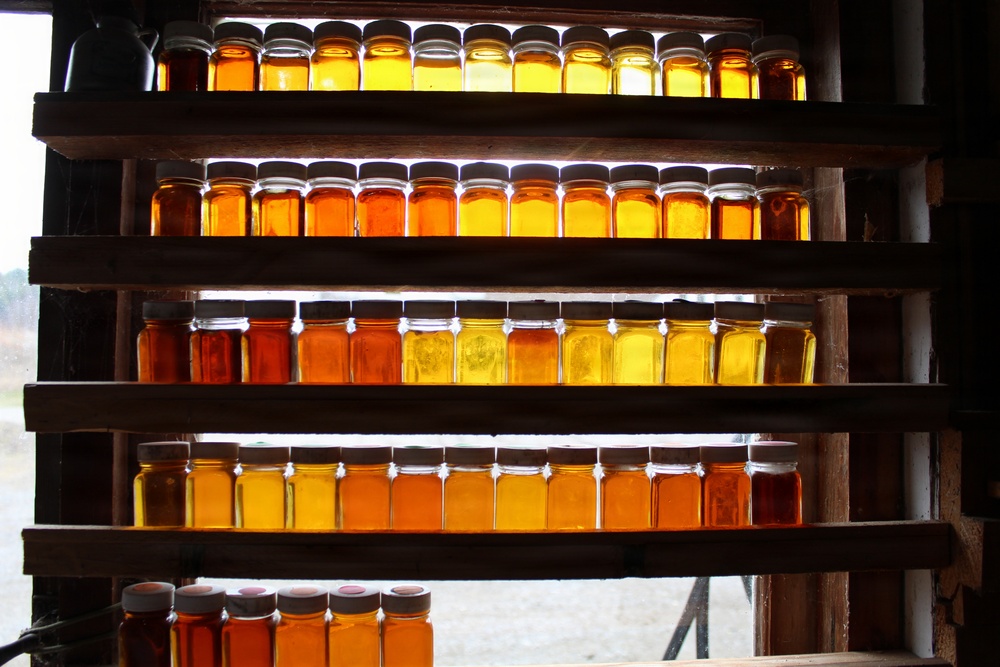
Photo By Briana Shepherd | Jars of maple syrup samples line a windowsill inside the Twin Maple Sugarworks...... read more read more
 Subscribe
Don Gale was hunting in the Green Mountain National Forest, toward the end of deer season, when he sat down on a rock and took it all in. “Stick season” to most Vermonters, there must have been leaves on the ground and a nip in the air, and likely not a whole lot to “take in”. Yet Gale looked around and he said to himself, “Wow, this would make one heck of a sugarbush.” For those of us who happily slather maple syrup on everything but have never harvested that sweet nectar ourselves: a sugarbush is a group of sugar maple trees which could be tapped for maple sap. By drilling a small hole into a maple tree and inserting a spout, or tap, sap can flow from the tree. Gale was looking out at acres and acres of untapped maple. It’s no wonder Gale could spot the potential in the woods that day. He started sugaring— collecting and processing maple sap—when he was 15 years old. He used 35 buckets to collect the sap on his family’s property. When he and his wife moved to Vermont in the 90s, they started sugaring on their own property with those same 35 buckets. They eventually bumped up to 330 taps and buckets, but it was that hunting trip that really boosted operations. This year, they’ve got about 4,900 taps set in the National Forest.
The forest did not provide Gale with a deer that day, but for almost the last 30 years, it has provided him with hundreds of thousands of gallons of maple sap. In turn, Gale has been providing thousands of gallons of maple syrup to customers from all over the world. He’s supplied to businesses, donated to local organizations, and attended a nearby farmers market for years. In any given sugaring season, there are 6-8 other locals working with Gale part-time to support the operation. Gale has been making improvements, fine-tuning the process every year. In 2011, a loan from USDA Farm Service Agency, enabled him to upgrade his equipment, which dramatically increased efficiency. Still, for the first 24 years, every penny earned went right back into the operation. Until eight years ago, when he grossed more than he ever did in his pre-retirement life as an engineer, “we actually put money in savings!” says Gale. Turning a profit is nice, but sugaring isn’t really about the money for Gale, just like hunting isn’t really about the deer. “When I market myself, I actually market the National Forest. I tell people how beautiful it is,” says Gale. “There’s always something interesting to take a picture of and a lot of people have taken me up on a hike out to the sugarbush.”
Gale isn’t the only one hiking around that part of the mountain. He says he’s met many folks in the area recreating. Cross-country skiers are especially common this time of year. Again, for the maple indulging, uninitiated: Gale no longer uses buckets to collect sap dripping from trees, he uses small diameter plastic tubing, or lines, that run from the tree taps to a mainline to a storage tank. Now, couple that image with the cross-country skiers, and you might think there would be bit of a calamity on the mountain. In reality, Gale hangs his lines as high as he can reach during the off season, and most passing through seem to know what they’re looking at when they enter the sugarbush. He says there’s never been any trouble sharing the land for multiple uses. In fact, “they use the same trails I use for sugaring,” says Gale. Back at the sugar shack, where the sap is processed into maple, Gale fields questions from folks who are less familiar with a maple operation. It’s common for people from different states or even different countries to drive past tap lines on their way to buy maple. They’ll ask Gale if those tubes they saw close to the road are his. Gale’s tubes are more tucked away in the forest, but he tells them, “Ours look a lot like that, but we’re not tapping trees that are 6 inches in diameter.”
Permitting with the National Forest means agreeing to a set of mitigation measures to ensure the health of the forest. As a permittee, Gale agrees to only tap trees 12” or greater in diameter. He also only installs one tap per tree or two taps if the tree is 18” or larger in diameter. The depth of the tap can be no greater than 1.5” into the tree and all taps are to be removed at the end of the season for the tree to heal. There is a list of additional mitigation measures addressing tap size, tube color, even motorized travel. A Forest Service employee, usually a forester, walks the permit area during and after the sugaring season to check on the stand and to make sure mitigation measures are being followed. Forest health experts from the USDA Forest Service office of State Private and Tribal Forestry also visit each of the permit areas in the fall to monitor for pests and measure root starch levels and tap hole closures. All in an effort to sustain forest health. “Maple is simply one more sustainable product that is harvested from the National Forest,” says James Donahey, District Silviculturist for the Green Mountain National Forest. “Keeping it sustainable takes commitment by our permittees to follow our guidelines and the expertise of our forest health experts to alert us to threats to the tree’s resilience.” The beauty of National Forest land is that 100 years from now, someone else could be tapping in the same location Gale is today. All while friendly skiers continue to zip past. But only if the sugarbush is managed properly. The Forest Service’s role is to bridge that gap between Gale working the land today and someone else working it decades from now. “A few of our permittees hold permits for the same operations that generations before them held, and it’s my hope that all of these sugarbush operations can have that same opportunity,” says Donahey.”
“I appreciate Mr. Gale continuing a tradition that is important to the history of Vermont,” says Sarah Skinner, Forest Service Archaeologist. “When I am working in the field, old sugar shacks are probably one of the top three things we still find evidence of in the forest.” As an archaeologist and a Vermonter, Skinner loves to see the taps go in and the steam billow from shacks around the state. “It’s amazing to visit a local sugar house, to see the equipment they are using now, and then go into the forest and document an old evaporator pan from the late 1800s,” she says. “This is what Vermont is known for, and that spans generations.” Vermont consistently leads the nation in maple production. According to USDA National Agricultural Statistics Survey, the US produced 5,771,000 gallons of maple syrup in 2025. 3,064,000 gallons came from Vermont. Green Mountain National Forest is proud to contribute to those numbers. There are currently seven commercial maple operators permitted to tap on the National Forest. This year, that’s a total of 9,220 taps. Green Mountain staff alone couldn’t possibly put in 9,000 taps and run a maple operation on top of everyday duties. But by actively managing the land they can promote forest health, balance forest use, and ensure that people willing to work the land can continue to do so for generations to come. Gale is one of the largest maple operators in the forest. If he hadn’t pursued a special use permit 30 years ago, that may have been 30 years of untapped potential. Thirty years of maple, brewing in trees on the National Forest never to see a single pancake. The horror.
| Date Taken: | 04.21.2026 |
| Date Posted: | 04.21.2026 15:40 |
| Story ID: | 563275 |
| Location: | VERMONT, US |
| Web Views: | 121 |
| Downloads: | 0 |

This work, Tapped Potential: National Forest Maple, by Briana Shepherd, identified by DVIDS, must comply with the restrictions shown on https://www.dvidshub.net/about/copyright.


No keywords found.




