
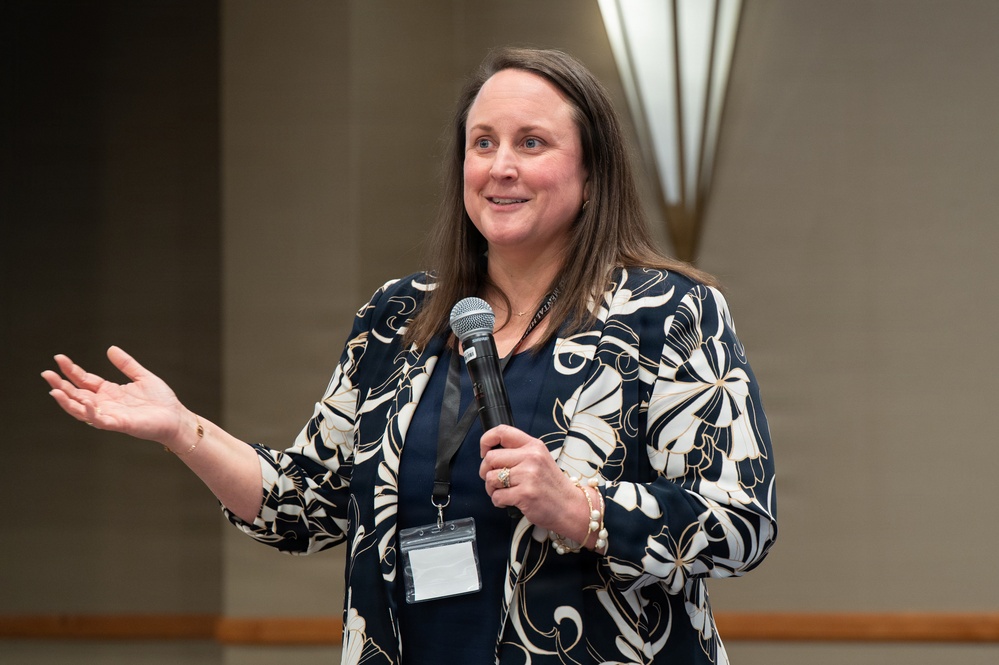
Photo By Megan Hearst | U.S. Air Force Col. Elisha Pippin, director of psychological health, gives an overview...... read more read more
Modern warfare brings increased cognitive and operational demands that reinforce mental health as a critical component of combat capability.
Air Force Medical Service leaders advanced the efforts to align mental health policy, training and leadership practices to mission readiness requirements outlined in the Department of War’s 2026 National Defense Strategy, during the Mental Health Leadership and Readiness Symposium in Orlando, Florida, on March 9-12.
The DoW’s lines of effort to defend the homeland and to deter adversaries through strength, call for the services to be trained, equipped and ready at a moment’s notice.
U.S. Air Force Col. Elisha Pippin, director of Air Force psychological health, shared an overview of the Department of the Air Force Mental Health enterprise, noting that mental readiness requires as much preparation as physical readiness for future large-scale combat operations.
Forging resilient warfighters for today’s battlefield involves leadership that will execute mental health support and training, which will equip them with the psychological strength needed to join and regenerate for the fight, Pippin said.
The development of Air Force Medical Command provides that centralized, decision making structure to strengthen operational medical capabilities for all DAF warfighters, according to U.S. Air Force Brig. Gen. Eveline Yao, AFMEDCOM special assistant to the commander.
“Let’s stay focused, resolute and prepare our medics, psychologically and emotionally, for the new priorities in the National Defense Strategy,” she said. “And not just for the future fight, but for the now.”
Another theme of the symposium was the U.S. Space Force’s evolving mission and on-going efforts to address Guardian mental health.
U.S. Air Force Lt. Col. Kieran Dhillon, director of Space Force psychological health, said rapid mission changes are an opportunity to build a model of care tailored to address Guardian occupational health risks.
“This is history.” Dhillon said. “Everyone in this room can play a part in shaping what Space Force medicine, what mental health looks like.”
Guardians operate in highly specialized environments, often in secure or remote locations, where access to care and mission demands present unique challenges.
U.S. Space Force Brig. Gen. Nick Hague, assistant deputy of Space Operations, emphasized the human element behind space operations and provided insight from his spaceflight missions a former NASA astronaut.
“Resilience isn’t discovered in the moment; it’s forged in the years before it’s needed - it’s knowing how to process and cope, and having a support system that you can trust,” he said. “Resilience is not about survival. Resilience is about being able to get back on that rocket five months later and launch again. Get the mission done.”
To support performance in high-stress operational environments, leaders discussed operational readiness training as a method of preparing service members for real-world conditions.
Dr. Amy Adler, a clinical research psychologist with the Walter Reed Army Institute of Research, presented iCOVER, a 60-second structured approach to manage acute stress reactions, equipping Airmen and Guardians with skills to return to a high-level of functioning.
Commander Andreas Espetvedt Nordstrand, a clinical psychologist with the Norwegian Armed Forces Joint Medical Services, shared insights from international training efforts, including support to Ukrainian forces.
He said ORT scenarios have helped service members identify potentially traumatic stressors in a deployed environment that reduce combat endurance, and discussed key methods they can integrate into mindful practice to regulate emotions and sustain performance.
Other speaker sessions highlighted resources like the Air Force’s Family Advocacy Program and ADAPT for specific interventive-support, and spiritual readiness as a means to understand how sense of purpose and meaningful connections can strengthen resilience.
| Date Taken: | 04.14.2026 |
| Date Posted: | 04.14.2026 09:16 |
| Story ID: | 562349 |
| Location: | FALLS CHURCH, VIRGINIA, US |
| Web Views: | 98 |
| Downloads: | 0 |

This work, Building a mission-ready DAF mental health enterprise for the future fight, by Maristela Romero, identified by DVIDS, must comply with the restrictions shown on https://www.dvidshub.net/about/copyright.


No keywords found.





