
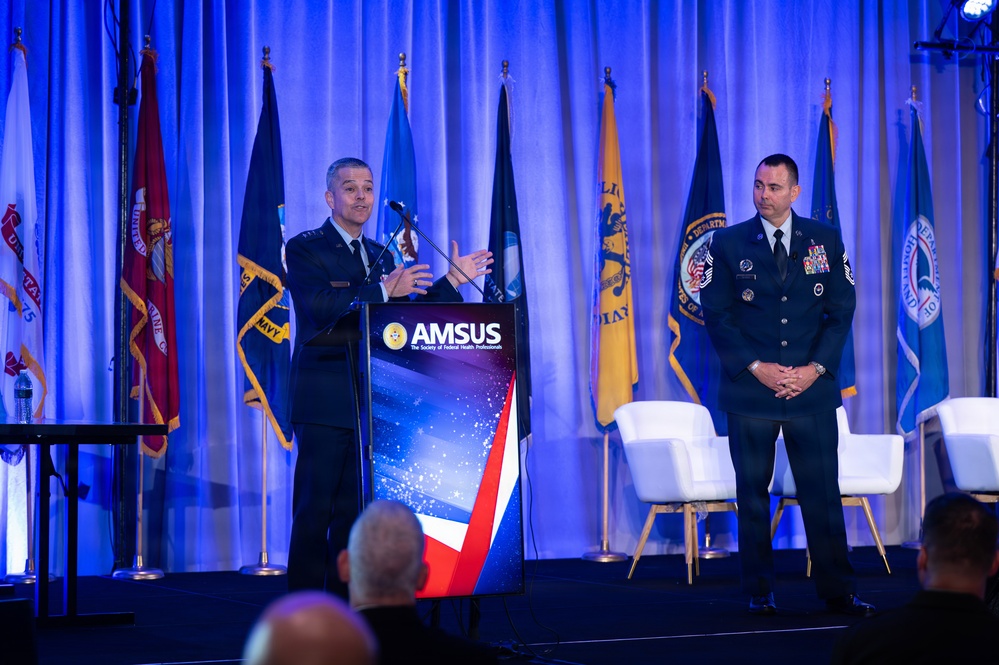
Photo By Megan Hearst | Lt. Gen. John J. DeGoes, U.S. Air Force and Space Force Surgeon General and Air Force...... read more read more
Air Force Medical Service leaders discussed the future of Air Force and Space Force medical readiness during the 2026 AMSUS conference March 3-5 in Oxon Hill, Maryland.
Representatives from the Defense Health Agency, the service surgeon generals and other leaders joined more than 1,600 federal and military health partners at AMSUS to discuss the future of federal health care.
The leaders discussed modernizing joint medical capabilities for large scale combat operations, leveraging new artificial intelligence technologies during education and training, and developing a holistic approach centered on cognition and mental health for Airman and Guardian resilience. The leaders agreed that a collaborative approach between the services and federal agencies is necessary to strengthen federal health care and modernize military health and readiness.
The event also celebrated individual achievement. During the opening ceremony, six Airmen were among the 15 professionals recognized https://amsus.org/page/2026AnnualMeetingAwards. Selected from a competitive field of nearly 300 applicants, they were recognized for their outstanding contributions to federal healthcare.
Adapting care for future conflict
Lt. Gen. John DeGoes, U.S. Air Force and Space Force Surgeon General and Air Force Medical Command commander, described AFMEDCOM’s role in medical readiness.
DeGoes said, “AFMEDCOM improves the AFMS’ ability to support Air Force and Space Force operational medical needs. Medical Airmen will align with units of action enabling them to train the way they will fight. AFMEDCOM will deliver ready medics postured for battlefield trauma care - all while better integrating with DHA for health care delivery.”
To prepare for the future fight, Air Force leaders are no longer assuming air superiority will occur - contested airspace complicates aeromedical evacuation. As a result, medical Airmen are preparing for prolonged field care and contested logistics in this new complex, contested environment.
“If we do not have air superiority and we cannot rely on on-demand aeromedical evacuation … then we need to change and be ready,” DeGoes said. “Holding patients longer, maybe not being resupplied, learning triage and doing things differently with our service partners and international partners.”
Modernizing joint operational medicine, technological capabilities
To keep pace with the changing demands of the mission, medical education and training must also advance.
U.S. Air Force Chief Master Sgt. Thomas Wigington, Joint Staff Surgeon Office senior enlisted advisor, said medical capabilities must evolve from being interoperable to interchangeable to ensure a seamless, integrated medical capability. He added that the force must also leverage artificial intelligence technology to advance predictive and preventive health capabilities.
Dr. Jonathan Woodson, Uniformed Services University president, added that combining foundational knowledge with AI-supported tools is crucial for accelerated learning and mission success.
“AI will not replace the military health provider, but it will reinvent us, and we've got to know how to train our people appropriately to use these tools in the future,” Woodson said. “Medical readiness will not just be a supporting function, it will be a decisive one.”
Strengthening the enlisted medical force through civilian partnerships
Chief Master Sgt. James Woods, Chief, Medical Enlisted Force and Enlisted Corps, described the enlisted role in supporting the warfighter. He said medical providers make up roughly 70% of the medical force and are critical to combat casualty care.
He stressed the importance of military-civilian partnership in providing sustainment training necessary for medics and technicians to operate at their full clinical scope. He highlighted Mike O’Callaghan Military Medical Center at Nellis Air Force Base, Nevada, as a model. In the last two years, the Las Vegas-Nellis partnership has integrated more than 500 military medical providers into civilian hospitals to develop skills in patient trust-building, hands-on trauma care and other specialties.
Building resilience, force regeneration in operational environments
AFMS leaders defined lethality as a mindset that begins with psychological readiness and peer support to sustain warfighters in high-casualty, distributed, and drone-intensive future conflicts. After musculoskeletal injuries, another common limitation to deployment or return to duty are mental health-related challenges.
Col. Elisha Pippin, Air Force director of psychological health, said more than 80% of AFMS mental health care is for non-mental health disorders, indicating a strong, healthy force. Sustaining that strength is a DAF priority.
She said described efforts to sustain the force including a proposal to employ realistic, operationally relevant psychological scenarios during training, develop a new mental health self and buddy-care protocol, and an initiative with the 711th Human Performance Wing, Wright-Patterson Air Force Base, Ohio, to research the “will to fight.” These efforts are designed to enhance psychological resilience essential to regenerate readiness at the frontlines.
“We believe that lethality is not a health status or skill set, but it's a mindset,” she said. “The capabilities and resources are static without the willingness to use them.”
In the space domain, medical leaders are using occupational analysis as a tool to understand unique Guardian stressors and inform future Space Force medical standards.
U.S. Air Force Col. Melissa Runge, Space Force Medical Operations Directorate deputy director, said a 2024 occupational health survey identified three key areas that must be optimized to improve the performance of Guardian: cognition, fatigue management and mental health.
“What makes Guardians so special? They operate in a domain where failure incites global consequences. And readiness must be absolute. Our established medical standards and our medical support must reflect that reality,” she said. “In a global mission, the cumulative toll of change, fatigue and adjusting to rotational readiness is critical to ensuring they have the endurance required for their mission.”
| Date Taken: | 03.27.2026 |
| Date Posted: | 03.30.2026 06:29 |
| Story ID: | 561450 |
| Location: | FALLS CHURCH, VIRGINIA, US |
| Web Views: | 184 |
| Downloads: | 0 |

This work, AFMS leaders shape future of military health with joint services, federal health experts at AMSUS, by Maristela Romero, identified by DVIDS, must comply with the restrictions shown on https://www.dvidshub.net/about/copyright.


No keywords found.





