
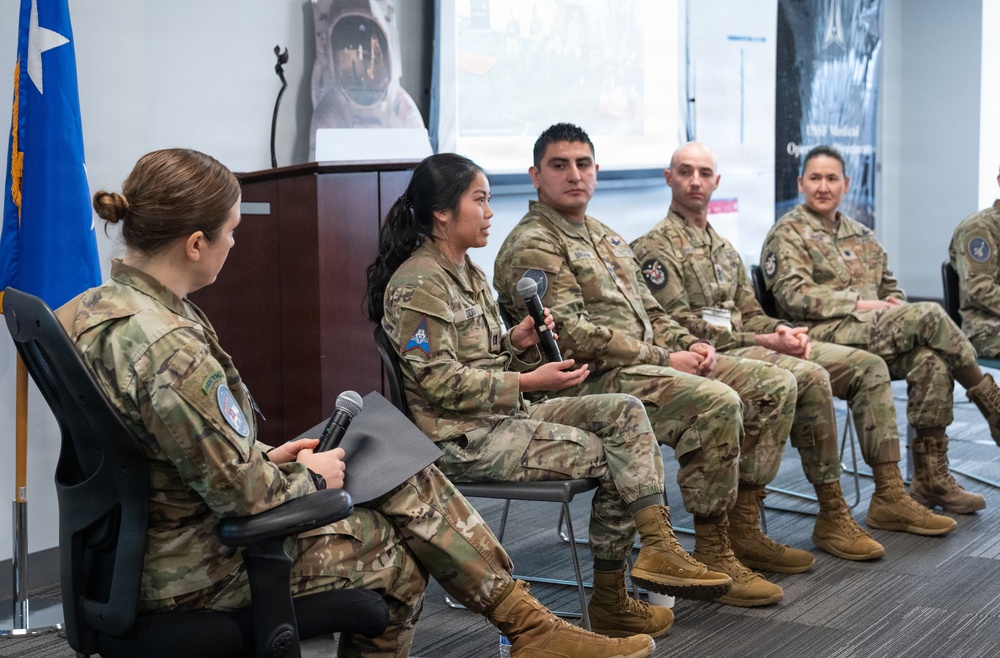
Photo By Megan Hearst | U.S. Space Force Capt. Kathryn Odom, Space Delta 5 Future Operations Division...... read more read more
As Guardians work to maintain an advantage in an increasingly contested space domain, Air Force medical leaders hosted the inaugural Space Force Medicine Stakeholder Summit, Feb. 23-26, to align efforts to improve Guardian medical support.
The Air Force Surgeon General’s Space Force Medical Operations Directorate hosted more than 100 Department of the Air Force leaders and civilian partners to discuss the space warfighter’s unique operational demands and the partnerships required to close medical readiness gaps. The leaders discussed themes including medical standards, cognitive performance, occupational health, the Space Force’s Holistic Health Approach and interagency collaboration.
Defining the operational reality
U.S. Air Force Maj. Gen. Sean T. Collins, director of the Space Force Medical Operations Directorate, challenged attendees to identify critical gaps and workshop solutions through partnership.
“This can't be done alone,” Collins said. “We need to architect integrated capabilities, and that's why you're all here to help collaborate, design and identify those innovative solutions that will enhance Guardian lethality and mission success.”
Since the Space Force was established in 2019, Guardians have demonstrated that installation readiness is inseparable from combat effectiveness in the space domain. Guardians regularly work in a high-stakes domain requiring sustained attention and rapid decision-making on a day-to-day basis regardless of their operational location.
Emphasizing this, the USSF created a three-phase Space Force Generation model, which is uniquely designed for an employed-in-place force, said U.S. Space Force Lt. Col Amanda Manship, Combat Forces Generation division chief, Combat Forces Command. The rotational model requires synchronized support throughout the phases to sustain performance.
Developed in tandem with this operational model is the medical support needed to strengthen Guardian resilience and holistic well-being for the future fight.
U.S. Space Force Senior Master Sgt. Ky Covert, USSF Combat Forces Command Training and Force Generation Directorate senior enlisted advisor, shared the command’s Guardian Heartbeat Initiative - an effort that integrates mental health metrics and collaboration with Guardian Resilience Teams to better understand operational stressors and inform prevention.
Experts from the Air Force Research Laboratory’s 711th Human Performance Wing shared efforts to improve cognitive agility and human performance with research that employs predictive modeling, wearable technologies and tracking various biomarkers.
Col. Lidia Ilcus, command surgeon for U.S. Space Command, tied research and readiness to operational risk in a distributed fight where the medical needs may not be fully identified.
Using the Space Force Medical Operations Directorate as an example, she said the U.S. Air Force Surgeon General established the directorate in March 2023 to address Guardian readiness and challenges Space Force personnel face due to their unique mission sets.
“The expectation is you figure out how to care for them,” she said, urging leaders to proactively build medical support where it does not yet exist.
Translating mission into policy
Throughout the summit, leaders agreed on the need to standardize Guardian qualifications and access to medical resources, particularly in geographically separated units, while leveraging data-informed insight from the operational field and research partners. This collaborative effort aims to balance mission effectiveness with occupational safety and long-term health outcomes.
Leaders demonstrated how data tools such as the Guardians Aggregate Medical Operations Readiness Application, known as GAMORA, can package space-unique readiness data trends for commanders, reducing actionable gaps and informing resource decisions.
U.S. Air Force Lt. Col. Kieran Dhillon, director of USSF psychological health, reiterated the value of mission immersion and evaluating observations during site visits to understand real-world conditions. “It is one thing to see what a mission is on paper, and it is quite another to actually go to a physical location and see how that mission is being executed,” she said.
U.S. Space Force Brig. Gen. Nick Hague, assistant deputy chief of Space Operations and former NASA astronaut, reinforced the human dimension of space operations.
“Human performance is holistic. It’s multi-faceted. If we don’t acknowledge that, then we’re failing,” he said. Drawing on his astronaut cognitive training, Hague advised Airmen and Guardians to deepen self-care practice, which for him, cultivated resilience and adaptable behavior for high-stress missions.
“I can’t help somebody if I’m not trying to take care of myself,” he said. “So, it’s driving home that culture and letting people know that’s the expectation.”
Strengthening partnerships
Leaders also said partnerships play an important role in expanding space medicine knowledge. Whether it’s working with Air Force Medical Command leaders to prioritize Space Force readiness, Uniformed Services University staff to develop space medicine curriculum, or the Defense Health Agency for collaboration on Guardian access to care, relationships are critical.
Dr. Vincent Michaud, NASA deputy chief health and medical officer, reinforced the importance of collaboration in developing civil space medical standards that aided NASA’s rapid expansion of commercial space activity. He said integrating medical expertise early in system design helps mitigate risk and avoids costly restructuring. As the summit closed, leaders agreed space medicine must evolve collectively - integrating policy, research and partnerships to sustain combat-ready and resilient Guardians.
| Date Taken: | 03.11.2026 |
| Date Posted: | 03.11.2026 07:03 |
| Story ID: | 560128 |
| Location: | FALLS CHURCH, VIRGINIA, US |
| Web Views: | 63 |
| Downloads: | 0 |

This work, DAF space medicine leaders, civilian partners strategize policy at inaugural Space Force Medicine Summit, by Maristela Romero, identified by DVIDS, must comply with the restrictions shown on https://www.dvidshub.net/about/copyright.


No keywords found.





