
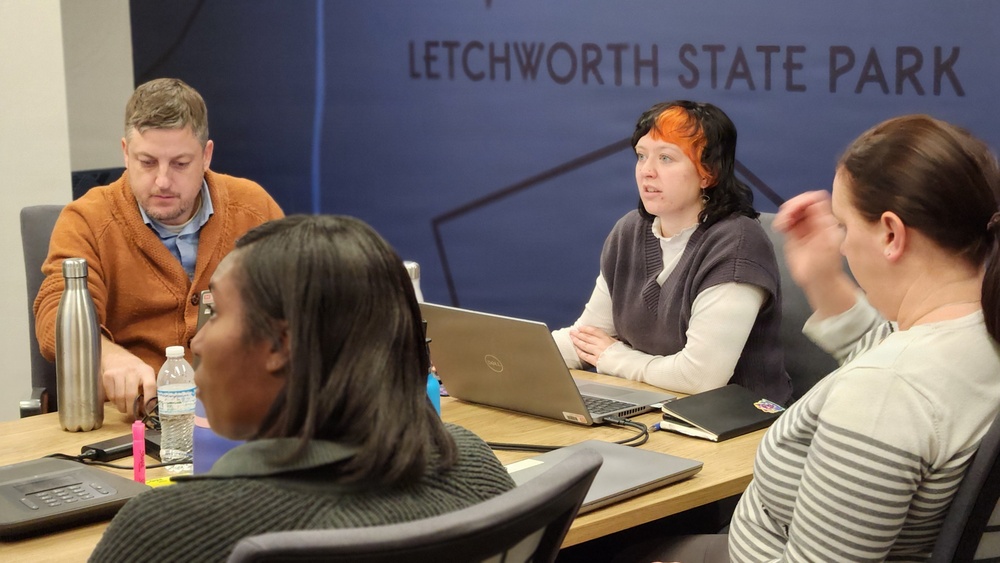
Photo By Avery Schneider | U.S. Army civilian Emma Crooks, a project engineer assigned to the U.S. Army Corps of...... read more read more
When people think about engineering, fields like mechanical, civil, structural, and electrical often come to mind. Fewer, perhaps, would put the word “value” before it. Yet, for the U.S. Army Corps of Engineers, value engineering is a critical discipline focused on maximizing project function while ensuring taxpayer dollars are used as efficiently as possible.
To shed light on this important process and its impact, the Buffalo District's new District Value Officer, Emma Crooks, sat down for an interview.
(This interview has been edited for length and clarity.)
Avery Schneider (AS): What is value engineering?
Emma Crooks (EC): Value engineering, in a broad sense, is a systematic approach to increase a project or product's value, by analyzing what the functions are of the project or product and what the resource draws are.
There's this value function. For example: a breakwater.
The function of the breakwater is to protect the harbor. And the resources required is money from Congress. The engineers come together and develop the design, balancing the function and resources.
And so, how can you increase the function of that without totally increasing the resources, or vice versa? You can reduce the resources and then also increase the function.
So, at the end of the day, value engineering is an efficiency kind of thing, getting the best bang for your buck.
People associate value engineering a lot of times with cost. But a lot of the VE studies that we go through where we analyze a project for a week at a time, a lot of times there are hidden values associated with them that don't necessarily have money attached to them, but the end customer will be much happier with the result.
Value engineering is definitely an interesting side of engineering.
AS: Why do you think it's important to the Corps of Engineers and in particular the Buffalo District?
EC: The Corps of Engineers – we are civil servants, and we want to make sure that we're executing our taxpayer dollars properly and efficiently and fulfilling our customers’ needs.
For the Corps of Engineers in Buffalo District specifically, I like to draw to the breakwaters and piers, because that's what I work on the most and that's where we see a lot of our VE efforts applied. Same with dredging.
And I think it's most important, at least in the Buffalo District, to make sure that those breakwater projects are designed and executed as efficiently as possible.
A good example is making sure that we're not developing a design that will result in excess stone ordered or falling short of the quantity the contractors will need to order. This is not necessarily a function of the project, but a way in which we can help guide the design team using VE principles.
AS: Ultimately, who benefits from value engineering?
EC: Obviously, the customers and the contractors that we're working with. All of our stakeholders, like local stakeholders. But also, the greater United States – taxpayer dollars I'm paying and everybody's paying, you want to make sure that it's going towards something efficiently. I think just everyone in general.
And I would like to also say that the Corps of Engineers – we don't just do value engineering on our projects.
One of my first projects that I worked on was Swan Creek. That's out in Ohio. The U.S. Environmental Protection Agency and Ohio EPA came to us and asked if we could execute a VE study for them for one of their projects.
It's not just the Corps. We are kind of like the VE consultants for a lot of different government entities.
AS: What kind of project was Swan Creek?
EC: Swan Creek had a lot of industrial waste dumped into it over the years, so the project looked to dredge the waste out and cap areas that they couldn't dredge.
It was in the feasibility stage, so there was a lot of flexibility in terms of seeing what the actual function of the project is, what the local stakeholders had in mind when it came to the project, and it really helped define the project moving forward into the design phase.
AS: I'm glad you mentioned the EPA, because in reading through what VE is for myself, I saw that the Office of Personnel Management requires it for all federal agencies with a project over $1 million. As you said, we do it for other agencies. Are we unique in that way? Are we the only agency that you might find a value engineering section in, or is it at least more common for us in the Corps of Engineers?
EC: It's more common for the Corps of Engineers. In one of my training courses that I attended to become the district value officer, we were working with folks from the Department of the Interior as well. The EPA has their own value engineering program, but they come to the Army Corps to execute and award VE facilitation due to our robust contracts with VE consulting firms.
AS: When is VE required?
EC: VE is required for any [Corps of Engineers] project that the construction value exceeds $2 million. If we're having clearing and grubbing at Mount Morris Dam, it's probably not going to exceed the $2 million, but you’d be surprised what projects hit the $2 million threshold.
There are quite a few projects that we review per year that exceed $2 million in construction contracts. This current year, we are projecting 10 or more projects—ranging from breakwater repair to dredging and others—that will exceed the threshold and address the VE requirement.
AS: I was reading the engineer regulation that describes VE, and I saw there's a six-step process that you follow. Out of those six steps I saw “creativity.” That kind of stood out from the rest of it. I think the average person might think that in a field where the goal is to save money and save resources – basically hard dollars and cents and a look at technical and factual information – the creativity might seem a little out of the ordinary. How do you get creative?
EC: The creativity phase is founded on the function analysis phase.
The six steps are the information phase, collecting information. The function analysis phase is when you define the functions of the project. The creativity phase is when you kind of just throw anything out there. Even your wildest ideas are thrown out.
The function analysis and creativity phases are the two most unique parts of this process compared to other things like Six Sigma or the Fishbone Method.
It's very interesting when you're in a room with a bunch of engineers who are told you have to stay within your lane, and you stay within your box, and you stay within the parameters of what things are set. And you tell them, “Give me your wildest idea.” That’s, honestly, when the magic happens because you kind of let them loose.
For a VE study, you have an outside facilitator that's not part of the project, and their job is to facilitate the discussion. A lot of times they utilize sticky notes up on the walls or notes written on a whiteboard to support the discussion. All these ideas are written on a sticky note which creates a good visual of just how many ideas were generated. One of my favorite things is you can't pass judgment on any of these ideas. The lack of judgment allows creativity to flow, and this is where some of the best ideas are created.
I noticed in the Swan Creek study, especially, there were a lot of people that had a lot of preconceived notions of what the project was going to be or what they wanted the project to be. In this creativity phase, it's kind of like an icebreaker, where everyone's shaking out their ideas and putting them out there and seeing them written down on the walls.
And then hearing from other people, how different disciplines affect each other, how [project management] affects the engineers, how the engineers affect contracting. It puts everyone on an even playing field. This supports collaboration and brings each individual into a larger mindset at 1,000-foot level, instead of in a microcosm of their discipline.
The best facilitators make everybody add a lot of ideas.
AS: What's an example of a project that you wouldn't think would hit that threshold.
EC: Even some dredging projects. I don't see that as a huge project that needs to be addressed per se, but we're moving so much material out of some of the harbors that often times we exceed the threshold.
We have these things called programmatic value engineering studies. And there's actually going to be a new one coming soon. The Huntington District is putting one together for our region.
Basically, a programmatic study looks at a type of project. Programmatically, most dredging projects follow similar cadence and design templates. Programmatic studies think of a general dredging project and see where we can gain efficiency and increase value for those kinds of projects.
For example, we're going to be dredging in Cleveland. And we pull together a document where we look at all the value engineering proposals which are pretty much ideas generated in the programmatic VE study that are places where we can gain efficiency or have certain advantages that are good reminders to incorporate into that project.
So, for example, for navigation improvement projects, you classify material more accurately by additional testing. Just by having that reminder every time we have a dredging project come through over $2 million, it’s a good thing for the [project delivery team] to consider.
By utilizing programmatic VE studies, we don't have to do a new one every time we execute a dredging project. It's kind of like looking at our past homework and saying, “Oh, I remember, let's make sure we incorporate that.” It also ties into the Biddability, Constructability, Operability, Environmental, and Sustainability process.
As a district value officer, I sign off on our reports for that process and then make sure that we have addressed VE in some capacity if the project’s construction contract estimate is over $2 million.
AS: Now that you mention value engineering proposals, is classifying material more accurately by additional testing an example of a more common proposal that you see?
EC: That is one of the more common proposals that we accept for dredging projects.
For our routine breakwater projects, if you have a standard rubble mound overlay, one of the value proposals that that programmatic study had an example of is “adequately detail how end sections will be closed off or connected” for, basically, transition details.
Say we don't have all the construction funding now, and we're only going to construct a certain length of the repair, how are we going to cap those off and have a nice transition where it's not just an ended wall or a steep drop off? We want it to be graded. That was generated in the Chicago District programmatically, maybe a couple of years ago, and it's something that we incorporate now in our projects. It’s just good lessons learned.
AS: To make it tangible for people, since the average person doesn't know how a breakwater is constructed – they just see a pile of rocks – how does making sure that something like that transitions and isn't just cut off or sloped make that cost less or that there’s more value?
EC: If we had that really steep cut off, it might create more damage than good, instead of having a gradual slope. Think about how waves run up on a beach.
If the wave is hitting a very vertical face, then the waves are going to shoot up into the air and create a spray. But if it's gradual, then the waves will have a larger area to dissipate their energy, and we won't have to worry about developing additional repairs in that area once additional sections of the breakwater repair are revisited.
Aggressive wave action would cut away at the existing structure or the repair? So, it's adding value for us in the future when we can finish up the repair.
AS: Any other notable ways, or is there anything like an uncommon example that you can think of? What about a big one?
EC: We conducted a value engineering study for the Formerly Utilized Sites Remedial Action Program’s Niagara Falls Storage Site. That that was a very beneficial VE study.
That one is pretty close to home, obviously, and you want to make sure that you're doing the due diligence of taking care of that kind of waste.
One of the [proposals] that comes to mind was material handling for this one. One of the bigger proposals is making sure we're not double-handling material.
When you're removing the waste into the debris containers, it's more efficient to unload it and process the waste in one sequence and then have it leave the site, than if they were to remove the debris, put it in a container, have it sit, and then pick it up and move it around to another location for storage, and then and then transfer it to the facility to process it.
I remember there was a pretty good ‘aha’ moment when there were a couple of inefficiencies in the process in which they would be transporting the material within the site before it leaves. The [architecture and engineering firm] that was working on it and [Corps of Engineers] folks said, “Oh, this is a big opportunity.”
And sometimes you don't have those ‘aha’ moments because you may be pulled in certain directions in your day-to-day. There are always ways to come together as a team and work on things. But during the VE study, especially like the Niagara Falls Storage Site where it's such a big project, having everybody sit in a room for a week straight just to discuss that project and be laser focused in – that's the only thing they're focused on – I think those are the kinds of moments that create opportunities for projects through VE studies.
Everyone's sitting in the conference room together. Most of the time you don't have your computers open. There's no checking emails. That's one of the ground rules for VE studies: You have to have all your attention here.
AS: What was the ballpark cost savings because of the VE study for Niagara Falls Storage Site?
EC: There's something that I want to define: In general, is it's never called “cost savings” until we execute the project. It's considered “cost avoidance.” That's because we haven't spent the money yet.
By executing the VE study, we have the potential – if we accept all the proposals and integrate them into the project – for a $5.7 million cost avoidance on the Niagara Falls Storage Site project, the largest project—in terms of cost—in the Buffalo District’s history.
AS: In a year, how much money is saved through cost avoidance or cost savings?
EC: Every year this is something that we put together in our reporting. This last year, fiscal year 2025, our total annual VE savings – called “savings” now because we've executed these projects and awarded the contracts – is $4.83 million.
AS: Is that typical for a given year?
EC: It is pretty typical. We see it fluctuate depending on which major projects are awarded in any given fiscal year. For example, this year we had [the FUSRAP Shallow Land Disposal Area] Trench Excavation [contract] awarded. Every year we'll see a good chunk of our cost savings attributed to that project.
But if we don't have a big VE study project that is awarded, we don't really see that high of a cost savings.
Our district, in general, is not one of the big powerhouses for cost avoidance or cost savings, solely because we do have a lot of civil works projects that are lower in dollars. We utilize programmatic VE studies and, subsequently, have less opportunity for high-cost savings. Most of the [military construction] districts are the ones that kind of carry in terms of cost savings. And that's just because they're doing mega projects every year.
AS: Every little bit helps though?
EC: Every little bit helps, yeah, and we do our best. The Shallow Land Disposal Area trench excavation was the project that attributed $4.53 million to our cost avoidance this year.
AS: Is VE something that exists in every district?
EC: Yes, every district has a district value officer. There are also regional value officers, and then there is the Office of Value Expertise all the way up at headquarters.
AS: What does the district value officer do?
EC: The district value officer manages the Value Engineering program at the district level. Day-to-day what that looks like is tracking projects that are hitting or exceeding the $2 million threshold. Getting in contact with those [project delivery teams] to see when their 35 and 65 percent design milestones hit so that we can accurately and in a timely manner address VE. It also consists of signing verifications and checking that we have addressed VE on projects that are required by the Office of Personnel Management.
It also consists of training. They have a very strict training cadence. We have to have a certain number of hours managing the program. There are certain trainings. This year I'm targeting either taking facilitator training or Value Management 2 training. And putting together, at the end of the year, the annual plan for the coming year and the annual report of what just happened in the previous year. And another big one is making sure I'm working with the programs team and the schedulers and checking that VE milestones have also been accurately recorded.
In terms of addressing VE, every project will have a value management plan. It's similar to a project management plan, a PMP. There are details about the project, what stage of the project you're in when you write the document, what the scope of the project is, any constraints, and how we will address VE.
It's my job as district value officer to decide what kind of method of addressing the VE is appropriate.
AS: How do you see your role?
EC: It's an interesting role because I feel like a steward of taxpayer dollars. I'm making sure that we're being efficient and effective. I feel like I'm kind of like The Lorax, where I'm like, “Are we speaking for the trees?” but for the taxpayer’s money.
It's definitely interesting because I get to work with a lot of different people. I think it's pretty unique in the sense where I get to work with the PMs and the engineers, not just on the civil work side, but also on the FUSRAP and environmental side.
It's kind of like I'm a little bee buzzing around to everybody else and making sure that everyone's set for VE. It definitely keeps me entertained.
AS: What was your degree in school?
EC: My degree is in industrial engineering, which is all about efficiency. So, it makes sense why I ended up in this role.
A lot of times industrial engineering is working in a factory and making sure that the steps of building a product are efficient. It really homes in on cost, where every second on a production floor matters. If you can pump out one more part every minute of the day it adds up overtime. My degree was in industrial engineering from [the University at Buffalo].
AS: Was value engineering a field you knew about?
EC: No, I didn't, but I did have my green belt in Lean Six Sigma, which is another systematic approach, pretty similar to VE on more of root cause analysis applied to manufacturing processes.
The way I like to put it is, it wouldn't make sense to drive to [the grocery store] and then drive home and then drive to [a clothing store] and then drive home and then drive to [the car wash] and then drive home. It would make more sense to go to the one that's farthest away [and hit them all in order on] the way home. It is what’s called the “traveling salesman” problem in industrial engineering. This is one facet of what my degree is.
AS: The regulation says, “The district value officer shall achieve the Value Methodology Associated Certification within one year of designation as district value officer with the ultimate goal of obtaining the Specialist in Value Management Designation within four years of the assignment. Are those things you already have or those things you're working on?
EC: The VMA is something I already have, along with the VMF1 training and VMC training. That puts me as an apprentice of value management. I achieved those when I was the assistant value officer.
AS: Outside of that formal part of training, what did it take to become the district value officer in your view?
EC: A lot of mentorship from the previous district value officer, who has been a great mentor and taught me so much about value engineering. Through mentorship, I learned how to address the gray area projects where you're not sure what the best way to address it is from a VE standpoint.
I think also having good relationships with other district value officers in our region. We have monthly meetings with the [USACE Great Lakes and Ohio River Division] folks and then we have monthly meetings with the [community of practice] in general. Those are the soft training things where you don’t have to attend these, but it helps a lot hearing what other district value officers are experiencing in their districts. They call it “Coffee Talks.” There's never a plan or agenda. We just go and talk about things we are seeing on a district level and compare notes on projects and things we are experiencing day-to-day.
AS: In general terms, what does the annual VE plan entail? How do you forecast value engineering for a whole year?
EC: For the whole year, we develop an estimate of how much overhead budget we would need. Any training coming up. In the next four years, I need to get my facilitator training done and my VMF2 training done.
Any outreach plans – how we get ahead on projects. We're thinking about doing a “lunch and learn” with the [project managers] and [technical leads].
And contracting helps a lot. They have an idea of what projects are coming down the pipeline. Same with programs. So, it's a lot of coordinating with them on which projects they think are going to be awarded this year, and then you kind of back it up.
We have a general idea of what the cost avoidance would be per project.
AS: When it comes to VE, what do you think is the most important in terms of best practices?
EC: Documentation. Making sure that you’re thorough with your documentation, having proper decision logs and good file management. Obviously, we are here to make sure projects have value, but we also have a big part in making sure OMB is satisfied. Staying organized, super organized.
AS: Is there something in VE that you're most proud of?
EC: It just makes me proud when I sit in on a study and see people working together.
I'm just proud to work alongside the people that I do in the VE studies because there's so much passion for everyone's individual disciplines. It's an honor to be able to sit in with them and see them thrive and see them work towards a common goal.
Because a lot of times when you're working on projects, you have your own certain individual deliverables, but VE studies – I just think that they really bring everyone together. I'm just proud to be able to help facilitate those.
It makes me happy. It's inspiring.
This information includes elements of AI-generated content, which were reviewed and edited by relevant DoW personnel to verify appropriateness and compliance with DoW policies and guidance.
The Buffalo District delivers world class engineering solutions to the Great Lakes Region, the Army and the Nation to ensure national security, environmental sustainability, water resource management, and emergency assistance during peace and war. Learn more at www.lrd.usace.army.mil/buffalo.
For 250 years, the U.S. Army Corps of Engineers has been at the forefront of the nation’s engineering excellence, responding when called. From constructing fortifications during the Revolutionary War, to building the infrastructure that saw America’s strength grow militarily and economically, USACE’s mission has always been to deliver engineering solutions for our nation’s toughest challenges. Learn more about the USACE 250th anniversary at http://www.usace.army.mil/Home/250th.
| Date Taken: | 03.31.2026 |
| Date Posted: | 03.31.2026 09:43 |
| Story ID: | 561620 |
| Location: | BUFFALO, NEW YORK, US |
| Web Views: | 34 |
| Downloads: | 0 |

This work, More Than Just Cost-Cutting: Finding the 'Hidden Value' in Federal Projects, by Avery Schneider, identified by DVIDS, must comply with the restrictions shown on https://www.dvidshub.net/about/copyright.


No keywords found.





