Eighty years after U.S. Army Air Forces Master Sgt. Thomas “Pop” Virnelli was killed in a winter aviation accident, a small French community gathered to ensure his name would not fade with time.
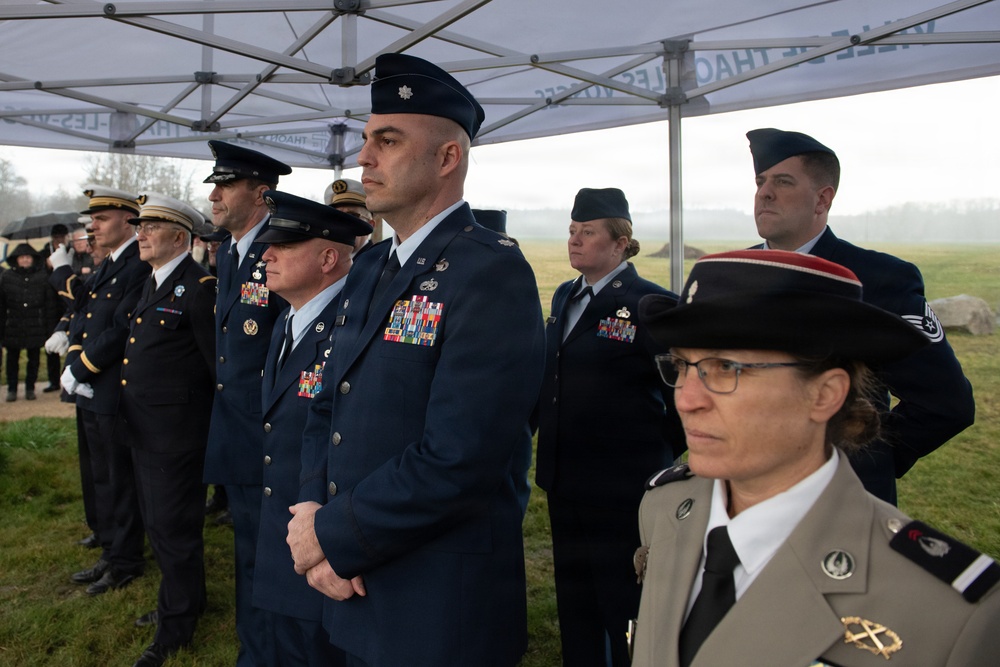
Near the snow-covered field where his aircraft went down in January 1945, residents and students recently unveiled a memorial plaque in his honor during a ceremony at the airfield from which he last took flight in Dogneville, France, Feb. 16, 2026. The effort was led by students from the Quality and Logistics Department at the Technical Institute of Épinal, who designed, funded and produced the memorial as part of their coursework.
Airmen from the 102nd Intelligence Wing, Massachusetts Air National Guard, attended the ceremony, reinforcing a bond of service that spans generations. Virnelli was a Massachusetts National Guardsman when he was federally activated for World War II, joining the 101st Observation Squadron in 1930. Today, that unit is the 101st Intelligence Squadron, a direct component of the 102nd IW.
Led by Col. Kevin Archer, commander of the 102nd Intelligence, Surveillance and Reconnaissance Group and Lt. Col. Aaron Charbonneau, commander of the 101st IS, the group consisted of Airmen who follow in Virnelli’s footsteps of service.
"Witnessing this French community honor Master Sgt. Virnelli’s sacrifice makes it deeply personal, not abstract. He serves as a touchstone to the legacy and history of everyone who came before us in the 101st,” Charbonneau said. “Pop's sacrifice comes with a name, a family and a squadron. This tribute shows that his story endures, and it gives us peace to know he is in good hands in Épinal. It falls to us to continue finding opportunities to remember his sacrifice and that of all who fought to free a people from tyranny."
The new marker stands near the closest accessible point to the crash site. A second plaque at the historic Dogneville airfield marks the place from which Virnelli took off for the final time.
Born in Italy in 1893, Virnelli immigrated to the United States as a teenager and later settled in Saugus, Massachusetts. He volunteered for military service, enlisting in 1921 and continued flying in the decades that followed, building a life in aviation.
Over the years, he flew for American Airlines, worked as a flight instructor, and helped found Mayflower Airlines and the Eastern Aero Club in Massachusetts. In 1930, he joined the 101st Observation Squadron, now known as the 101st Intelligence Squadron.
As global conflict loomed, Virnelli volunteered for federal service on Nov. 25, 1940. He became a founding member of the 72nd Liaison Squadron and, because of his age and experience, was placed in charge of the unit’s engineering section.
Liaison squadrons flew light aircraft known as “L-Birds,” conducting artillery spotting, reconnaissance, supply runs, medical evacuations and command transport missions. Virnelli oversaw maintenance operations through campaigns in North Africa and Europe, keeping aircraft mission-ready under combat conditions.
On Aug. 24, 1944, he led a four-man team into the French Alps to recover critical components from a damaged L-5 aircraft behind enemy lines. Operating under heavy fire, the team retrieved the equipment. For his actions, Virnelli received the Bronze Star and the Air Medal.
"In the face of unprecedented conflict, we honor Master Sgt. Thomas Virnelli for his profound bravery and defined sacrifice. Though his life was cut short, his story lives on to inspire and instill purpose among those who serve,” said Staff Sgt. Diana Sauer, a geospatial intelligence analyst with the 101st IS. “We will continue to honor his memory in acknowledgment of the liberty and freedoms we withhold today."
On Jan. 24, 1945, five months after his heroic actions in the Alps, he departed Dogneville in a Stinson L-5 Sentinel, serial number 42-99171. Flying north along the Moselle River near Girmont, the aircraft struck a high-tension wire and crashed in the snow.
Virnelli was killed, leaving behind a wife and four children. He is buried at Épinal American Cemetery. For years, much of his wartime service remained unknown to his family. His children were young when he died, and many details of his missions were classified.
The French memorial began not as a government initiative, but as a student and community project.
At the Technical Institute of Épinal, students studying industrial logistics and quality management operate a small production workshop. They design and manufacture sewn goods, create technical documentation and refine production processes. Sales from those products funded Virnelli’s plaque, as well as a second memorial honoring another American Airman buried at Épinal American Cemetery.
Faculty members said the location of Virnelli’s plaque was selected intentionally. Positioned near a sports field and public space, it places the memorial within everyday view of the community’s younger generations.
“I was deeply moved by the extraordinary opportunity to witness the ceremony and plaque dedication for Master Sgt. Virnelli in France,” said Capt. Jessica Barry, a 101st IS flight commander. “Standing on the sacred grounds of the Dogneville Airfield and the field in Girmont, surrounded by students paying homage to his sacrifice, was an emotional and unforgettable experience."
As the ceremony concluded, attendees stood quietly near the airfield. Eight decades earlier, Virnelli had lifted off from that same ground — an immigrant who chose to serve his adopted nation, a veteran of a global conflict, and a father whose story his family was still uncovering years after his death.
| Date Taken: |
03.12.2026 |
| Date Posted: |
03.12.2026 11:53 |
| Story ID: |
560385 |
| Location: |
FR |
| Web Views: |
142 |
| Downloads: |
0 |
PUBLIC DOMAIN

This work, Massachusetts National Guardsmen, French students honor fallen WWII Airman, Master Sgt. Thomas Pop Virnelli, by Timothy Sandland, identified by DVIDS, must comply with the restrictions shown on https://www.dvidshub.net/about/copyright.

 Subscribe






