Acquisition reform is playing a major role in the Army’s modernization efforts to ensure it remains at the forefront of technological innovation while rapidly delivering essential warfighting capabilities to the Soldier.
To discuss how to make this happen, current and former Army Acquisition Corps leaders attended a Leadership Professional Development (LPD) session held on 18 Feb. at Fort Belvoir.
“Leadership during change in acquisitions is about three things,” said Command Sgt. Maj. (Retired) William D. Pouliot, one of two speakers who led the LPD session. “Maintaining clarity in ambiguity, moving with disciplined urgency, and building a culture that makes ethical, resilient decision makers.”
Maj. Gen. (Retired) Brian P. Cummings joined Pouliot during the LPD event to share his vast experience in Army acquisitions. Cummings and Pouliot have a combined 65 years of knowledge in navigating the complex acquisition process.
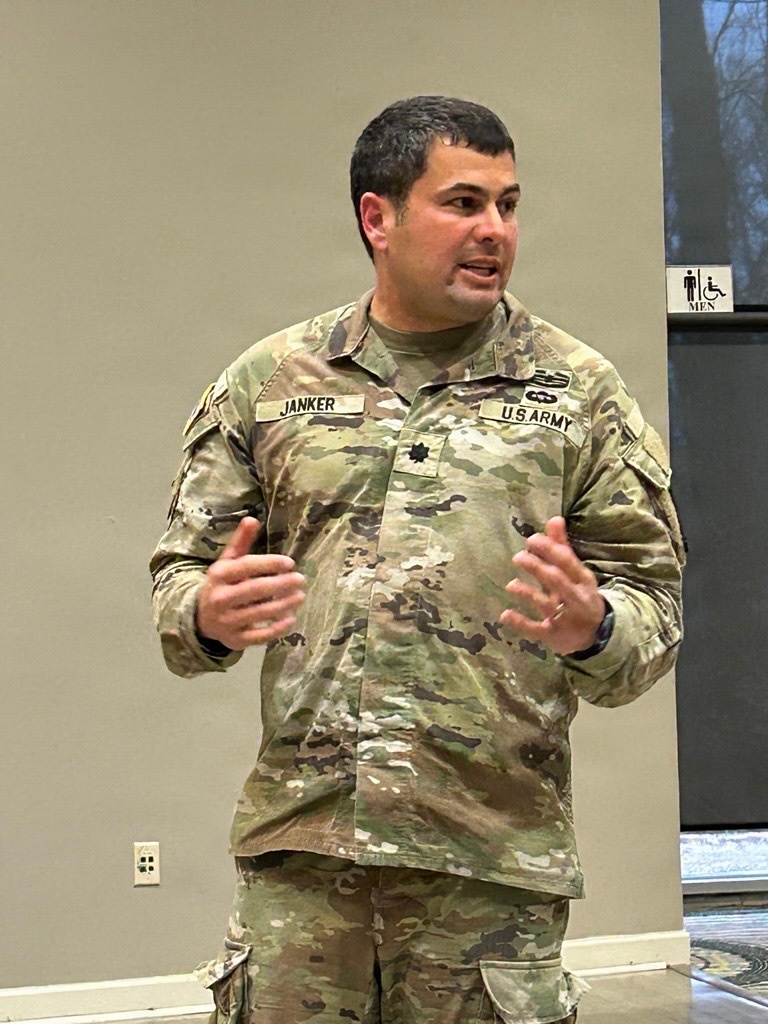
In late 2024, Lt. Col. Paul Janker of Product Manager Biometrics (PM Bio) connected with Cummings – who initiated the LPD series at Fort Belvoir in 2015 – to restart the LPD effort to address challenges and opportunities for acquisition leaders.
“The timing was perfect because of the reorganization across the CPEs [Capability Program Executive offices],” said Janker.“Such LPDs are an excellent way to kickstart the communication that allows teams to start ‘norming’ [during transitions].”
Acquisition Corps leaders play a central role in streamlining the complex acquisition process. This ranges from managing staff and working with vendors to balancing the demands and stress of rapidly shifting priorities.
As the Army modernizes, Cummings and Pouliot emphasized the need to build a culture that aligns with the evolving demands of the acquisition community. Pouliot stressed the importance of ethical courage and operational focus, noting that leadership during change must cultivate a culture where speed and integrity co-exist.
Cummings said creating an environment that inspires staff to be decision makers during times of transition is key to success.
“If you do a major change in an organization the very first task that you should do is to inspire,” said Cummings.
“Remember that your number one responsibility as a leader is to create a wonderful, operating environment where everyone is trusted, loved, and respected so they can do what they need to do.”
Such leadership strategy insights resonated with LPD attendees like Assistant Product Manager Daniel Kuehl from Product Manager Force Protection Systems (PM FPS).
Kuehl recalled how Cummings shared how to build better relations with subordinates.
“I really enjoyed listening to retired Major General Cummings’ anecdote about the Master Sergeant that got him to take the time to speak with three individuals each day,” said Kuehl. “Sometimes we need to organize ourselves and set micro goals in order to execute our leadership responsibilities to the best of our ability.”
Cummings and Pouliot emphasized speed must be paired with clarity and focus to avoid the pitfalls of what they call “ambiguity creep.”
They also urged acquisition leaders to “protect focus,” stressing that program offices must prioritize critical objectives and communicate honestly with their teams, particularly when resources are uncertain.
“If everything is a priority, then nothing is a priority,” Pouliot said.
In the high-stress environment of acquisition, where programs often involve significant financial resources to provide Soldiers the equipment they need, building resilience and empathy is critical.
“Truly love your people. Be kind and pleasant and give people hope. Let them know that what they do is important,” Cummings said. “Empathy is more than an expression of sympathy or kindness toward someone; it is a deeper sense of understanding of a heartfelt connection to the feelings and emotions of others.”
Cummings and Pouliot noted that the reorganization within the Army’s acquisition offices is also designed to integrate acquisition leaders more closely in the decision-making process.
Through the insights shared by Cummings and Pouliot, acquisition managers at the LPD event learned how to navigate change with confidence and purpose, ensuring that Soldiers always have the tools they need to succeed.
Kuehl said he looks forward to attending more LPDs to apply what he learns there on the job.
“I have walked away with something from every LPD I’ve attended,” Kuehl said. “Whether that something is completely new or just a refresher on a topic learned long ago, there is always value. Even the greatest swordsman must sharpen his blade.”
| Date Taken: |
02.18.2026 |
| Date Posted: |
03.02.2026 15:33 |
| Story ID: |
559221 |
| Location: |
US |
| Web Views: |
77 |
| Downloads: |
0 |
PUBLIC DOMAIN

This work, Accelerating Modernization: Leadership and Change in Army Acquisition, by M. Scott Bortot, identified by DVIDS, must comply with the restrictions shown on https://www.dvidshub.net/about/copyright.

 Subscribe






