
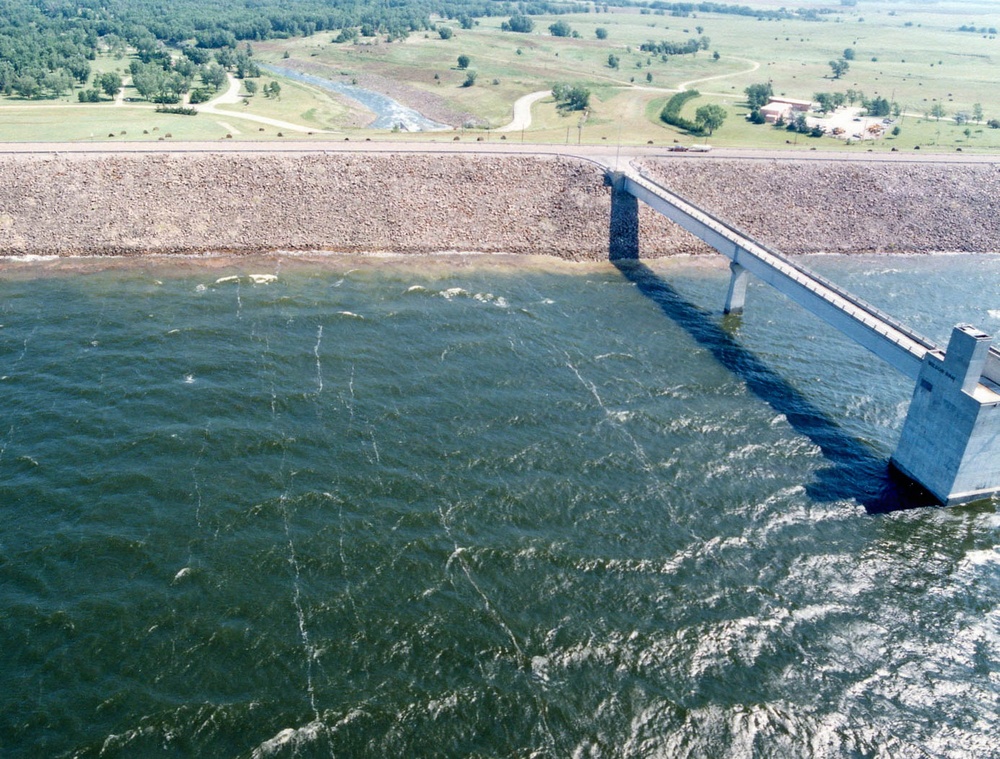
Photo By Lawrence Brooks | An aerial view of the Wilson dam control tower and a portion of its earthen dam that...... read more read more
 Subscribe
Classic films like the “Wizard of Oz” and a Kansas museum dedicated to preserving the film’s history, made the state famous for its wide-open rural farmland, rolling prairies and fields of sunflowers. The image it created still fits much of central Kansas, where Kanopolis and Wilson reservoirs are tied to the Smoky Hill and Saline rivers.
Because these waters are more often associated with fun in the sun rather than flooding, there is a tendency to underestimate the subtle dangers dams can pose to nearby communities. But that innocent assumption is a misnomer since more than 410,000 people and nearly 30,000 structures sit downstream of both, putting more than $18.1 billion in land and property at risk.
“Any dam embankment holding back water, [creates] potential energy,” said civil engineer and Dam Safety Program Manager Allen Chestnut. “If the dam is incapable of holding the water, it could come cascading downstream and cause potentially catastrophic damages.”
If you’re looking for examples of “catastrophic damage” in the region, one can look to the impacts of the 1993 and 2019 floods, respectively. For Chestnut and other USACE engineers who are on the frontlines of preparation and response to flooding, the history of these most recent flood events seems almost omnipresent.
That’s why he and the Kansas City District, U.S. Army Corps of Engineers Dam Risk Communications Team, proactively convened in the latter half of 2025 for a four-day workshop at the Smoky Hill Museum in Salina, Kansas. Their focus — revising risk communications strategies for Kanopolis and Wilson reservoirs in the event of any flood, whether small or large.
“It may be low to moderate, but we don't want people to think there is no risk. We're doing our best to manage that risk, but part of it is due to people living in communities downstream of the dams,” said Chestnut. “So, we just want them to be aware they have [some] flood risk if they’re living in those areas.”
Although these engineering marvels provide innumerable benefits, there are always inherent risks associated with infrastructure designed to store millions of gallons of water meant for passage into the larger river system.
Despite the risk, dams and the rivers they supply were designed to be the life blood of our nation’s freshwater infrastructure system.
“We operate and maintain our dams to maximize benefit to the public and all have [federally] authorized purposes,” Chestnut said. “That includes flood risk management, water supply and quality, irrigation, fish, wildlife, and recreation.
Perfecting public communication to protect life and property
The Dam Safety Communication Team consists of both subject matter experts and support personnel with identified roles and responsibilities. Each member represents various departments from across the enterprise such as dam safety and technical support, planning, water supply and management, economics, emergency management, public affairs and lake project staff.
Economist Jennifer Henggeler — a 17-year veteran — is one of them. She was added to the team in 2025 for her expertise as an economist and outreach specialist. When speaking on her role, she described it as twofold.
“I provide analysis behind some of the key communication points related to risk and what/who are in harm’s way … with economics modeling results in mind,” she said. “[My second role] as the communications lead, is to finish drafting the risk communication plan that all disciplines played a role in contributing to.”
The workshop was conducted by staff from the Institute for Water Resources, an internal agency supervised by USACE’s Director of Civil Works. Their mission ranges from supporting analysis of emerging water resources and trends, to training USACE staff in planning and operations.
Chestnut said none of this could have been accomplished without their expertise.
“[Facilitators] Stacy Langsdale and Chrissa Waite did really well helping guide us through the process of developing our risk communication plan,” he said.
Each day of the workshop began with a review of the previous day’s work, followed by new modules focused on that day’s defined objectives. The team then developed messaging strategies using tools such as action matrixes and Strengths, Weaknesses, Opportunities and Threats or SWOT analyses, that tailored to the different interests and concerns of both internal and external stakeholders.
Once those messages were established, the group identified the most effective ways to continuously share the information through public and private channels. And for Kanopolis and Wilson reservoirs, the number of stakeholders that must be communicated with before, during and after a flood event is extensive.
That list ranges from federal agencies to local homeowners and businesses. They include USACE headquarters, the Federal Emergency Management Agency, levee districts, the Kansas Water Office and Department of Transportation, local utility companies, fire and police departments and city leadership in potentially affected communities.
Henggeler said the modules served as refreshers for seasoned team members and teaching tools for newcomers like her, helping the team develop clear, concise messages to help guide communities in an emergency situation.
“If a large flood hasn’t occurred recently, then people lose sight that it’s a possibility,” she said. “Having a proper communication plan and explaining why or how a particular stakeholder may be impacted, helps them understand the consequences that may occur [if they don’t act with urgency].”
Even as a knowledgeable and experienced staff member who supervises a team of six, Henggeler found it was a beneficial experience based on how much she learned throughout the process.
“Incorporating the thoughts and ideas from all the team members was important, especially the [lake] project staff who are familiar with the areas and interact with the public,” she said. “[USACE] needs to tailor their messaging depending on who or which group we are talking to. The messaging we have for levee districts will differ from what we are telling residents.”
According to Chestnut, the work didn’t stop after the workshop ended and members of the team went back to their regular duties either, since they continued to refine the plan after returning to the office. Once the revised messaging was established, it was up to him, IWR staff and Jennifer Henggeler to go through the 54-page communications plan and finalize it.
“The goal is to get our risk communication plan for these dams completed in the near future,” he said.
Chestnut believes what the team completed is vitally important for anyone living near a dam because everyone needs to know where and how to find information for general understanding and preparation — with one such place being the National Inventory of Dams website. It’s another critical tool that is also updated using information from the risk communication plan.
“It is a great resource,” he said. “Anybody from the public can go online and look up any of our dams and see where their property is located to [know] if it’s in an inundation area.”
| Date Taken: | 02.10.2026 |
| Date Posted: | 02.10.2026 17:38 |
| Story ID: | 557881 |
| Location: | SALINA, KANSAS, US |
| Web Views: | 69 |
| Downloads: | 0 |

This work, From data to dialogue: Sharpening public communications for federal dams, by Lawrence Brooks, identified by DVIDS, must comply with the restrictions shown on https://www.dvidshub.net/about/copyright.


No keywords found.




