
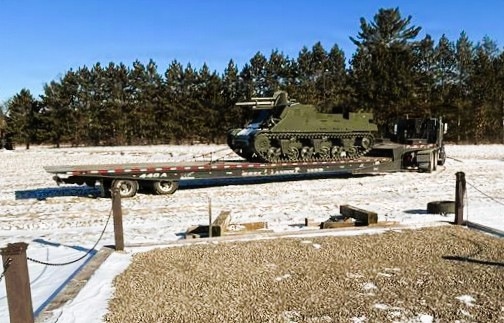
Courtesy Photo | Fort McCoy team members move a piece of Army equipment to the installation's Equipment...... read more read more
 Subscribe
In an effort that was four years in the making, an M7 “Priest” Self-Propelled Gun and an M114 155 mm Towed Howitzer were placed on equipment pads at Equipment Park on Jan. 28 in the Fort McCoy Commemorative Area.
According to Historian Ward E. Zischke with the 88th Readiness Division, these two pieces were part of the former Fort Snelling Military Museum Collection.
“The M114 Towed Howitzer was on a display pad to the north of Building 507 at Fort Snelling and was in excellent shape. The M7 Priest was in the motor pool and was rusty,” Zischke said.
Zischke said in 2011 the Army Center for Military History dissolved the Fort Snelling Military Museum and started taking the artifacts away.
“Somehow the 75th Division made some sort of deal and the Priest and M114 and a Sherman tank got taken down to the Army Maintenance Support Activity at Fort Sheridan, Ill., and stayed there for years,” he said.
Enter Chris Hanson and Kaleen Holliday, director and deputy director of 88th Readiness Division Public Affairs respectively. Both Holliday and Hanson worked alongside Zischke to get the equipment moved to Fort McCoy for the Equipment Park in the Commemorative Area.
Both Hanson and Holliday had previously worked in the Fort McCoy Public Affairs Office — the office in charge of the Commemorative Area. They both knew how well the addition of this equipment would be for historical purposes. Hanson, especially, completed a great deal of coordination to get the two pieces of equipment moved to Fort McCoy.
The equipment initially arrived at Fort McCoy on Jan. 12, 2023, from Fort Sheridan. From there, the professionals at Fort McCoy’s Installation Material Maintenance Activity of the Fort McCoy Logistics Readiness Center (LRC) went to work to get the two pieces prepared for outdoor display.
By mid-year 2024, the equipment items were fully set up to be set out on display at Equipment Park. The next process was to find a way to move the items to Equipment Park.
That effort was finally mapped out and decided by Jan. 28. It would involve a cooperative effort between Fort McCoy LRC, Fort McCoy Directorate of Public Works (DPW), and DPW’s roads and grounds contractor, said Nate Sobojinski, chief of the DPW Operations and Maintenance Division.
“This was a joint effort between LRC (contracted staff), DPW, and DPW’s roads and grounds contractor, Kaiyuh Services,” Sobojinski said. “We were waiting until the ground froze. Working with Mark Nohr and the team at LRC, myself at the DPW, and a less than $500 service order to roads and grounds … we got it done.”
Previous planning ideas to move the equipment included using cranes and other equipment and to contract it out would have been tens of thousands of dollars. In this case, all that expenditure was saved.
In addition to Sobojinski and Nohr, people completing the move were Dave Nedland and Karl Schoenfeld with the Fort McCoy LRC contractors serving as semi and forklift drivers respectively. From the roads and grounds contractor, John Pauley (project manager) and Mike Pierce (excavator operator) served as key players, Sobojinski said.
History of equipment Now that the two equipment items are in place at the two equipment pads that were open at the park, work to add signs and to document the historical value of these items begins.
With the M7 “Priest” Self-Propelled Gun, Army historical facts show it had a unique role. According to history, the official designation of this tracked vehicle is the 105 mm Howitzer Motor Carriage M7. It received the nickname of “Priest” by the British due to the pulpit-like machine gun mount.
Specifications show the M7 is a fully tracked self-propelled artillery piece for armored unit fire support. The item is from World War II as it entered service in 1942 and was also used in post-war service by several nations.
The Priest’s length is 19 feet, 9 inches. Width is 9 feet, 5 inches. Height is 8 feet, 4 inches. Weight is 50,600 pounds, or 23 tons. Main armament is the 105 mm M1/M2 howitzer and it could carry 69 rounds.
The crew size for a Priest was typically seven to eight people (commander, driver, gunner, cannoneers), depending on variant and source, history shows. Between April 1942 and July 1945, the total number of M7s built were: 3,489 M7 units, 826 M7B1 units, and 127 M7B2 conversions (from M7B1).
In post-World War II action, the M7 served with several nations into the 1950s and beyond. Even though the howitzer was eventually replaced in U.S. service by the more modern M198 in the late 1970s and early 1980s, its decades of use around the world speak to its rugged design and usefulness as a heavy indirect fire weapon.
Artillery crews often respected it for its reliability, and its continued appearances on battlefields as late as 2025 — whether in training or actual combat — are a testament to its longevity.
With the M114 155 mm Towed Howitzer, it’s one of the U.S. Army’s longest-serving artillery pieces. The M114 began life in the early 1940s as the 155 mm Howitzer M1, designed to give U.S. and allied forces a reliable medium-weight artillery piece capable of indirect fire support. It entered production right as World War II was under way.
The Howitzer wasn’t fast or self-propelled — it was towed — typically by a truck or artillery tractor, then set up by its crew (about 11 gunners) to rain heavy shells onto enemy positions, history shows. It was used during World War II, Korean War, Vietnam War, and other conflicts.
Even though the Howitzer was eventually replaced in U.S. service by the more modern M198 in the late 1970s and early 1980s, its decades of use around the world speak to its rugged design and usefulness as a heavy indirect fire weapon.
Hanson said he’s glad to see the equipment make its way to Equipment Park for future generations of visitors to enjoy.
“This is so incredible to see the project finally come to completion,” Hanson said. “From start to finish, we relied on the capability and generosity of so many people from delivery to Fort McCoy, unloading and restoration, to ultimately placing them on the pads for public display. They all deserve our thanks.”
Learn more about and Equipment Park by visiting the Fort McCoy website at https://home.army.mil/mccoy/my-fort/all-services/public-affairs-office-1/fort-mccoy-commemorative-area.
Fort McCoy’s motto is to be the “Total Force Training Center.”
Located in the heart of the upper Midwest, Fort McCoy is the only U.S. Army installation in Wisconsin. The installation has provided support and facilities for the field and classroom training of more than 100,000 military personnel from all services nearly every year since 1984.
Learn more about Fort McCoy online at [https://home\.army\.mil/mccoy\]\(https://home\.army\.mil/mccoy)\, on Facebook by searching “ftmccoy\,” on Flickr at [https://www.flickr.com/photos/fortmccoywi](https://www.flickr.com/photos/fortmccoywi)\, and on X (formerly Twitter) by searching “usagmccoy.”
Also try downloading the My Army Post app to your smartphone and set “Fort McCoy” or another installation as your preferred base. Fort McCoy is also part of Army’s Installation Management Command where “We Are The Army’s Home.”
| Date Taken: | 01.29.2026 |
| Date Posted: | 01.31.2026 22:59 |
| Story ID: | 557132 |
| Location: | FORT MCCOY, WISCONSIN, US |
| Web Views: | 1,436 |
| Downloads: | 0 |

This work, Fort McCoy team members finish effort to move two new items to installation’s Equipment Park, by Scott Sturkol, identified by DVIDS, must comply with the restrictions shown on https://www.dvidshub.net/about/copyright.


No keywords found.




