
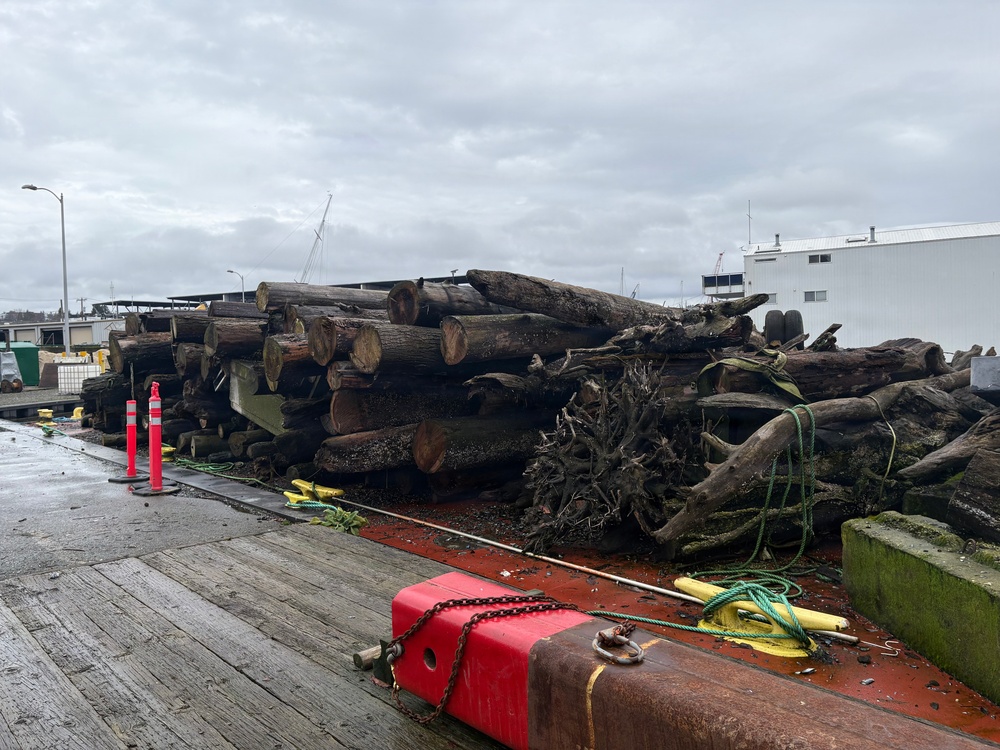
Photo By Nicole Celestine | A U. S. Army Corps of Engineers' barge, at Lake Washington Ship Canal and Hiram M....... read more read more
The U.S. Army Corps of Engineers (USACE) is primarily known for its infrastructure projects—dams, navigation locks, flood control systems and maintaining deep waterways.
But beneath the surface of these mission-critical activities lies a hidden, often overlooked resource: tons of driftwood, massive timber logs and woody debris collected during routine operations.
Every year, USACE, Seattle District clears tons of debris from the Puget Sound and its tributaries. But what happens to that material after they’ve been salvaged?
Thanks to collaborations with environmental and conservation organizations, salvaged material finds a new home in shoreline reclamation and erosion control, or ecosystem restoration projects. The collaborations that turn "trash" into critical habitat, help USACE advance its mission while actively protecting shorelines and nurturing aquatic life.
The Source: A Byproduct of Mission Success
Seattle District’s Navigation Section is responsible for removing and disposing derelict objects (e.g., sunken vessels), waterfront debris and derelict structures, and other sources of drift, that may damage vessels or threaten public health, recreation or the environment at publicly maintained commercial boat harbors. Its Motor Vessel (MV) Puget patrols the inland waters of Puget Sound, collecting debris and obstructions to navigation.
It’s no surprise that this continuous maintenance yields vast quantities of durable wood. According to MV Puget Small Craft Operator Stephen “Skip” Green, the volume is substantial.
“In a high-flow year, we can clear about 900 tons of large woody debris (LWD) from a waterway,” said Green. “The wood is often old-growth, incredibly dense, and perfectly preserved by the water. Partnerships with organizations that manage environmental conservation and sustainability help us steward this material responsibly. We are able to find beneficial reuse about 80 percent of the tonnage we collect.”
The Partnership: Repurposing for Resilience
The need for a sustainable disposal method aligned perfectly with the goals of environmental and conservation organizations focused on shoreline and riverine habitat restoration.
The solution is a simple and enduring partnership.
USACE collects the LWD, cuts them down to more manageable pieces and places them on barges at Lake Washington Ship Canal and Hiram M. Chittenden Locks in Seattle, for transport.
The Port of Seattle uses the salvaged LWD to stabilize eroding Elliott Bay and Duwamish Waterway bank lines in their shoreline restoration projects. According to Kathleen Hurley, senior environmental program manager (Maritime Environment and Sustainability), the Port installs the logs “…to mimic the historic function of large-wood originating in upstream watershed areas and accumulating in estuarine locations – providing habitat complexity and shoreline stabilization.”
Simply put: the logs stabilize the shoreline and provide long-term, durable habitat complexity.
The Port has used between 1450 and 1475 logs in 10 separate “green” shoreline projects constructed since 2006: (1) Duwamish Waterway—Terminal 105 (two projects), Terminal 108 (two projects), Terminal 107, Terminal 117/Duwamish River People’s Park, South Riverside Drive, 8th Avenue South public shoreline access site, and (2) Terminal 91 and Centennial Park (two projects). It has also used LWD in four city projects and numerous community art projects.
“Salvaged large wood is particularly effective for restoration use in disrupted urban industrial environments and the logs obtained from the Army Corps are ‘unique ’- simply not available at scale otherwise,” said Hurley. “The large wood is an important component of our projects; we anchor the logs using stainless steel cable and duckbill anchors to stabilize the shoreline and create habitat planting zones. It’s the Port’s good fortune to work with the Army Corps toward shared objectives--operational efficiency and environmental improvement.”
Measurable Outcomes and Mission Achievement
The process not only saves taxpayer dollars but also streamlines the vessel’s operations, ensuring the crew can focus on core missions without lengthy and costly disposal logistics (i.e., landfill disposal fees, fuel consumption, air emissions, traffic congestion and heavy truck haul distances).
It also allows USACE to demonstrate its commitment to environmental sustainability beyond just compliance. Community members see tangible evidence that USACE is a responsible steward, actively collaborating with local entities to improve the environment. The partnership fosters trust, making future USACE projects easier to communicate and execute.
“We’re grateful for the partnership with the Army Corps that supports navigational safety for commercial and recreational vessels, while also providing useful material for our habitat and shoreline restoration projects,” said Sr. Environmental Program Manager George Blomberg, who spearheaded the Port’s partnership with USACE in 2006. “This is a fantastic example of federal-local government partnership.”
The partnership between USACE and environmental and conservation entities serves as an influential model for resource management nationwide. By viewing salvaged timber not as a disposal problem, but as a public asset, USACE ensures that the byproducts of essential infrastructure maintenance are continually recycled for the greater good of America’s waterways and coastal health.
Praising the partnership’s enduring success, Seattle District’s Navigation Section Chief Bradford Schultz II said. “This isn't about doing one good deed: it's about inserting sustainability into our operational DNA. We are successfully executing our flood control and navigation missions, while concurrently providing the building blocks for ecosystem resilience. Our expert MV Puget crew has a unique place as the lumberjacks of the Salish Sea and has been instrumental to maintaining these partnerships. The logs we salvage are now protecting shorelines, proving that sound engineering and conservation can go hand-in-hand.”
| Date Taken: | 01.12.2026 |
| Date Posted: | 01.13.2026 12:25 |
| Story ID: | 556095 |
| Location: | SEATTLE, WASHINGTON, US |
| Web Views: | 72 |
| Downloads: | 0 |

This work, Second Life: Turning Debris into Critical River and Coastal Habitats, by Nicole Celestine, identified by DVIDS, must comply with the restrictions shown on https://www.dvidshub.net/about/copyright.


No keywords found.





