
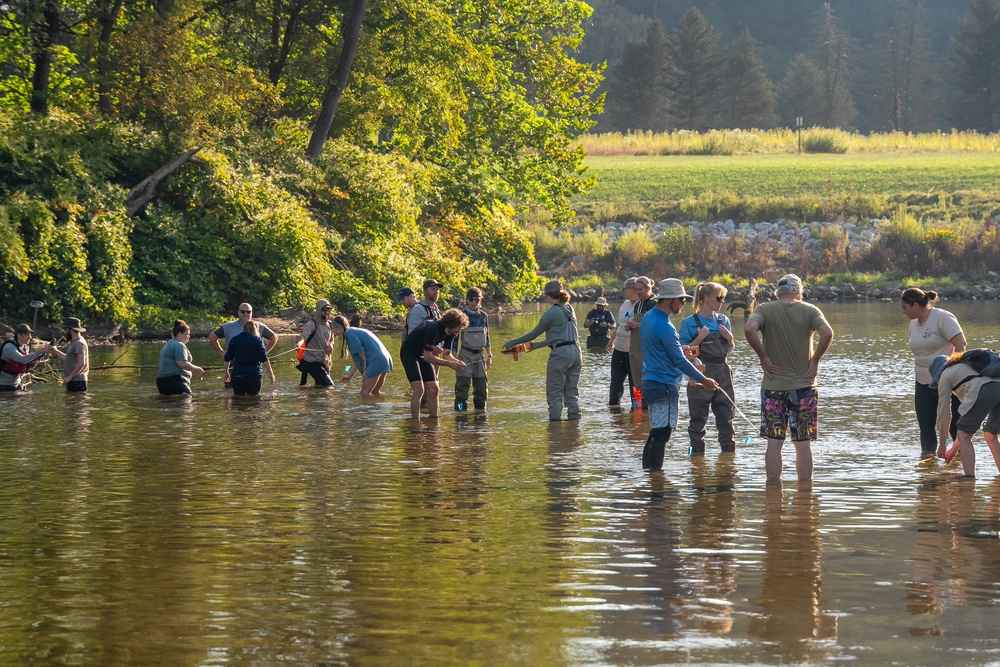
Photo By Andre Hampton | The U.S. Army Corps of Engineers, Buffalo District worked in collaboration with...... read more read more
CLEVELAND — A multi-agency team took a hands-on approach to boosting native mussel populations in the Cuyahoga River this fall, marking a new chapter in efforts to restore the health of one of Ohio’s most iconic waterways.
Scientists and specialists from the U.S. Army Corps of Engineers Buffalo District worked alongside the National Park Service, U.S. Fish and Wildlife Service, Ohio Department of Natural Resources, Cleveland Metroparks, Cleveland State University and Edge Engineering & Science to reintroduce hundreds of freshwater mussels into the river.
The project centered on roughly 670 Fatmucket mussels, each outfitted with tiny, numbered tags and P.I.T. (passive integrated transponder) chips — the same type of microchips used to track household pets. The tags allowed researchers to monitor the mussels’ movement, growth and overall health as they settled into their new environment.
Working together in a science laboratory at Cleveland State University, the team spent long hours tagging the 670 mussels in preparation for placing them at strategic locations throughout Cuyahoga Valley National Park in Peninsula, Ohio.
Freshwater mussels have been found in the Cuyahoga River for hundreds of years, but industrial growth, dams and pollution sharply reduced their numbers. Their reappearance in the early 2000s followed significant improvements in water quality.
Placing the mussels was a delicate task. Researchers made a tiny divot in the riverbed — no bigger than a fingertip — and set each mussel in place with its foot down and siphon facing up. That orientation helped the mussel anchor itself and begin filtering water, an essential step that improved water quality and stabilized river sediment.
Experts believe the return of these globally imperiled species could have an outsized impact. Healthy mussel communities support cleaner water, provide habitat for other organisms and strengthen the overall functioning of the river ecosystem.
The long-term goal is to re-establish a thriving freshwater mussel community in the lower Cuyahoga River within Cuyahoga Valley National Park. USACE and the National Park Service said the project aligns with their broader mission to restore and enhance the river’s ecosystem for future generations.
The Buffalo District delivers world-class engineering solutions to the Great Lakes Region, the Army and the Nation to ensure national security, environmental sustainability, water resource management, and emergency assistance during peace and war.
For 250 years, the U.S. Army Corps of Engineers has been at the forefront of the nation’s engineering excellence, responding when called. From constructing fortifications during the Revolutionary War, to building the infrastructure that saw America’s strength grow militarily and economically, USACE’s mission has always been to deliver engineering solutions for our nation’s toughest challenges.**Learn more athttp://www.usace.army.mil/Home/250th.
This article was written with assistance from artificial intelligence.
| Date Taken: | 12.02.2025 |
| Date Posted: | 01.12.2026 14:38 |
| Story ID: | 556076 |
| Location: | CLEVELAND, OHIO, US |
| Web Views: | 47 |
| Downloads: | 0 |

This work, Agencies Team Up to Restore Native Mussels in the Cuyahoga River, by Andre Hampton, identified by DVIDS, must comply with the restrictions shown on https://www.dvidshub.net/about/copyright.


No keywords found.





