
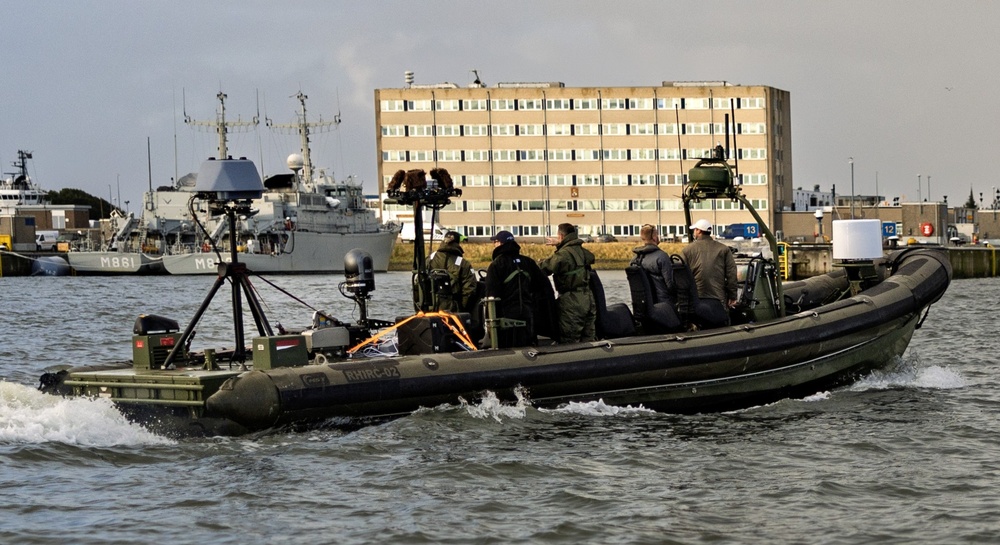
Photo By Deacon Westervelt | NETHERLANDS (Sep. 23, 2025) A team from the Naval Postgraduate School (NPS) recently...... read more read more
A new, innovative detection system for countering uncrewed aerial systems (c-UAS) conducted its first field tests at sea during the Bold Machina (BOMA) exercise in the Netherlands this September. Rapidly developed by a small team led by officer-scholars from the Naval Postgraduate School (NPS), the c-UAS system deployed aboard a Dutch Navy fast raiding, interception, and special forces craft (FRISC).
Designed for passive operation, the system employed artificial intelligence (AI) to integrate multiple independent sensor platforms to detect and identify class 1 drones. Because these types of drones are numerous, small, and difficult to track, they pose significant threats. When fully functional, the system provides special forces operating in the maritime domain valuable protection against distant incoming drones without compromising their position.
The NPS efforts support the U.S. Department of War’s priority to accelerate drone development and deployment outlined in “Unleashing U.S. Military Drone Dominance.” The memo laid out the plan for how the department would “... power a technological leapfrog, arming our combat units with a variety of low-cost drones made by America's world-leading engineers and AI experts.”
Local and International Teamwork
NATO Allied Special Operations Forces Command (SOFCOM) sponsored BOMA with technical support from the NATO Center for Maritime Research and Experimentation (CMRE). Over 150 personnel from 17 individual NATO special operations forces (SOF) commands and two NATO partner SOF commands participated. Representatives from Ukraine also attended. International collaborations like this are essential for ensuring national and global security and maintaining cooperation between allies.
Military conflicts often drive rapid advancement and adoption of new technology. Exemplifying this, the war in Ukraine has thoroughly demonstrated the urgent need to detect hostile drones that continuously evolve in capability. And NPS is helping to harvest these hard-earned lessons.
“For us, it’s a question of survival,” said a special operations forces colonel, who serves in the Armed Forces of Ukraine and is also earning a master’s degree in defense analysis from NPS. “So, we’re more than motivated to create the most efficient and effective weapons and counter-weapons to use against enemies as soon as possible and as cheaply as possible.
“Every time I watch or read the news about a missile attack or drone attack or mixed attack, it’s so hard,” the Ukrainian colonel added.
But all of the Ukrainians understand the vital importance of their advanced education at NPS — to share what they know and what they are learning. It’s a force multiplier and will allow them to make bigger contributions to Ukraine’s defense once they return. “One thought that actually warms and encourages me is this education. Sharing our experiences. Thinking more strategically. It will help me execute my mission much better,” he said.
During the Ukrainian colonel’s studies, he joined over 80 other NPS officer-scholars — from the U.S. and across the globe — and faculty from the defense analysis and information sciences departments to observe NPS’ Joint Interagency Field Experimentation (JIFX) exercise held in August. It’s here where he encountered the BOMA team from NPS testing their c-UAS system in collaboration with other experimenters and industry partners. He and his countrymen had insight to share.
Former NPS provost Scott Gartner is now a professor teaching for the NPS Department of Defense Analysis. He was responsible for organizing the large student and faculty group visit to JIFX because he understands its importance.
“JIFX captures what's really special about NPS. It's a collaboration of students, faculty, military, industry, government, and leaders from all over — just like NPS,” said Gartner. “I think that kind of collaboration is critical. It's applied and working to accomplish important advances, which is demonstrated by JIFX’s focus on innovation. It’s the secret sauce of NPS.”
Bold Machina Design Challenge
SOF combatant craft, such as FRISCs and other rigid-hull inflatable boats (RHIBs), on open water can be at high risk of drone attack because they’re exposed without cover. NATO SOFCOM identified this vulnerability as the focus of their design challenge for the 2025 BOMA exercise.
Back in January, as two NPS officer-scholars worked toward their graduate degrees, they faced the seemingly impossible while enrolled in a special directed study course that covered this BOMA design challenge.
The course was a 90-day sprint study that tasked them “to understand the unique c-UAS challenges posed to maritime SOF combatant craft and propose next steps to close an existing capability gap.”
U.S. Navy Lt. Cmdr. Max Leutermann, an engineering duty officer studying system engineering, and Swedish Armed Forces Maj. Patrik Liljegard, a special forces officer studying defense analysis, eagerly accepted the challenge. They brought over 35 years of military service together, and their multidisciplinary experience proved invaluable to finding a solution.
“The ability for NPS to bring together defense subject matter experts, industry partners, and operationally experienced officer-scholars was recognized by NATO Allied SOFCOM as a unique opportunity to develop innovative solutions to a real-world problem,” said Kevin Smith, the lead and principal investigator for the BOMA effort at NPS. “This partnership not only advanced warfighting capability, but also greatly enriched the educational experience of all of the students involved.”
Liljegard and Smith presented the proposal to NATO Allied SOFCOM in Poland last April, where it was approved and additional funding for them to build a prototype was provided. But they still needed a lot of help to turn their proposed solution into reality. So, by forming partnerships across industry, they found the resources and expertise able to assist them.
“NATO required us to create a system that was passive so that operators who were on a small boat wouldn’t give off any sort of detectable signatures or emissions,” said Leutermann, who served as a submariner for years. “We spent the beginning of the year figuring out solutions. Now, we started figuring out how to build it and who to build it with.”
Testing Counter-UAV Prototype at JIFX
Temperatures in August frequently climbed to over 100 degrees at NPS’ JIFX, which is held quarterly in southern Monterey County at Camp Roberts. The scorching, dry, and dusty inland terrain did not exactly mimic the conditions likely faced during a SOF mission aboard a FRISC silently cruising along the coast of northern Europe. Instead, the harshness at JIFX in summertime provided benefits in other ways.
It was this environment that enabled the c-UAS team to shake out their prototype while navigating unexpected challenges as they pushed the system beyond its limits. They needed to complete this rigorous testing in time for BOMA.
“We had a very tight timeline,” said Leutermann. But he and Liljegard had been thinking ahead. They attended the JIFX exercises earlier in February and May as observers to learn how to best take advantage of the August exercise.
“After we built a mockup, we took it to JIFX to test and prove its functionality. Our goal was to detect drones. Eventually, the system will go on a RHIB for BOMA. But we first strapped the system into the back of my pickup truck and used it like a land boat.”
Their c-UAS system tied together four subsystems: — Multiple independent sensor platforms, which are customizable to the requirements and resources of the operators. — The Tactical Hybrid Operational Router (THOR), which provide the power and network to the hardware. — The Operational Data Integration Node (ODIN), which is an AI-driven, sensor fusion engine. — The navigation display, which overlays the drone detection data from the sensors on the graphical user interface for the operators.
“While companies and other NPS students at JIFX flew their drones all around, we tried to detect them,” Leutermann continued. “Different types of drones at different altitudes, distances, directions, angles of attack, and all of that. Our second goal at JIFX was processing what we detected and representing it on the navigation display.”
The sensor platforms used by the system included: short-range acoustic and electro-optical/infrared (EO/IR) from Mara; direction-finding radio frequency (RF) from DroneShield; broad-spectrum RF from Silvus Technologies; long-range EO/IR from Trakka Systems; and low probability of intercept/detection radar from DspNor.
To counter evolving drone design and adversary tactics, AI from an Nvidia Jetson developer kit drives the c-UAS system by fusing the multi-sensor data, refining real-time UAS detection models, and updating threat libraries. The operators receive the output on a SeaCross navigation display, giving them the detected drone’s bearing, range, altitude, orientation, and identification.
Their system combined sensors and hardware from seven different companies in Australia, Norway, Sweden, and the U.S. Together, these industrial partners provided the sensing, compute, and interface capability the team needed to succeed.
Not all the system’s sensor platforms were in place or ready for evaluation during JIFX, and building of the THOR and ODIN subsystems was ongoing. However, there was still much to learn, and the team spent the days at JIFX driving around the base in their “land boat” detecting drones.
Mounted on a mast attached to the pickup bed of the “land boat,” the Mara sensor platform caught the attention of the NPS students from Ukraine.
Mara’s CTO and co-founder Sriram Raghu explained, “They had great questions, like can our system detect against low altitude flights? What about resilience against fiberoptic drones? What kind of sensors are we using to do different kinds of detection? These questions were helpful to hear from them because they were very aware of the limitations of the different sensors.
“Our system uses a combination of sensors because the behavior of individual sensor types can vary under certain conditions. For instance, on a really hot, sunny day like today, drones light up against the sky on a thermal camera. But against the ground they don’t. Similar things happen with microphone signatures. If drones fly at certain speeds and their motors spin certain ways, they can trick the microphones. So, lots of good insight from them.”
Also attending JIFX were other teams from NPS conducting electronic warfare (EW) studies and operating drones. Like pilots who fly crewed aircraft, certified remote drone operators must stay in practice by flying regularly. So, JIFX provides an outstanding opportunity for them to keep current with flight hours by not only flying drones for their field tests but also assisting in-need experimenters who don’t have their own drones and operators. This collaboration is a very big win-win.
“JIFX not only provides our EW team with the opportunity to perform live RF hardware experimentation in the field, but it allows us to gain valuable ‘stick time’ in order to maintain small-UAS flight proficiency,” said Lt. Cmdr. Calvin Sessions, an electrical and computer engineering Ph.D. student from NPS’ Radar and Electronic Warfare Laboratory and a certified remote drone operator. “In addition to flying for our own investigations, JIFX is an excellent networking event, and we’re happy to collaborate with fellow engineers and researchers.”
“The BOMA team was one of our collaborations that our team worked with going into the event. During JIFX, they told us where to fly as they recorded their data. After the event, we provided their team with the actual flight track data pulled from our system to assist in their analysis. It was a pleasure to give them the support that they needed for their research, and it helped us out, too.”
Leutermann and Liljegard benefitted from working together with others at JIFX as well. Without the exceptionally collaborative environment at JIFX, it would have been impossible for them to fully integrate the hardware and software of their c-UAS system’s multiple sensor platforms.
The intense testing under field conditions that they were able to achieve greatly expanded their understanding of how the system would operate best, which allowed them to better optimize its functionality in preparation to execute during the BOMA exercise.
NATO Special Operations Forces Command’s BOMA 2025
In a matter of months, Leutermann and Liljegard had developed, built, tested, and prepared a prototype of their c-UAS system for sea trials during BOMA by the Dutch Navy from the port city of Den Helder, Netherlands. However, this did not mean the system was complete and fully functional.
“Our system is a system of systems,” said Liljegard, who has made over 10 global deployments with the Försvarsmakten or Swedish Armed Forces. “It was not fully integrated and fully operational before going to BOMA due to the timeline and the unavailability of some of the sensors we planned to use.”
During the first days of BOMA, sensors and equipment were still arriving and had to be connected. The team assembled and integrated hardware and software that they had never used before. But the multinational industry partners that joined them at BOMA stepped up in a big way.
“The great thing is how far we reached in such a short timespan with the NPS team and the industry partners, who all worked together,” added Liljegard. “If one of the companies lacked something, then another company shared its resources. It was fantastic to see everybody work toward the same goal of completing the system.”
Still, having to complete the prototype system while at BOMA was a delay that ate up valuable sea trials time. Once ready, the team deployed aboard a FRISC several kilometers offshore and waited for contacts. Four different types of class 1 drones launched at them—ordinary RF controlled, modified RF controlled, fiberoptic, and autonomous.
“We were able to put all the sensors on the boat, power them up, connect them to the fusion engine, funnel all the detection data through the fusion engine and the database, and then populate it all on the SeaCross display,” Liljegard said of the engagements.
As the FRISC maneuvered, the team watched the drones track on the navigation display in real time. For some drones, Leutermann and Liljegard not only tracked the drones themselves for the entire time in the air but also the drone controllers’ positions. In one case, after the third sighting of a drone not in their UAS library database, the system was able to learn it was a new type of drone, add it to the library, and alert the team that it was a threat.
“In the end, we showcased a system that integrated sensors from multiple companies into one display that operators can use,” said Leutermann. “That capability didn’t exist before. We were able to bring something new to the field.”
Despite the challenges, teammates Leutermann and Liljegard both agreed that the performance of their c-UAS system was very successful and did indeed meet the objectives set by BOMA.
Continuing the Collaboration
NATO says a critical function of the BOMA exercise is to adapt “lessons from ongoing conflicts, transforming today’s battlefield realities into tomorrow’s maritime SOF capabilities.” The collaboration with NPS was so productive that NATO SOFCOM is supporting another 90-day sprint study this winter to explore unique needs in underwater communications, command, and control.
Applying lessons from the war in Ukraine was especially relevant. So, members of the Ukrainian Special Operations Forces participated in the BOMA exercise. While in attendance, they had also visited with the NPS c-UAS team. As Ukrainians also did during JIFX at NPS, they provided insightful feedback to help further advance the development of the system.
The success of the c-UAS system at BOMA could not have been accomplished without the prototype experiments run at NPS’ JIFX exercise in August. For decades, JIFX and its predecessor programs have enabled the rapid development of innovative technology—drones, lasers, AI, additive manufacturing, and much more—vital to meeting national and global security challenges.
“The war in Ukraine has made one point unmistakable: defense innovation must move much faster,” said Aleksandar Matovski, an expert on Russian and European security at NPS’ Institute for Regional and International Security (IRIS).
“New technologies such as the one c-UAS team demonstrated at the BOMA exercise in the Netherlands must be built and fielded at speed to close critical gaps, and existing systems updated almost daily to outpace adversaries who are learning and adjusting rapidly,” Matovski continued. “NPS is uniquely positioned to accelerate these efforts, drawing on its deep academic expertise, officer-scholars with operational experience, strong industry ties, and long-standing programs such as JIFX.”
NPS, located in Monterey, California, provides defense-focused graduate education, including classified studies and interdisciplinary research, to advance the operational effectiveness, technological leadership, and warfighting advantage of the naval service. Established in 1909, NPS offers master’s and doctorate programs to Department of War military and civilians, along with international partners, to deliver transformative solutions and innovative leaders through advanced education and research.
| Date Taken: | 12.10.2025 |
| Date Posted: | 12.11.2025 21:24 |
| Story ID: | 553961 |
| Location: | MONTEREY, CALIFORNIA, US |
| Web Views: | 597 |
| Downloads: | 1 |

This work, Rapidly Developed Counter-Drone Prototype Succeeds at NATO’s Bold Machina, by Daniel Linehan, identified by DVIDS, must comply with the restrictions shown on https://www.dvidshub.net/about/copyright.


No keywords found.





