
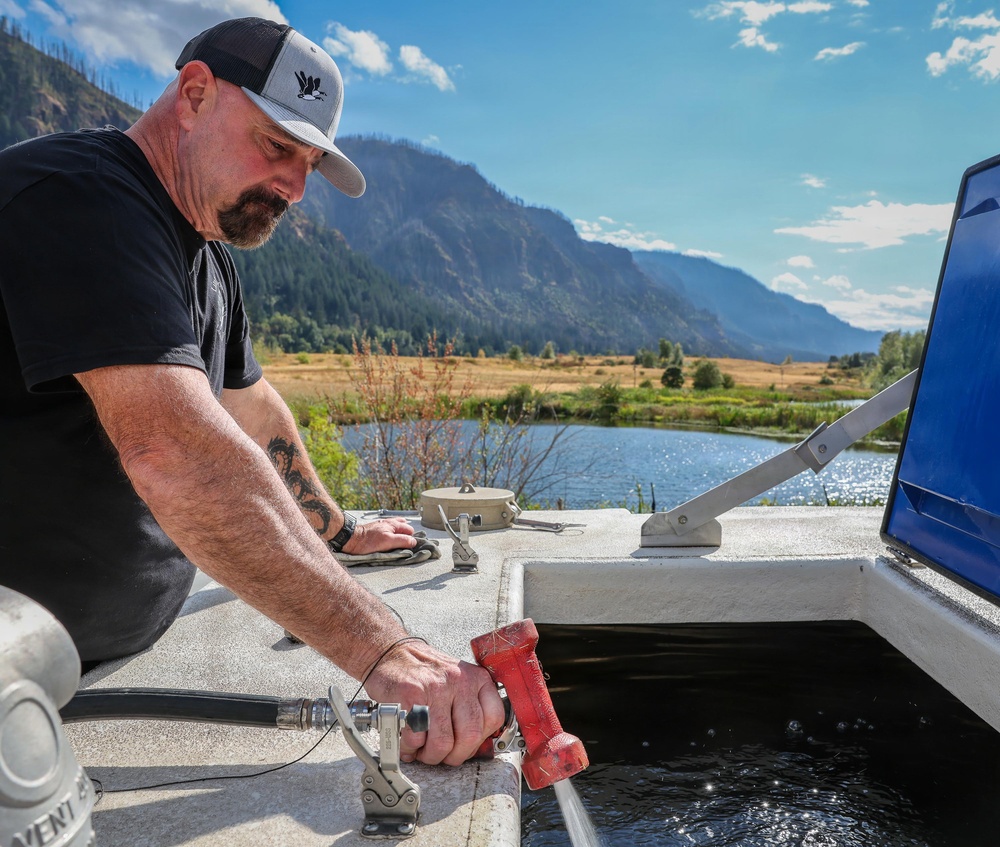
U.S. Army Corps of Engineers Maintenance Worker Keith Pommerening checks the water quality in a juvenile fish transport truck, Sunday, Aug. 30, 2026. Throughout the journey, drivers continuously monitor water temperature and oxygen levels to ensure optimal conditions for the juvenile salmon and steelhead.
Precise temperature management is critical to the survival of juvenile salmon during transport. Even minor temperature spikes can be devastating; warm water holds less dissolved oxygen, accelerating the fish's metabolism and causing extreme physiological stress, exhaustion, or disease susceptibility. By maintaining a cool, stable environment (typically targeting mid-50s Fahrenheit), the U.S. Army Corps of Engineers minimizes metabolic stress and mitigates thermal shock. This ensures that the salmon remain healthy and resilient when they are released back into the river system below the Bonneville Dam to continue their migration to the Pacific Ocean.
| Date Taken: | 09.15.2026 |
| Date Posted: | 09.15.2026 12:26 |
| Photo ID: | 9937860 |
| VIRIN: | 260830-A-GA333-1026 |
| Resolution: | 3000x2542 |
| Size: | 1.44 MB |
| Location: | US |
| Web Views: | 5 |
| Downloads: | 0 |

This work, Juvenile Fish Transport along the Salmon River [Image 8 of 8], by Elijah Wittum, identified by DVIDS, must comply with the restrictions shown on https://www.dvidshub.net/about/copyright.
![A middle-aged man wearing a black t-shirt, gray cap, and work gloves is leaning over or operating equipment next to a large tank or container labeled 'Juvenile Fi[sh]'. The setting appears to be an outdoor fish hatchery or juvenile fish facility. The image is a close-up, candid-style photograph taken in natural daylight.](https://d1ldvf68ux039x.cloudfront.net/thumbs/photos/2609/9937783/75x75_q95.jpg "Juvenile Fish Transport along the Salmon River")


No keywords found.





