
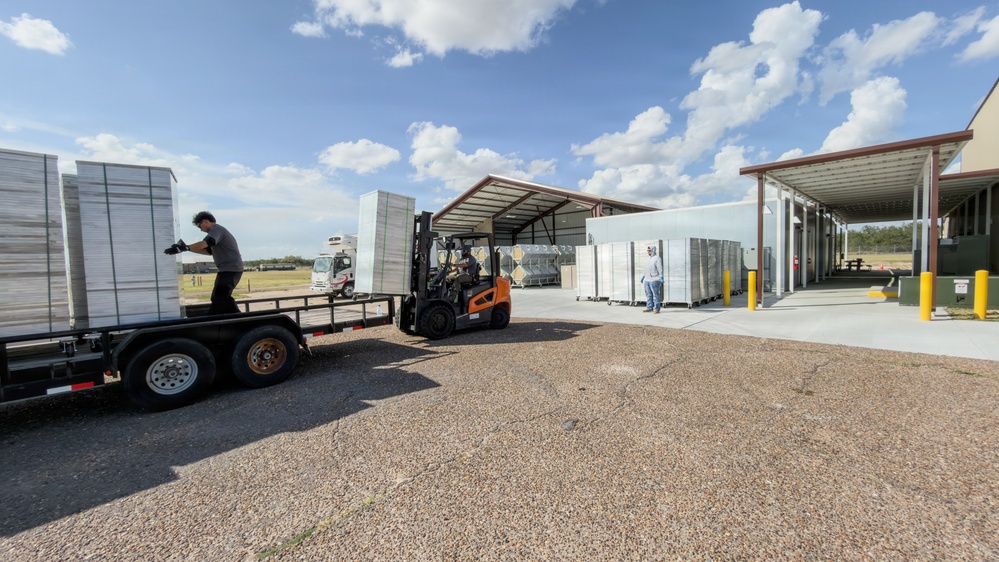
U.S. Department of Agriculture (USDA) Animal and Plant Health Inspection Service (APHIS) New World Screwworm (NWS) Dispersal Facility at Moore Air Base in Edinburg, Texas, on July 2, 2026.
Their dispersal rate will increase from approximately 60 million to a total of 80 million flies next week. Here, staff unloads new towers of emergence racks that have just arrived and are seen outside the open-air shelters, where other crews clean and dry of the existing emergence screens
The sterile fly program, built on decades of multinational cooperation, uses continuous aerial release to halt the spread of New World Screwworm by overwhelming wild populations with sterile males. With multi agency coordination—from CBP inspections to USDA documentation, facility processing, Texas National Guard training, and specialized aviation support—the operation demonstrates an intensive, international effort to protect livestock, wildlife, and communities across the region.
Videos are available at
https://www.dvidshub.net/feature/NewWorldScrewworm
Photos are available in the USDA APHIS Collection https://www.flickr.com/photos/usdagov/collections/72157625204032244/
Courtesy Media.
The shipment is carted into one of the facility’s Cold Rooms, set to 51-degrees, where technicians open each cooler to verify contents, inspect quality, and record temperatures. Pupae are measured into buckets and immediately dyed fluorescent green to identify them as processed at this facility in Texas—a step carried out in a small cement mixer before the material is poured into an auger feeder. The auger dispenses uniform amounts of pupae into the frame channels of the emergence screen trays; a nutrient cube is added to each tray. Tray stacks are capped with ventilation covers and rolled into an Emergence Room, where a vacuum ventilation hose is attached on top. The system pulls air from the bottom upward and up through the tower, maintaining about 81 degrees and 72 percent humidity to promote even emergence.
From each batch, a screened grid tray is filled with 100 pupae. With this sampling they can track the emergence rate. Technicians monitor fly development to determine when the insects are ready for dispersal, enabling planners to schedule flight routes and timing. Once a batch reaches target emergence of 94.5%, trays are moved back to the cold room where the flies become dormant.
Overnight, personnel in the Cold Room conduct the “knock down” process, tapping trays over a square screen funnel to guide the chilled, inactive flies into dispersal boxes—about two million flies per box, with roughly 80 trays emptied for each container. [This process demonstrated but actual work not seen]
Before sunrise on July 2, morning crews check fly temperatures at 4:30 a.m. and load the boxes into a refrigerated truck bound for the South Texas International Airport, Edinburg, Texas. On this day, Texas National Guard members train alongside USDA and aircrews to learn aircrew dispersal duties. The dispersal effort is increasing and the men and women from the Guard are needed meet the new operations tempo. At the flight line, King Air 90 and other twin turboprop aircraft—modified with onboard cooling systems and external dispersal chutes—are loaded with sterile flies. Pilots and dispersal technicians conduct preflight checks, taking advantage of calm early morning weather. Once at the drop zone the aircraft will follow GPS guided north–south or east–west grids at about 6,500 feet, allowing broad, even distribution over the target zone near the Mexico border. As he pilots to the first drop zone, he will alert the Servidios Aeros’ Dispersing Technician Jorge Perez to prepare for dispersal. On the pilot‘s cue, Perez activates the aircraft’s dispersal systems. A motorized auger system begins to slowly turn to maintain a controlled release rate while the autopilot flies the preprogrammed pattern. Periodically, Perez inspects the operation of the system, the condition of the flies and peers through a narrow observation port to see how well they are being deployed through of the chutes. After completing each grid, crews land to refuel before returning to their next assigned route. Captain Burgess has more than a year of experience flying these missions south of the US/Mexico border before transferring to the Texas operations site.
Back at Moore Air Base, the cycle continues with the cleaning and drying of the screens and coolers, while others heat and mixing a solution of water and nutrients in commercial kettles. The mixture is then pumped into trays and air cooled before going into a cold room to firm up into a translucent gel. Their dispersal rate will increase from approximately 60 million to a total of 80 million flies next week. New towers of racks have just arrived and are seen outside the facility.
The sterile fly program, built on decades of multinational cooperation, uses continuous aerial release to halt the spread of New World Screwworm by overwhelming wild populations with sterile males. With multi agency coordination—from CBP inspections to USDA documentation, facility processing, Texas National Guard training, and specialized aviation support—the operation demonstrates an intensive, international effort to protect livestock, wildlife, and communities across the region.
More videos are at https://www.dvidshub.net/search/2.0?q=new+world+screwworm&type=video
Photos are at the USDA APHIS New World Screwworm Collection https://www.flickr.com/photos/usdagov/collections/72157625204032244/
USDA Media by Lance Cheung. Attribution appreciated.
| Date Taken: | 07.02.2026 |
| Date Posted: | 08.14.2026 14:16 |
| Photo ID: | 9869862 |
| VIRIN: | 260702-P-RD001-6402 |
| Resolution: | 8064x4536 |
| Size: | 7.38 MB |
| Location: | EDINBURG, TEXAS, US |
| Web Views: | 2 |
| Downloads: | 0 |

This work, New World Screwworm Sterile Fly Aerial Dispersal [Image 36 of 36], by Lance Cheung, identified by DVIDS, must comply with the restrictions shown on https://www.dvidshub.net/about/copyright.


No keywords found.





