
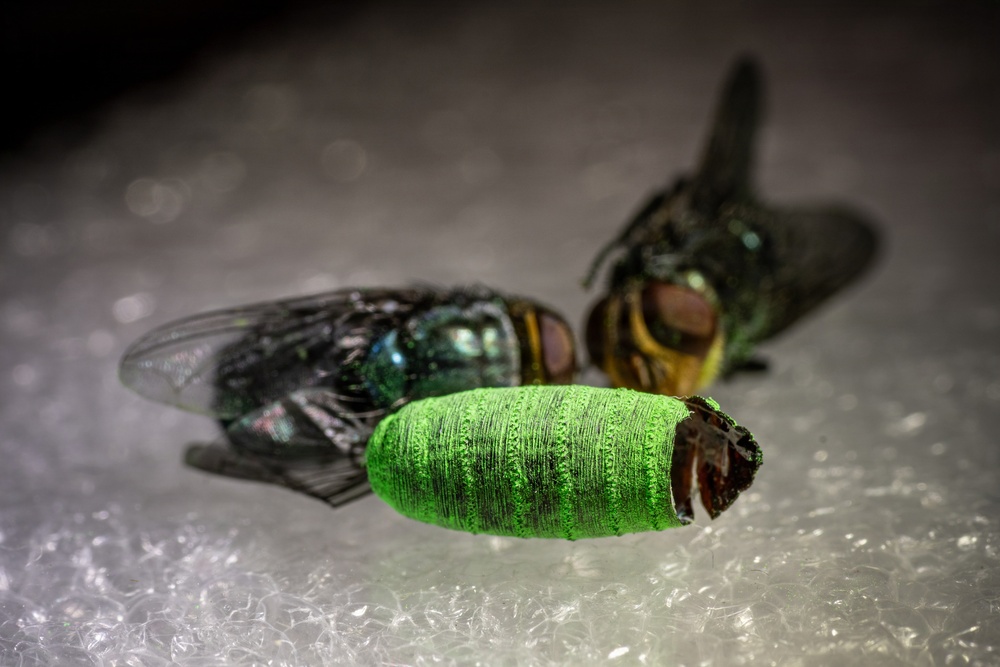
Dyed sterile pupae, male and female New World Screwworm flies being examined at the U.S. Department of Agriculture, USDA, Animal Plant Health Inspection Service, APHIS, New World Screwworm Sterile Fly Dispersal Facility at Moore Airfield, in Edinburg, Texas on Feb 10, 2026 where a proven biosecurity strategy is helping to ensure the New World screwworm, NWS, stays out of the United States. Though eradicated domestically decades ago, NWS remains in parts of South America and has moved northward through Central America and Mexico. It is not currently present in the United States, and this facility plays a critical role in keeping it that way. The process begins with sterile fly pupae, produced by COPEG in Panama, arrive at the New World Screwworm Sterile Fly Dispersal Facility in coolers to keep them dormant. The coolers are taken inside a cold room, where, the pupae are portioned into bins and coated with a fluorescent green dye in a rotating tumbler—marking them as part of the U.S. eradication program. (Mexico uses orange dye for its program to help scientists track dispersal coverage.) The dyed pupae are placed on screened panels fitted with food cubes and stacked into rolling towers, then moved into a climate‑controlled emergence room where precise warmth and humidity promote timely development into adult flies. Each batch is monitored using a 100‑pupae sample grid. During this time, samples of flies are raised in screened cubes with different variables to test their longevity and other factors. In the laboratory, various kinds of microscopes and lights are used to inspect sample pupae and flies. When emergence reaches the target threshold, the towers return to the cold room, where chilled air is drawn through it to makes the adult flies docile. In a process called “knock‑down,” racks are inverted and gently tapped so flies fall into tray‑funnels and collection boxes. Teams then load aerial dispersal containers with specific quantities. The dispersal boxes are then mounted in the cabin of specialized aircraft for release over predetermined locations—often in grid patterns and at operational altitudes designed to maximize coverage and ensure sterile males vastly outnumber wild males. USDA Media by Lance Cheung.
| Date Taken: | 02.10.2026 |
| Date Posted: | 04.21.2026 11:35 |
| Photo ID: | 9629261 |
| VIRIN: | 260210-A-A4469-5273 |
| Resolution: | 5616x3744 |
| Size: | 5.87 MB |
| Location: | EDINBURG, TEXAS, US |
| Web Views: | 25 |
| Downloads: | 4 |

This work, Groundbreaking Ceremony Marks New Era in Agricultural Biosecurity at Moore Air Base [Image 4 of 4], must comply with the restrictions shown on https://www.dvidshub.net/about/copyright.


Groundbreaking Ceremony Marks New Era in Agricultural Biosecurity at Moore Air Base
No keywords found.





