
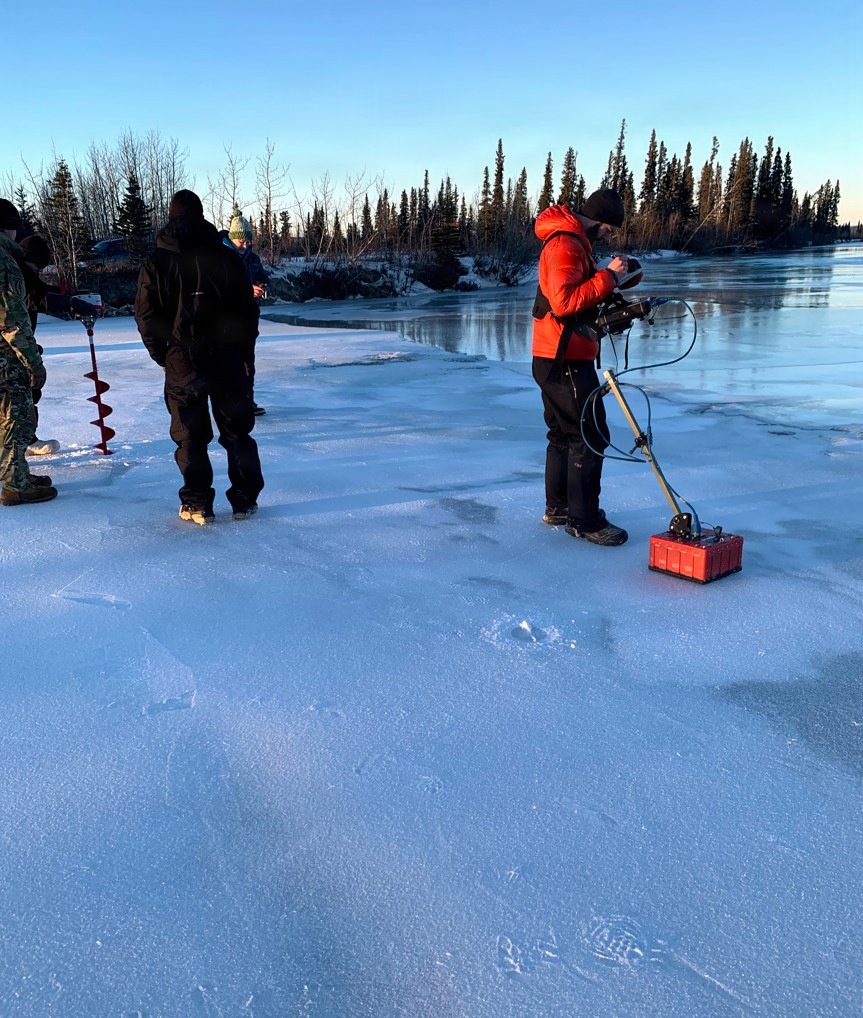
Courtesy Photo | Ground-penetrating radar (GPR) antenna being used to conduct ice thickness tests on...... read more read more
 Subscribe
Military operations in cold regions inevitably necessitate maneuvering across, through or over frozen surfaces, making ice bridges among the most critical components of this infrastructure.
These specialized crossings play a pivotal role in mission success, but they also carry significant challenges. The proper siting, design, monitoring, and operation of ice bridges are essential to reducing potential environmental impacts and mitigating severe risks to both personnel and heavy military equipment.
"It's very similar to when you're wondering if that pond or stream near your house is safe to ice skate on in the winter," explained Daniel Vandevort, a research civil engineer at the U.S. Army Engineer Research and Development Center’s Cold Regions Research and Engineering Laboratory (CRREL). "The difference is that ice bridge constructors have to figure out if the ice is safe for military vehicles weighing thousands of pounds. The good news is that methods exist to help ice bridge constructors identify, manage and monitor ice bridges for these hazards."
Vandevort and a team of fellow CRREL researchers have coalesced those methods and more into a single, comprehensive set of SOPs concerning the design, maintenance and operation of ice bridges, equipping military leaders and planners with detailed insights into the historical development of ice bridges, site selection, construction methods and operational and seasonal considerations.
They also specifically address considerations unique to U.S. Army training areas in Alaska, alongside an examination of the ramifications of changing weather conditions and increasing environmental uncertainty related to the lifespan of ice bridges.
By formalizing these protocols, the research team has provided the U.S. Army with a safer, more predictable framework for cold-weather engineering that it was previously lacking.
"Time and again, and especially in cold climates like Alaska, situations came up where operators asked us, 'what's the protocol for this?' and when it came to things like ice bridging, snow road construction and other cold regions engineering tasks, there was a lot of confusion about what the best and safest course of action was," said Vandevort. "We hope these SOPs severely reduce that confusion."
To develop the SOPs, the team drew on the laboratory’s decades of cold-weather research experience, as well as the insight brought by individual researchers.
“CRREL has decades of cold regions science andengineering experience and knows how to communicate that to military operators,” said Vandevort. “The value of that is really hard to express, but it's huge and probably the mainreason whyour lab is the right choice for things like cold regions SOP development.It's also important to say that the experience leveraged from ourAlaska-based team is also incredibly valuable. There's really nothing like lived experience.”
A version of the article first appeared in the https://www.same.org/tmeissue/tme-september-october-2026/ of The Military Engineer magazine. Republished with permission.
| Date Taken: | 09.17.2026 |
| Date Posted: | 09.17.2026 17:09 |
| Story ID: | 575015 |
| Location: | US |
| Web Views: | 14 |
| Downloads: | 0 |

This work, Navigating the Frozen Frontier: Standardizing Ice Bridge Operations for Military Maneuvers, by Justin Campfield, identified by DVIDS, must comply with the restrictions shown on https://www.dvidshub.net/about/copyright.


No keywords found.




