
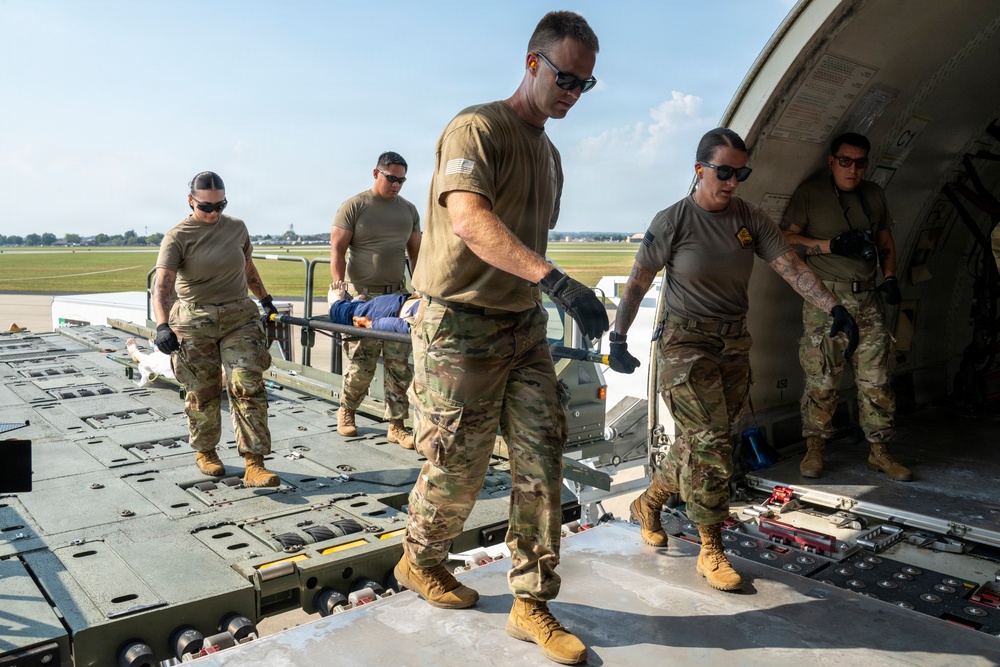
Photo By Sgt. 1st Class Christopher Hernandez | Four U.S. Army Reserve Soldiers assigned to the Aurora, Colo., based 7450th Medical...... read more read more
SCOTT AIR FORCE BASE, Ill. — More than 30 Army Reserve Soldiers of the Aurora, Colorado-based 7450th Medical Operational Readiness Unit, a downtrace unit of the Army Reserve Medical Command hierarchy, trained and operated as the patient insertion team in synchronization with other military and civilian personnel during Exercise Ultimate Caduceus 2026, henceforth known as UC26, here Sept. 7-12, 2026.
UC26 is a U.S. Transportation Command-led annual patient movement field training exercise held here, Alpena, Michigan; Boise, Idaho and Fort Campbell, Kentucky. Approximately 400 military and civilian personnel from AR-MEDCOM downtrace units, USTRANSCOM, U.S. Northern Command, U.S. Strategic Command, U.S. Air Force aeromedical evacuation crews, Critical Care Air Transport Teams, U.S. Department of Veterans Affairs, Defense Health Agency, U.S. Department of Health and Human Services and myriad commercial partners all coordinated with each other in the shared responsibility in ensuring unity of effort.
In addition to the 7450th MORU Soldiers, more than 40 personnel from the 7451st MORU out of Joint Base Lewis-McChord, Washington comprised of the exercise control element, known in military parlance as the “white cell,” and live role-players to supplement the manikins prepared as simulated patients.
U.S. Army Reserve Maj. Jesse Back, commander of Headquarters and Headquarters Company, 7450th MORU and the officer in charge of the PIT crew, said the FTX replicates large-scale patient reception at point of injury, immediate first aid and triage, patient movement and transportation, in-flight care and continued care in medical treatments inside and outside of the continental United States.
“The mission of the PIT is to provide manpower to help execute the large-scale patient movement exercise that Ultimate Caduceus is, and so we are the manpower to help move patients through the tracking process to help them understand the mission,” said Back.
Part of the duties and responsibilities of the PIT crew were to prepare the simulated patients by using manikins with various injuries and effects, applying moulage and prosthetics to both the simulated patients and live role-players.
Additionally, the PIT crew facilitated and executed the ground aspect of patient movement and distribution — loading and off-loading patients, respectively to and from tactical airlift, rotary-wing and light transport aircraft such as the C130J Super Hercules, U.S. Army UH- 60L Black Hawk and C-12 Huron; as well as multiple commercial aviation and Civil Reserve Air Fleet platforms.
Back also said the PIT crew not only was a vital component in the joint-service, interagency network of patient movement, care and transportation — it is wholly conducive to readiness assessment and validation for his crew and the rest of the exercise participants.
“Our mission helps with the understanding of large-scale combat operations because as we are moving the patients through, they’re getting validated by each section the CCATT; the doctors and the nurses all through the patient process line,” Back said. “We’re the ones intricately moving those patients through those steps, so that way they can get good, solid training and to help them have a successful exercise.”
U.S. Army Reserve 1st Lt. Suenomi Cobb, a medical-surgical nurse assigned to the 7450th MORU, said her training experience as a member of the PIT crew enriched her understanding and appreciation of interoperability with U.S. Air Force personnel.
“It was awesome to see the Air Force and how they operate on the aircraft and how they communicate,” Cobb said. “From what I learned here, I’ll be able to take back the Air Force’s way of loading and off-loading patients, how we communicate with one another, especially with the loud engines running in the aircraft.”
Moreover, the Grand Rapids, Michigan denizen said she was able to perform in other roles in UC26 outside of the PIT crew.
“I actually got the opportunity to be a simulated patient for the Air Force,” said Cobb. “They loaded me onto a C130(J), I flew all the way to Idaho and en route I was a behavioral health patient, so I got to simulate a mental health crisis onboard the aircraft.”
Overall, UC26 and other joint-service, interagency field training exercises ensure that the Army Reserve medical enterprise is sufficiently trained and equipped for mobilization in tandem with interoperability partners in support of large-scale combat operations and large-scale mobilization operations.
“We’re getting good teamwork training, we’re communicating, we’re getting back to the basics as far as litter carries which some people haven’t had since Basic Training and just overall, patient movement,” said Back.
“Just understanding how we interact with our partners, because this is a global exercise — multiple Air Force partners, Navy and other (DoW) partners to help understand where we fit in that mission set.”
| Date Taken: | 09.16.2026 |
| Date Posted: | 09.16.2026 22:13 |
| Story ID: | 574946 |
| Location: | SCOTT AIR FORCE BASE, ILLINOIS, US |
| Web Views: | 23 |
| Downloads: | 0 |

This work, Army Reserve patient insertion team amplifies readiness, interoperability during UC26, by SFC Christopher Hernandez, identified by DVIDS, must comply with the restrictions shown on https://www.dvidshub.net/about/copyright.


No keywords found.





