
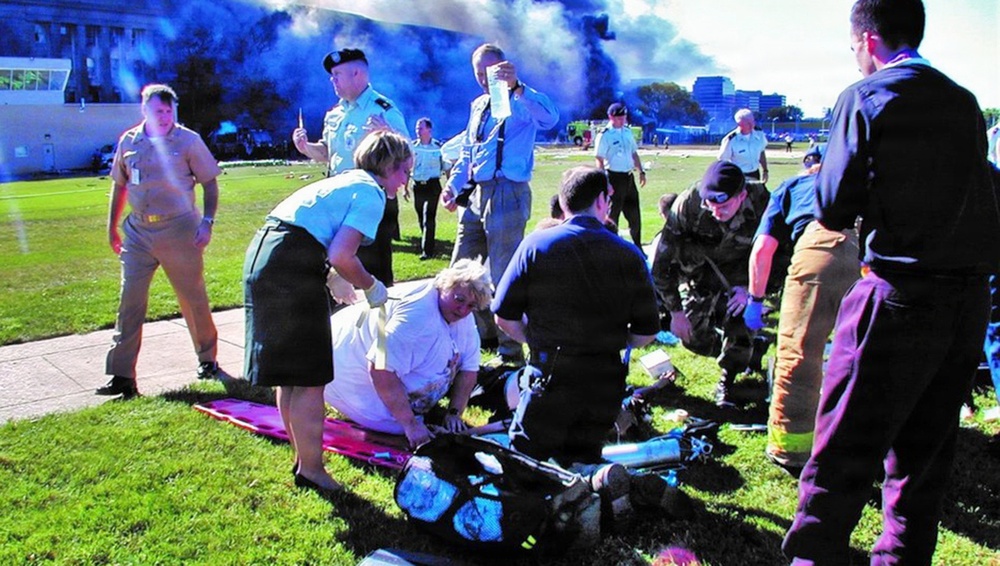
Photo By Andrew Ortuzar | Medical professionals treat injuries outside the Pentagon in Washington, D.C., on the...... read more read more
At 9:37 a.m. on Sept. 11, 2001, a hijacked airliner struck the western side of the Pentagon. Amid the smoke, fire, and sudden chaos, brave military medical professionals at the DiLorenzo TRICARE Heath Clinic, now known as the DiLorenzo Pentagon Health Clinic, rushed straight into the danger zone: One making the arduous journey to the Pentagon, and two military nurses organizing the clinic's staff and gathering supplies, deploying medical teams, and establishing triage centers and makeshift emergency rooms inside and outside the building. Across the country, a military doctor refused to stand aside when the country was under attack — answering the call to help at ground zero in New York City.
The military medical heroes recalled the moment they realized the planes had hit.
“It was instantaneous,” said retired Army Maj. Lorie A. Brown, chief nurse of the clinic on the day of the attacks, “You saw hundreds of people running, screaming, and then also flowing into the clinic. You just knew what happened.”
Retired Air Force Maj. Bridget Larew, the clinic’s chief of primary care,took charge of medical triage and treatment at the scene.
Larew was “in our lobby, which has glass doors, looking into the hallway of the Pentagon, and we started seeing people coming out of the building,” and within minutes the clinic staff determined a mass-casualty event was emerging.
A clinic turns into an emergency room
Larew and Brown realized their commander, retired Army Col. (Dr.) James Geiling, director of the clinic, may be unable to reach them. “We started sending staff outside to set up a triage area outside of our door.”
As Larew and other providers began treating patients, Brown activated the clinic’s mass-casualty plan. Calls for help came in over the radio from locations throughout the Pentagon, and Brown dispatched teams consisting of a physician, nurse, and two medics, utilizing the clinic as a center of operations.
The clinic’s capabilities were quickly stretched to its limits. “We didn’t have a whole lot of supplies,” Larew said. She emptied the staff’s personal backpacks to create mobile medical kits. “I made an IV backpack, an oxygen backpack, and a bandage backpack. I put these three people together and said, ‘You’re a team.’”
“Because I was a nurse practitioner, I decided to be the provider,” Larew said. She began treating patients as they emerged in the Pentagon’s center courtyard, instructing medics to wheel supply-filled gurneys into position, designating areas for “immediate, nonurgent, and pending death,” she said.
During the first 30 minutes, the expectation of a second plane crash began to permeate the scene while clinic personnel treated patients in the center courtyard and inside the clinic.
“We had to evacuate,” Brown said. “We got the radio call saying, ‘You’ve got to evacuate, evacuate, evacuate.’ So, we told everyone, ‘Grab everything you’ve got, grab your patients, and we’re going. Grab what you can and run.’”
The situation quickly demanded improvisation. Larew and her center courtyard team “loaded up a litter full of supplies. We put IV solutions, oxygen, and everything else onto a gurney and rolled it outside,” and in doing so, established triage sites in areas surrounding the building.
When a senior U.S. Air Force officer requested medical support to re-enter the smoke-filled building, Larew sent those improvised expeditionary teams in with him to search for survivors.
Brown’s team could not access the ambulances operating near the crash site and had only the supplies they carried from the clinic. Some of the patients required hospital care.
“We had patients, some intubated, on that lawn,” Brown said. “We only had so much oxygen.”
With communications limited and no ambulances immediately available, Brown improvised a patient-evacuation plan, saying, from the top of a car, “Whoever’s got a van, an SUV, a truck we’re going to put these patients in and make our way, if not to the nearest hospital, at least to the far side where we know there are ambulances.”
Brown then went back inside the ongoing fires at the Pentagon with several members of her staff to reestablish treatment in the center courtyard and look for additional survivors.
“I said I was going back in,” Brown recalled. “I’m going back in to see if we can find some more patients.”
Larew was quickly coordinating medevac for those wounded. “I just looked at the crowd and said, ‘Does anybody have a car in this parking lot? Does anybody have their keys to the car?’” she recalled. Staff loaded patients into civilian vehicles, sending them to local hospitals with doctors riding alongside them.
Larew said these moments felt like they were happening in slow motion, she said. “America was under attack. I felt like I was above me looking down, watching me do things: She’s starting the IV, she’s doing this, doing that, checking off in my brain that I was doing the right things.”
“I never thought the war would come to me,” Larew recalled. “But I stood up there and did what I thought I needed to do.”
That same morning, in Albuquerque, New Mexico, U.S. Public Health Service Lt. Cmdr. (Dr.) Susan Lippold was attending Office of Foreign Disaster Assistance training, when the second plane hit the World Trade Center in New York City. “When I exited the elevator, the TV was showing the second tower falling.” She soon learned that her best friend’s husband was at the Pentagon when it was attacked and no one had been able to reach him.
The 1994 graduate of Uniformed Services University immediately knew her military medical education and disaster response training could help. She didn’t think twice: Lippold immediately volunteered to deploy to ground zero in New York.
Preparation and coordination
These military medical personnel had a resource at the ready — combat medical training.
Leading up to Sept. 11, the DiLorenzo clinic operated as a bustling, tri-service health facility serving roughly 23,000 personnel working daily inside the Pentagon. With a dedicated staff of 200 military and civilian medical professionals, the clinic managed healthcare for the local military population.
“At the time, we took care of 20% of the active duty population in the National Capital Region,” said Geiling. “We took care of DOW folks, and being close to the flagpole, we had the opportunity to help senior leaders.”
To support this high-profile and high-volume demand, the clinic functioned like a multispecialty community health center.
“We had nurse practitioners, general medical officers and board-certified family medicine people,” Geiling recalled. “I had a cardiologist, occupational medicine providers, preventive medicine providers. We had a fitness center with fitness people. We did minor procedures there.”
When Geiling took command of the clinic, he brought an awareness of global operational vulnerabilities. While at the U.S. Army War College, prior to taking command of the clinic, he studied the medical responses to global incidences such as the 1995 Oklahoma City bombing and the 1998 U.S. embassy bombing in Kenya.
“There’s a lot of data in disasters,” he said, “How many casualties are there? What do the casualties look like? What do their injuries look like? What’s the response? Who comes? Who’s in charge? Command and control — all those things.”
Knowing emergency response at the Pentagon would depend on coordination with Virginia’s fire and rescue services, Geiling directed the clinic to rehearse emergency scenarios in May 2001.
Clinic staff worked with Arlington Fire and Emergency Medical Services to develop a tabletop exercise, using an aircraft accident near the Pentagon as the scenario. “That tabletop exercise was really a culmination of months of work,” Brown said. “We learned so much.”
“As a consequence, we got the blue vests,” Geiling said, “those are in all the pictures from that day. The blue vests were to identify who’s a medic and who’s not. The blue vests were there because we worked with Arlington Fire and Emergency Medical Services to get ready.”
The exercise also revealed communications gaps. Brown said radios did not always connect, as parts of the building created dead zones. The team mapped those areas and worked to improve coverage before the attack.
“Knowledge, communication, evacuation, more patients — whatever it was, the radios were critical,” Brown said.
A leader rejoins his team
At the time of the plane’s impact at the Pentagon, Geiling was on assignment in the intensive care unit at Walter Reed National Military Medical Center in Bethesda, Maryland, then called Walter Reed Army Medical Center in Washington, D.C. With limited information, he frantically tried to reach someone on the scene. He had cared for burn casualties arriving to the ICU at Walter Reed Army Medical Center not long after impact, “there were ambulances from everywhere, but the way most people evacuated the scene was in a personal vehicle.”
Geiling jumped into his car and raced toward the site. He encountered countless barricades and gridlocked traffic, anxiously navigating the labyrinth of road closures and police until arriving at the closest point he could — an uncrossable bridge. As the chaotic noise of ambulances and firetrucks echoed off the Pentagon, Geiling was “standing by the Jefferson Memorial looking at the building burning, thinking, ‘I need to be there.’”
Unable to cross the river at the Jefferson Memorial, he returned to his home in Rockville, Maryland, changed into his battle dress uniform, and packed a “go-kit,” knowing he may be gone for days. He finally reached the Pentagon two hours after impact.
Upon arriving, Geiling’s immediate priorities were the safety of his staff and assessing the medical mission. “How are my people doing? Is anybody injured? Is everybody getting taken care of?” he recalled asking.
He was grateful he had recently directed the staff to rehearse the response to a hypothetical aircraft collision into the building: “The good news is we had a great team. They took the ball and ran with it, in part, because we had rehearsed it in the past.”
The clinic successfully integrated with Arlington Fire and Emergency Medical Services, collaborating on the complicated response situation requiring constant problem-solving.
“We didn’t realize the number of burns. This was a fire,” Geiling said. “And how do you suddenly take a clinic and move all your stuff out to the center courtyard? How do you move oxygen around? They had to get innovative.”
Military preparedness in action
Geiling stressed the importance of training service members to lead when needed. He reflected on his team’s readiness in the face of a large-scale medical emergency. “It’s one thing to be a great leader from the front, but you must instill the confidence, training, preparation, and intestinal fortitude in your team to be able to run with it when you’re not there.”
Brown attributed the team’s actions to an intersection of preparation and a warrior spirit “It was just instinct. I think the training made such a big difference,” she said, “Col. Geiling’s focus — setting me up to hone my mass-casualty skills, go to courses, work with Arlington Fire and Emergency Medical Services, and do the tabletops — made the response instantaneous.”
A long night, and the mission ahead
Geiling said within about 90 minutes of impact, most immediate treatment had been rendered. “There was the isolated person who was rescued from the rubble, but for the most part, within a couple hours people were gone.”
The mission then evolved into support for the first responders on site and recovery efforts. Second and third-order medical issues emerged such as aerosolized asbestos, immunization needs, and smoke inhalation, as well as preparing to resume day-to-day operations. By 2:30 a.m., 16 hours after impact, staff and emergency responders at the Pentagon were exhausted.
“It’s the middle of the night, with search and rescue still ongoing. The building was still burning. It stank. We were all tired. We were all hot and sweaty. Some people were trying to sleep,” Geiling recalled.
He described an eerie silence amidst the hum of generators and flood lights, and he knew the operation would be long-term and difficult. He recalled looking up to see a firefighter attaching something to a piece of equipment and “suddenly this flag goes up, and it was just silent. It was just silent.”
Geiling saw the raising of the American flag as a sign of medical preparedness and perseverance on a day that would live in infamy.
“The sun was coming up, and the flag is right there, fire hoses going,” he said. “We’re still here. Bring it on. We got it.”
Joining the rescue later in New York
When Lippold arrived in New York about 10 days after the attacks, it was eerily quiet.
“I took a plane and I think there were one or two people onboard,” she recalled. “Arriving in New York, you could still see the buildings smoking at the World Trade Center — it was apocalyptic.”
“There was dust everywhere, still settling, along with burned-out buildings and abandoned cars,” she said.
At ground zero, she relieved another volunteer who oriented her to the site and the incoming response teams. Her role was to orient Disaster Medical Assistance Teams, or DMATs, to the site and oversee the medical care provided to first responders.
“I remember we saw about 500 people a day, predominantly rescue workers, across five DMAT teams,” she said. “There were a lot of cuts, dehydration, and exhaustion — small traumas, muscle and skin issues. Cuts and exhaustion were the main things.”
The teams also watched for more serious mental health concerns among exhausted responders, many of whom had lost colleagues, friends, or family members in the attacks.
“We had some people who were suicidal. We had colleagues tell us, ‘They’re not doing well,’ and we had to intervene. We connected them directly with mental health professionals.”
Lippold was also cognizant of her own mental health during this time — on top of the search and rescue efforts and the fear among the responders as they raced against time to find survivors, she was thinking of her best friend’s husband who had died on Sept. 11, along with thousands of others.
Lippold knew she needed to utilize her Military Health System mental health team: “Knowing a little bit about PTSD from studying at USU, I demanded counseling when I left. I wanted to talk to someone before I left, so I did.”
For Lippold, the response at ground zero in New York reinforced the value of medical professionals arriving with a defined mission, structure, and ability to work within an established chain of command.
“The military has done phenomenal response work,” she said. “They are organized. With their know-how and being ready to go — they do it really well.”
“It’s not every man or woman for themself,” she said. “The military has a mission.”
| Date Taken: | 09.09.2026 |
| Date Posted: | 09.10.2026 09:46 |
| Story ID: | 574194 |
| Location: | US |
| Web Views: | 7 |
| Downloads: | 0 |

This work, Military medical heroes respond on 9/11, by Andrew Ortuzar, identified by DVIDS, must comply with the restrictions shown on https://www.dvidshub.net/about/copyright.


No keywords found.





