
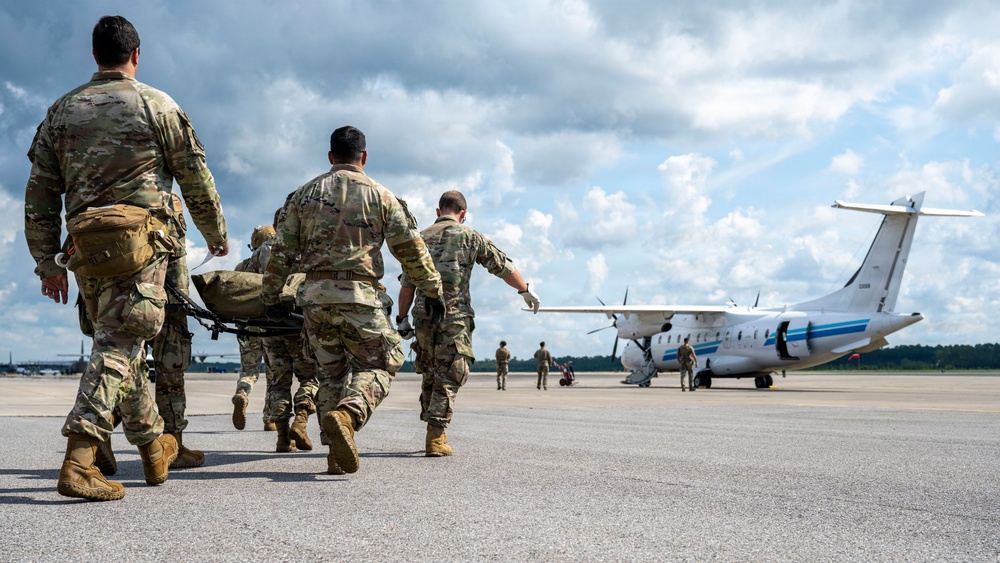
Photo By Senior Airman Isabel Tanner | U.S. Air Force medics assigned to the 31st Air Task Force perform a litter carry to a...... read more read more
HURLBURT FIELD, Fla. — As medics transported simulated casualties onboard a C-146A Wolfhound over Hurlburt Field on Aug. 5, another critical part of the mission moved with them: information. Medical teams tracked casualties, synchronized personnel accountability, and communicated movement requirements through command-and-control channels across air, ground and water, integrating functions often trained separately.
The flight was part of five days of distributed patient movement training for medics assigned to the 31st Combat Air Base Squadron from Hurlburt Field and Nellis Air Force Base, Aug. 3-7. Together, they synchronized casualty care, accountability, communications, and movement under operational conditions.
“Patient movement is ultimately about preserving combat power. We must be able to rapidly identify who can return to duty, who may return with additional care, and who requires movement to a higher level of care so they can return to the fight down the road,” said Col. Brad Dvorak, commander of the 31st Air Task Force, the unit of action to which the 31st CABS is assigned. “Getting those decisions right helps commanders understand their capability and capacity to regenerate the force to continue the mission at any time.”
Training progressed from casualty evacuation and aeromedical evacuation fundamentals to hands-on multimodal patient movement. An operational vignette and Air Force Special Operations School cultural-awareness brief tailored the team’s training to specific scenarios.
With support from the 492nd Special Operations Wing, Airmen practiced patient loading and securing on a MC-130 training platform. They were then familiarized with the C-146A at Duke Field and transitioned to airborne patient movement over Hurlburt. The experience allowed for operation under pressure on unfamiliar airframes, boosting the ability to facilitate solutions despite compressed timelines and unknown variables.
But moving the patient was only part of the problem.
During a culminating mass-casualty scenario, teams triaged simulated wounded, moved them to a casualty collection point, initiated treatment, then determined onward-movement requirements and transmitted evacuation requests through an expeditionary command-and-control architecture.
Medical teams simultaneously synchronized casualty disposition in coordination with the 31st ATF’s Manpower, Personnel and Services directorate, Mortuary Affairs, and Personnel Support for Contingency Operations. That synchronization turned casualty data into operational information commanders could use to assess remaining capability, anticipate losses, and begin regenerating the force.
Medical teams passed casualty and movement requirements through an intermediate command post to the 31st ATF wing operations center using a primary, alternate, contingency and emergency communications plan.
“Onloading and offloading patients onto aircraft, ambulances or boats is only one part of the movement process. The greater challenge is determining who needs to move, where they need to go and what transportation is available, while keeping commanders informed as conditions change,” said the 31st Air Task Force’s surgeon general. “We wanted Airmen to practice patient movement as an integrated system rather than a series of isolated tasks.”
On the final day, the problem moved to the water. Air Commandos with the 1st Special Operations Wing introduced maritime operations aboard two special tactics multi-purpose vessels and a flat-bottom skiff before teams moved casualties using beach and harbor approaches.
By week’s end, Airmen had moved casualties using standard ambulances, non-standard tactical vehicles, an MC-130 training platform, a C-146A in flight, and maritime platforms. Rather than assume dedicated medical evacuation capabilities, teams learned to integrate available transportation into the patient-movement system while maintaining casualty visibility, information flow, and the commander’s personnel picture.
The Tactical Operations Medical Skills lab within the Air Force Special Operations Command Surgeon General’s office brought expertise from across the command to execute the training, preparing conventional medical Airmen for resource-constrained, high-threat environments.
“This training pushed us to expand beyond our usual medic role,” said a U.S. Air Force medic from the 99th Medical Group assigned to the 31st CABS. “While accounting for casualties, performing field care, and moving patients with limited resources was a real challenge, learning from people we trust made adapting simple and reinforced how every action ties into the larger mission.”
The training reflects a broader challenge facing Air Force medicine in large-scale combat operations. Col. Valerie Sams, an Air Force trauma surgeon and director of the Center for Science, Technology and Advanced Research in Space (Cincinnati), https://www.wardocspodcast.com/post/trauma-czar-col-valerie-sams-md-on-skill-sustainment-clinical-readiness-and-optimizing-the-milita the importance of understanding “how we all fit into this big picture to support the warfighter.” She described future patient movement as occurring in “a not so perfect world,” where distance, constrained evacuation and multiple transportation platforms will require medical teams to move beyond traditional methods.
Leaders from the 96th Medical Group at Eglin Air Force Base, including its interim chief nurse and Aerospace Medical Service functional manager, observed the training, highlighting the potential to scale AFSOC-developed operational medical training to conventional Air Force medics.
The event built on a growing medical readiness training portfolio coming out of AFSOC, including “Touch the Mission” for mission familiarization, home station contested-operations training, the 31st ATF’s fielding of an air transportable clinic, and the Air Force’s first stateside Joint Trauma System-certified Valkyrie whole-blood training program.
“This training demonstrates what is possible when we combine AFSOC medical expertise with the aircraft, maritime capabilities and operational units already regularly training at Hurlburt,” said Col. Michael Brough, AFSOC Command Surgeon. “Combined with the medical capabilities across the Hurlburt-Eglin area, we have an opportunity to expand this type of operationally integrated training and make it available to medics across the Air Force.”
As the Air Force prepares for operations where evacuation timelines, communication capabilities, and dedicated medical transportation will be uncertain, moving casualties across a distributed battlespace while maintaining medical and personnel visibility can return Airmen to duty, regenerate the force, and preserve combat power.
| Date Taken: | 09.08.2026 |
| Date Posted: | 09.08.2026 19:01 |
| Story ID: | 574129 |
| Location: | US |
| Web Views: | 84 |
| Downloads: | 0 |

This work, Hurlburt, Nellis Airmen integrate multimodal patient movement to regenerate combat power, must comply with the restrictions shown on https://www.dvidshub.net/about/copyright.


No keywords found.





