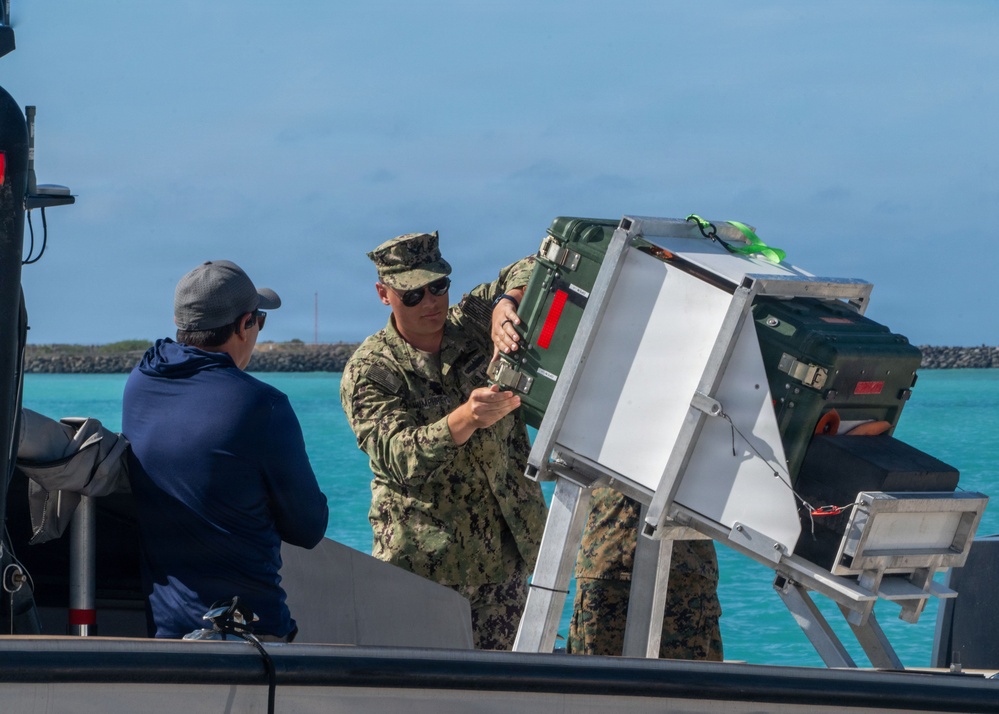
A team of nine NPS students across several departments and programs traveled to RIMPAC 2026 for an invaluable opportunity to take their graduate education and research from the classroom into the operational environment. Supported by nearly a dozen faculty and researchers, the NPS team advanced several student/faculty driven research efforts, working directly alongside fleet operators and industry partners during the world's largest international maritime exercise.
Led primarily by NPS’ Consortium for Advanced Manufacturing Research and Education (CAMRE), the effort allowed students to test research against real operational challenges while collaborating with military operators and industry partners. The experience helps shape future research, and ensures students are directly supporting fleet needs.
U.S. Navy Ensign William Schleper, a student in the NPS Department of Mechanical and Aerospace Engineering researching advanced manufacturing alloys, served as the officer in charge of CAMRE’s additive manufacturing team embarked aboard the aircraft carrier USS Theodore Roosevelt (CVN 71) and MV Asterix (A147). In addition to coordinating personnel, equipment, and shipboard integration efforts, he operated a Metal Powder Works M-175 Direct Powder system capable of producing metal powder from bar stock while at sea. The team also demonstrated multiple additive manufacturing technologies as part of a broader effort to evaluate a complete shipboard manufacturing workflow.
Moving that work from a controlled laboratory to an operational ship presented challenges that are difficult to reproduce in an academic environment.
“In a laboratory, we generally have stable power, controlled environmental conditions, readily available tools, and relatively unrestricted access to equipment,” Schleper said. “At sea, those assumptions no longer hold.”
Ship movement, heat, equipment placement, power requirements, safety restrictions, communications, logistics and the ship’s operational schedule all affected how the team conducted its work. As team leader, Schleper also had to balance the technical objectives of the research with the practical requirements of working aboard an operational vessel.
“That experience gave me a much better understanding of the difference between demonstrating that a technology works in a laboratory, and demonstrating that it is actually useful and sustainable for the fleet,” Schleper said.
The experience also shaped how he views his own research.
“Instead of viewing the printer as an isolated piece of equipment, I now think much more about the complete manufacturing system: raw material, feedstock production, printing, post-processing, inspection, and ultimately getting a usable component into the hands of the operator,” Schleper said.
While Schleper was focused on shipboard manufacturing, U.S. Navy Lt. Evan Humphreys, also an NPS mechanical engineering student, supported another part of CAMRE’s RIMPAC effort involving autonomous logistics and unmanned surface vessel operations.
Humphreys coordinated operations between CAMRE and USS Essex (LHD 2), Theodore Roosevelt and Asterix, while also working with industry partners Splash and HavocAI. He coordinated the movement of components between ships, shore locations, and unmanned surface vessels, as well as supporting spectrum coordination and access approvals required for operations in and around the Hawaiian Islands.
“I was able to apply the knowledge I gained in the classroom to inform decisions directly in support of USV operations,” Humphreys said. “The conversations were with Navy shore, ship, and industry stakeholders, requiring a tailored approach for each.”
During the exercise, CAMRE and its partners launched and recovered unmanned surface vessels from shore and ships while using the vessels to transport components between operating locations. Humphreys supported operations involving Splash's Typhoon and HavocAI's Kaikoa systems, including an evolution that brought the Typhoon aboard Essex through the ship's stern gate.
The operations revealed practical considerations involving communications reliability, cargo stowage, and vessel control during launch and recovery evolutions.
“The operations showed me that technology has progressed to the point where uncrewed systems can be relied upon to transit independently and arrive at a designated rendezvous point on time,” Humphreys said.
Working directly with industry representatives also gave Humphreys a firsthand look at how commercial developers help the Armed Forces adapt emerging technologies to operational requirements.
Although Schleper and Humphreys supported different parts of CAMRE’s work, their experiences reached the same point — having NPS students advance their research in the fleet allows them to better apply what they have learned, work through operational challenges firsthand, and carry those lessons back to campus, and ultimately, back to the fleet and force.
“The benefit of having NPS students participating is that we have the technical training to ask appropriate questions and think critically about the responses provided in order to provide accurate assessments of the operations at hand,” Humphreys stressed.
Schleper and Humphreys’ participation was part of a broader NPS presence at RIMPAC that included eight researchers and faculty members from multiple academic departments, with several students representing multiple military services, curricula and research domains. Together, they supported a broad portfolio of CAMRE experimentation working with military, government, academic and industry partners throughout the exercise.
Their experience reflects a unique strength of NPS: operationally experienced officers confronting real-world challenges, working alongside faculty and industry partners to develop solutions, and returning to the force with deeper understanding and practical insight. By connecting graduate education and research directly to fleet operations, NPS helps ensure its students are prepared not only to study complex defense challenges, but also to help solve them.
NPS, located in Monterey, California, provides warfighting-focused graduate education, including classified studies and interdisciplinary research, to advance the operational effectiveness, technological leadership and warfighting advantage of the naval service. Established in 1909, NPS offers master’s, doctoral and distance-learning certificate programs to U.S. Department of War military and civilian students, as well as to international partners, to develop warfighters andleaders who can think critically, solve complex operational problems and deliver mission-ready solutions through advanced education and research.
| Date Taken: |
09.08.2026 |
| Date Posted: |
09.08.2026 14:28 |
| Story ID: |
574100 |
| Location: |
MONTEREY, CALIFORNIA, US |
| Web Views: |
28 |
| Downloads: |
2 |
PUBLIC DOMAIN

This work, NPS Students Apply Graduate Research to Real-World Fleet Challenges During RIMPAC 2026, by SN Katherine Eldridge, identified by DVIDS, must comply with the restrictions shown on https://www.dvidshub.net/about/copyright.