
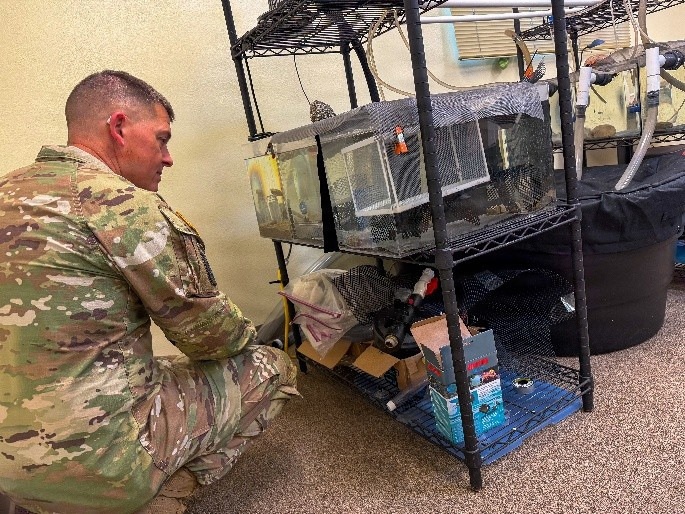
Photo By Augusta Vargas | Fort Hunter Liggett Garrison Commander Col. Jason McKenzie observes fish used in a...... read more read more
 Subscribe
FORT HUNTER LIGGETT, JOLON, CALIF. − With more than 160,000 acres of valleys, mountains, rivers, and open terrain, Fort Hunter Liggett (FHL) gives Soldiers the space they need to train for real-world operations. But managing that much land takes year-round work to keep training areas mission-ready while caring for the natural resources that share the landscape.
FHL’s Department of Public Works Environmental team helps manage those lands, with Environmental Biologist Jackie Hancock and her team leading the effort. One of its latest projects is a Western Ridged Mussel host-fish study. The species is currently under review for federal listing under the Endangered Species Act.
Freshwater mussels were already known to inhabit FHL waterways, but exactly which species called those waters home was uncertain. The Environmental team collected samples and sent them for analysis, confirming one as a Western Ridged Mussel.
“It was a complete surprise to discover it here because the nearest known populations are in Northern California,” Hancock said.
From the outside, the facility where FHL environmental staff worked looked much like the buildings surrounding it. Inside, however, it could easily be mistaken for the fish department of a pet store.
“This building serves as our environmental lab space and will also become our archaeological repository,” Hancock said.
Known as the “livers of the river,” freshwater mussels act as natural filters, helping clean the waterways they inhabit. An important part of their life cycle is that, to reproduce successfully, most freshwater mussels need a host, usually a fish.
The research process begins by collecting local fish and bringing them into the controlled environment of the lab. The fish are then exposed to mussel larvae, called glochidia, to see whether they attach and develop successfully. Hancock and her team track which fish species successfully support the larvae, providing important information for managing and conserving the Western Ridged Mussel population.
Keeping the fish and mussels healthy in a controlled environment requires specialized equipment. Hancock said her team received help from the Monterey Bay Aquarium after visiting the facility and learning more about its behind-the-scenes aquarium systems.
The aquarium donated equipment to FHL that could be repurposed for the study, while the Environmental team supplemented the setup with additional equipment as needed.
According to Hancock, a previous fire followed by heavy rainfall caused heavy sedimentation in portions of the San Antonio River. This event wiped out mussels in that area, reinforcing the importance of understanding where the Western Ridged Mussel can survive and if they can successfully live elsewhere.
Finding an alternative habitat is only part of the equation. The mussels also need the right fish to complete their lifecycle. FHL’s current host-fish study is helping Hancock and her team determine which local fish can support the mussel larvae and ultimately where the species may be able to survive.
“Our Environmental team’s work is essential to sustaining the lands that enable readiness,” said FHL Garrison Commander Col. Jason McKenzie. “Their efforts help preserve our training capabilities and ensure Fort Hunter Liggett remains postured to prepare Soldiers for the future fight.”
Studies like the Western Rigged Mussel project are just one part of FHL’s year-round effort to responsibly manage its natural resources. By identifying potential challenges early and addressing them proactively, FHL can protect sensitive species while preserving vital training lands Soldiers need to build readiness for the fight.
| Date Taken: | 08.27.2026 |
| Date Posted: | 08.27.2026 19:04 |
| Story ID: | 573412 |
| Location: | FORT HUNTER LIGGETT, CALIFORNIA, US |
| Web Views: | 28 |
| Downloads: | 0 |

This work, Fort Hunter Liggett—Sustaining the Land That Powers Readiness, by Augusta Vargas, identified by DVIDS, must comply with the restrictions shown on https://www.dvidshub.net/about/copyright.


No keywords found.




