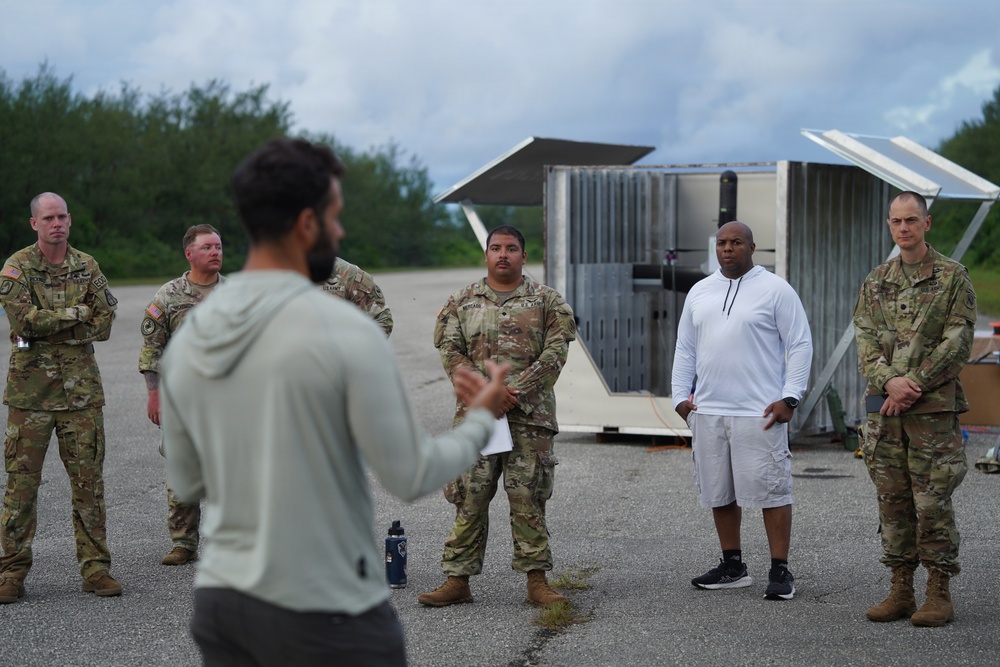
Photo By Sgt. 1st Class Ondirae Abdullah-Robinson | Carlos Murphy, an industry partner for the Coriolis and Cinder unmanned aircraft systems, gives a safety briefing to U.S. Army Soldiers and guests during a multi-day Special User Demonstration at Orote Airfield on Naval Station Guam, June 24, 2026, prior to a Coriolis unmanned aircraft system launch for Valiant Shield 2026. The technical coordination sequence was utilized by the 3d Multi-Domain Effects Battalion, 3d Multi-Domain Task Force, to safely test current and new technologies while mitigating operational risks during forward theater experimentation.
This safety briefing was conducted in support of Valiant Shield 2026. Exercises like Valiant Shield allow Pacific Command Joint Forces the opportunity to integrate forces from all branches of service and with our allies to conduct precise, lethal, and overwhelming multi-axis, multi-domain effects that demonstrate the strength and versatility of the joint force and our commitment to a free and open Indo-Pacific. see less
| View Image Page
PMTEC Bridges the Gap Between Tech Lab and Tactical Edge
NAVAL BASE GUAM, Guam - Moving emerging military technology from a pristine engineering laboratory to operational field readiness remains a persistent challenge in defense acquisition. A specialized theater training capability on Guam is providing the sandbox needed to bypass traditional development delays by matching defense vendors directly with tactical units.
From June 22 to June 25, 2026, the Pacific Multi-Domain Training and Experimentation Capability (PMTEC) experimentation environment enabled U.S. Soldiers assigned to the 3d Multi-Domain Effects Battalion (3d MDEB), 3d Multi-Domain Task Force, headquartered at Ft. Shafter, Hawaii, to employ a wide suite of emerging systems during Exercise Valiant Shield 2026. As a dedicated component of this collaborative framework, the unit executed a Special User Demonstration focused on the Dragoon Cinder and Coriolis platforms, provided by the Product Manager Launch Effects-Long Range.
"Experiments like this Army high-altitude balloon launch are exactly why PMTEC exists—to turn bold ideas into combat-credible capability," said Dr. Andre Stridiron, the program manager for PMTEC. "Partnering with U.S. Army Pacific on this high-altitude balloon experiment advances all-domain capabilities and strengthens integrated deterrence across the region".
By utilizing the unique environment of the Marianas, PMTEC forces defense technologies out of simulated test loops and subjects them to real-world operational stress. During the broader experimentation, heavy Guam heat and humidity triggered system errors on the flight line, forcing immediate mechanical adjustments and rapid updates to workflows.
Commercial developers noted that this immediate operational friction accelerates system refinement far faster than closed-loop testing.
"In a lab environment or even at a private test range, everything is controlled," said Zach Williams, the head of strategy at Icarus, the manufacturer of the Apollo R glider platform. "At an exercise, you're constrained by space and time. It drives mission planning, and it drives the vehicle to operate at its margins—at its absolute limit in order to adhere to the time and range constraints of the environment".
This direct operational feedback loop gives tactical line units a unique mechanism to shape future procurement priorities. Soldiers on the ground trouble-shot environmental and hardware limitations in real time, delivering localized assessments straight to engineering leads.
"Putting these advanced platforms directly into the hands of our Soldiers on the ground is the core of the Army's 'Transform in Contact' initiative," said Capt. Samantha Mohr, the commander of the Extended Range Sensing and Effects Company. "Our satellite communication systems operator-maintainers and crew members are building high-level tactical proficiency under realistic Pacific conditions. Testing these capabilities forward on Guam allows us to turn raw sensor data into an immediate common operating picture, ensuring our joint force leaders can make precise decisions at the speed of relevance".
This bottom-up feedback cycle bridges the traditional gap between conceptual performance and tactical utility. Junior leaders used the field environment to stress-test platform versatility, mapping out realistic parameters for deployment in austere island configurations.
"The integration we are doing out here bridges the gap between what a system can do on paper and how it actually functions in a dynamic environment," said 1st Lt. Alexis Madrigal, a military utility assessor with the U.S. Army Space and Missile Defense Command's concepts and workings branches. "Our Soldiers are troubleshooting on the fly, coordinating directly with tech engineers, and finding out what works when you are operating out of an austere theater like Guam. It gives our teams real ownership over the future of our force's capabilities".
For the participating defense contractors involved in the Special User Demonstration and broader PMTEC flights, the direct flight-line access to operational units provided critical data on how to refine software and hardware integration for the Pacific theater.
"Working directly with the 3d Multi-Domain Effects Battalion allowed us to see exactly how our vertical-launch capabilities integrate with a tactical unit in an austere environment," said Jason Douglas, the vice president of defense programs at Dragoon, the manufacturer of the Cinder and Coriolis platforms. "The feedback we received on the flight line is critical for refining autonomous operations in confined littoral positions".
Kevin Lord, an advanced electronic warfare strategy and requirements lead for L3Harris Technologies, the manufacturer of the Red Wolf launched effect platform, echoed the sentiment. "The direct feedback from the 3d MDEB team was invaluable in helping us understand their requirements and capability gaps, ensuring we are developing, designing, and deploying solutions that truly meet their needs," Lord noted.
As Exercise Valiant Shield 2026 continues through July 1, 2026, the operational sandboxes provided by PMTEC are proving vital to defense modernization. By exposing experimental systems to harsh regional realities alongside frontline troops, the theater testbed ensures the next generation of multi-domain tools is built to survive the reality of the tactical edge.