CRREL team tests ship-to-shore methods and technologies in Greenland
Courtesy Photo |
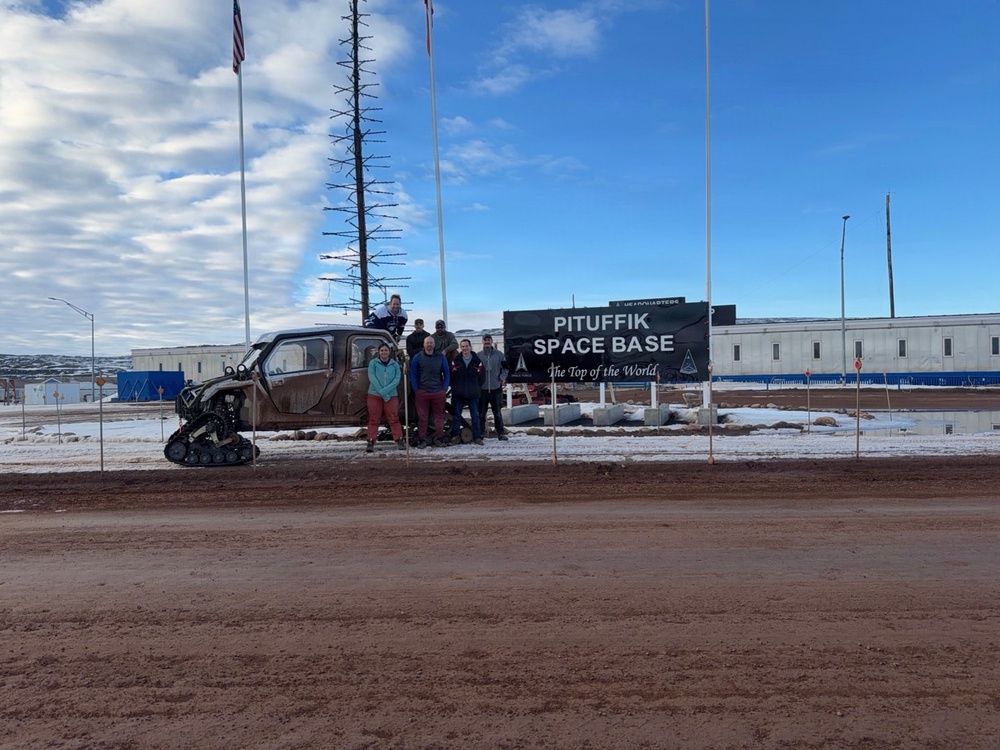
Participants in a Ship-to-Shore test event at Pituffik Space Base in Greenland.......read moreread more
Courtesy Photo | Participants in a Ship-to-Shore test event at Pituffik Space Base in Greenland. Organized by the International Cooperative Engagement Program for Polar Research (ICE-PPR) and Office of Naval Research (ONR), the event gave CRREL researchers the opportunity to test three specific technologies: passive sensing capabilities for determining ice thickness, path planning and validation for Unmanned Ground Vehicles (UGVs) and test Arctic camouflaging. see less
| View Image Page
CRREL team tests ship-to-shore methods and technologies in Greenland
Ship-to-shore operations – the means of moving people, goods and materiel from sea to land – present military planners with a number of complex challenges.
But performing these operations in the Arctic? The difficulty level ramps up considerably, with icebergs, unstable sea ice, seasonal thawing, ice blocking the shore and ships getting trapped in ice— just a few of the many issues that can arise when the temperature plummets.
To solve those issues, a team of researchers at the U.S. Army Engineer Research and Development Center’s Cold Regions Research and Engineering Laboratory (CRREL) in Hanover, New Hampshire, recently conducted a Ship-to-Shore test event at Pituffik Space Base in Greenland.
Organized by the International Cooperative Engagement Program for Polar Research (ICE-PPR) and Office of Naval Research (ONR), the event gave CRREL researchers the opportunity to test three specific technologies: passive sensing capabilities for determining ice thickness, path planning and validation for Unmanned Ground Vehicles (UGVs) and test Arctic camouflaging.
“Nothing substitutes boots on the ground and hands-on field work to understand the day-to-day challenges and how they impact military operations in the Arctic and other cold regions,” said Mike Parker, a CRREL research mechanical engineer and cold regions vehicle mobility lead.
The team used a microwave sensor currently used in agriculture – and thus more widely available and significantly less expensive than remote sensing systems currently used by the military – to successfully measure snow and ice thickness across a 3 kilometer transect of Northstar Bay. It flew a high-resolution LiDAR that aided THeMIS (Tracked Hybrid Modular Infantry System) UGV path planning and validated current winter path planning algorithms. Lastly, the team tested the performance of several different colors and patterns of Arctic camouflage.
“We learned a lot about the site conditions, logistics, and safety aspects of going onto the ice,” said Dr. Tom Douglas, a research chemist and senior scientific technical manager of CRREL’s Alaska Research Office in Fairbanks, Alaska. “We also learned that our UAS and vehicle platforms operate really well in challenging conditions.”
While the team was very happy with the test results, it experienced one of the truisms of life in the Arctic: not everything goes as planned.
“This gets compounded when you’re in a foreign country and in an extremely remote location where ‘overnight’ shipments take a week or two to get to you,” said Parker, who pointed to the logistics of getting all of the team’s equipment to and from Pituffik as one challenge they faced. “If you don’t bring everything you need then be prepared to improvise to complete the mission.”
The data gathered and lessons learned by the team will inform future research, as well as operational exercises.
“It is likely that the next major ship to shore activity in the Arctic will occur in a remote and austere location with alimited time horizon for planning,” said Douglas. “We want to reduce uncertainties to save money and lower risk.”
Besides the technical objectives achieved, the event also helped the research team build relationships with Pituffik leaders that not only helped during the event, but that will likely come in handy in the future.
“Life moves at a different pace in the Arctic, and sometimes it is best to slow down and develop the relationships that will ultimately increase productivity,” said Parker.
The research team did have one lament though: the approximately -10-degree Celsius temperatures (roughly 14
degrees Fahrenheit) weren’t quite cold enough for their liking.
“That is considered warm for much of the work we do,” jokingly bemoaned Douglas.

 Subscribe






