
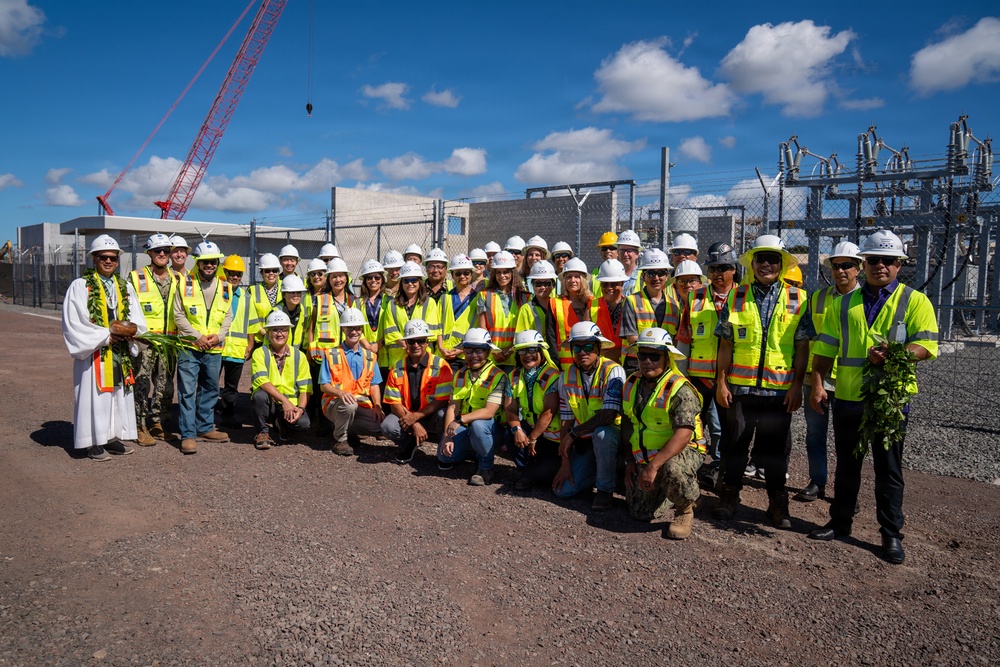
Photo By Jhewel Felipe | Representatives from Hawaiian Electric Company (HECO), Naval Facilities Engineering...... read more read more
JOINT BASE PEARL HARBOR-HICKAM, Hawaii — The path to powering Dry Dock 5 does not begin or end at the waterfront. It extends across Joint Base Pearl Harbor-Hickam (JBPHH) through utility poles and overhead lines, then continues underground through conduits and cables.
Bringing those separate pieces together is part of a Hawaiian Electric Company (HECO) project overseen by Naval Facilities Engineering Systems Command Pacific Public Works (NAVFAC PAC PW) and Officer in Charge of Construction Pearl Harbor Naval Shipyard (OICC PHNSY).
The electrical work supports P-209, the Dry Dock 3 Replacement project constructing Dry Dock 5 at Pearl Harbor Naval Shipyard and Intermediate Maintenance Facility (PHNSY & IMF). OICC PHNSY manages and oversees construction of the dry dock and its supporting infrastructure in coordination with Navy organizations, contractors and other project partners.
Among the most visible components of HECO’s work is the Waimomi Substation, completed in May 2026. Other components stretch through redundant areas on and near the installation, illustrating how work associated with the future dry dock reaches beyond its construction site.
“Hawaiian Electric is proud to work with our federal and military partners on this important project, which will support the Navy’s mission here in Hawaii,” said Jim Alberts, Hawaiian Electric senior vice president and chief operations officer. “Waimomi Substation fulfills an essential need to expand service to the Navy and will help improve energy security and resilience.”
The broader HECO project includes the Makalapa electrical circuit, consisting of utility poles, overhead conductors, underground conduits and cables connecting the Hickam and Waimomi substations. Additional work includes overhead poles and electrical lines near the Makalapa and Nimitz gates, along with cable connections between the Waimomi Substation and electrical infrastructure associated with P-209.
With construction occurring across adjoining sites and through areas used by the JBPHH community, managing the effort requires more than tracking electrical work. OICC PHNSY coordinates schedules, installation access, traffic control and environmental, security and safety requirements with HECO, NAVFAC PAC PW, contractors and other stakeholders.
For Raphael Ramos, an OICC PHNSY construction manager, that means working at the point where two major efforts meet.
Ramos serves as a liaison between HECO and the contractor constructing P-209, helping coordinate activities at neighboring sites while reviewing schedules and monitoring progress. His role allows the teams to identify potential conflicts and address installation requirements as work advances.
“For me, this milestone represents the culmination of tireless quality control, safety compliance and proactive risk mitigation by the entire project team,” Ramos said. “Delivering such complex utility infrastructure safely and on schedule allows us to celebrate a critical achievement, securing the power and operational foundation that will serve as the heartbeat of the entire P-209 project.”
While Ramos helped connect the organizations involved, Jeannette Menor followed the construction in the field.
As an OICC PHNSY engineering technician, Menor provided daily oversight of high-voltage utility construction. She documented progress, reviewed traffic-control measures and monitored the work for compliance with engineering plans and safety requirements. When she identified deficiencies or potential hazards, she worked with contractor quality-control personnel to address them.
Her oversight also followed the Makalapa circuit as construction progressed between the Hickam and Waimomi substations.
“To me, this project was more than just an assignment; it felt like contributing to a living piece of naval history,” Menor said. “Knowing that the new Makalapa circuit and the Waimomi Substation is a redundant power source for the P-209 dry dock connects my daily efforts directly to the future of fleet readiness.”
The project’s reach also brought construction near places where people live, work and travel. Brandon Gibu, a supervisory general engineer with OICC PHNSY, helped coordinate with the organizations and communities affected by activity at the various sites.
Gibu has supported the project since design development, working with OICC PHNSY, NAVFAC PAC PW, HECO and other stakeholders to provide construction oversight and distribute notifications about work affecting surrounding areas.
“A key accomplishment was helping the team beat the critical power need date through seamless coordination across diverse on- and off-base work sites,” Gibu said. “HECO and its subcontractors demonstrated exceptional flexibility to meet our expectations, resulting in execution so successful that Hickam Communities now uses our traffic control and work plans as the standard for other contractors.”
Those efforts came together at the Waimomi Substation on June 12, when HECO hosted a traditional Hawaiian blessing marking its completion. Representatives from HECO, OICC PHNSY, NAVFAC PAC and other project partners gathered to recognize the milestone and the people whose work extended across the installation.
The substation’s name connects the new infrastructure to the history of Pearl Harbor. “Wai” means water, and “momi” means pearl, referring to the small pearls once found in oysters in the area.
Completion of the Waimomi Substation marked progress on one part of HECO’s broader electrical project, but additional work remains. Crews will install utility poles and overhead electrical lines near the Nimitz and Makalapa gates and connect underground cables between the Waimomi Substation and Station Q, an electrical facility constructed as part of P-209.
Dry Dock 5 may be taking shape along the waterfront, but its future operations will depend on supporting systems extending well beyond its walls. Through NAVFAC PAC PW and OICC PHNSY’s oversight and the combined efforts of HECO, contractors and community partners, the electrical infrastructure intended to serve that future mission is taking shape across JBPHH.
| Date Taken: | 08.13.2026 |
| Date Posted: | 08.13.2026 18:44 |
| Story ID: | 572388 |
| Location: | JOINT BASE PEARL HARBOR-HICKAM, HAWAII, US |
| Web Views: | 33 |
| Downloads: | 0 |

This work, Powering Dry Dock 5 (P-209): Partnerships build infrastructure for future operations, by Jhewel Felipe, identified by DVIDS, must comply with the restrictions shown on https://www.dvidshub.net/about/copyright.


No keywords found.





