
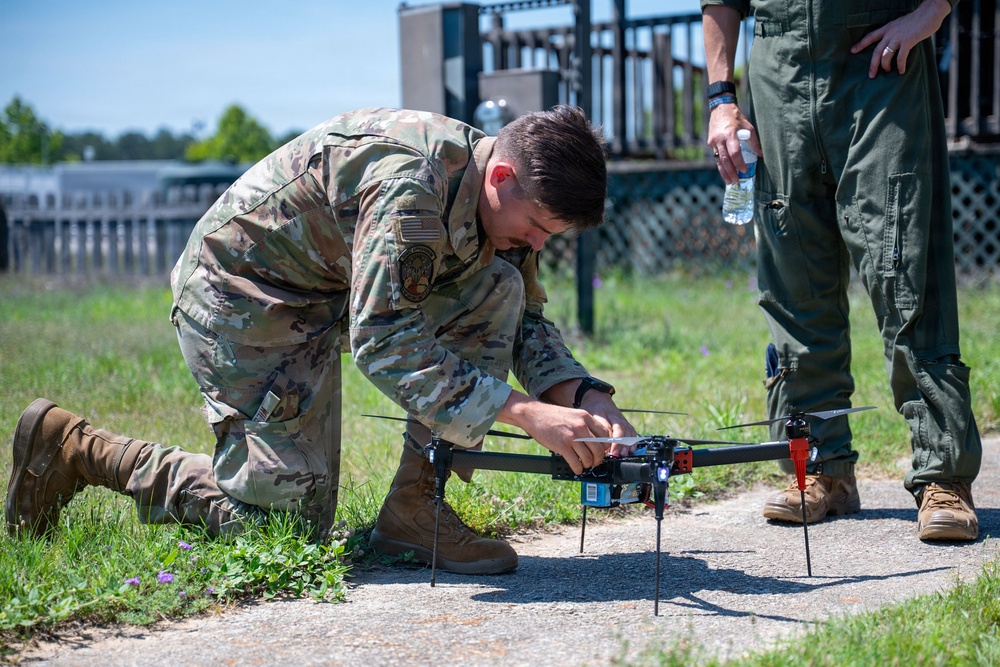
Photo By Airman Will Sherwood | U.S. Air Force Senior Airman Luke Wilson, assigned to the 9th Air Force (Air Forces...... read more read more
 Subscribe
JOINT BASE LANGLEY-EUSTIS, VA —Through the Point Defense Task Force, Air Combat Command is conducting the experimentation and data analysis required to inform Headquarters Air Force decisions on Point Defense, a rapidly expanding mission designed to safeguard air bases against a full spectrum of airborne threats, ranging from small unmanned aircraft systems to cruise missiles.
“Two years ago, we started as a tiny, agile battle lab with only six people. The threat landscape evolved, so we evolved too,” Lt. Col. Cody Moore, ACC Directorate of Operations A35 division chief. “Together we adapted and established the very foundation of how the Air Force will protect our installations from airborne threats for years to come. Because of our hard work, the heavy lifting of the initial charter, the foundational concept development is complete, and the playbook has been written.”
Within this mission, ACC’s PDTF develops innovative solutions, integrates advanced technologies, and addresses operational challenges to ensure installation security across the Air Force.
“The [Point Defense] Task Force is responsible for the analysis behind how we organize, train, and equip our forces for this mission and we have been working hard to provide recommendations and answers to senior leaders as soon as possible,” said Moore.
To drive this continuous innovation, the task force expanded its program by establishing dedicated battle labs to put testing directly into the hands of tactical total force Airmen.
As a subordinate unit formed under the PDTF, the Point Defense Battle Lab, located at the 319th Reconnaissance Wing in Grand Forks Air Force Base, North Dakota, executes operational rehearsals, and rapid testing and evaluation to validate capabilities such as electronic warfare, and active and passive defenses.
“We drive the priorities for the battle lab and tell them what our top concern is, and they go and develop tactics, techniques and procedures for it,” said Moore. “They are very adaptable when looking at the next big threat and working with industry on what is already out there so we don’t have to reinvent the wheel.”
With support from the 184th Wing, Kansas Air National Guard, the PDBL serves as a hub for collaboration and the primary engine behind ACC’s tactical experimentation and rapid prototyping for counter-sUAS.
Through these ongoing experiments, Moore and his team test their theories to develop the foundations of the future point defense blueprint.
As the Air Force builds a formal training pipeline, ACC is fielding a specialized Mobile Training Team to bridge the immediate readiness and training needs for current point defense operations.
These expert teams are actively deploying to ACC installations across the country, delivering an intensive two-week course to train local Airmen on the newly validated technology and tactics.
“This organization has developed a curriculum and have already sent out their first team of NCO instructors to teach Airmen. They started here at Langley and are now on the road to coach other installations.” said Col. James Price, special assistant to the Director of Operations for Headquarters ACC.
Point Defense capabilities require a closely integrated team of specialists, including base defense personnel, command and control operators, airspace managers, and radar maintenance and sustainment experts.
“You need all of those pieces of the puzzle to provide effective defense and to deconflict the airspace around our bases,” said Moore. “It’s not just the Air Force; it’s a whole-of-government problem. We are working with local air traffic control, local law enforcement, and joint partners to build those relationships.”
With the PDTF established, ACC continues driving the innovative tactics and joint-force integration necessary to protect against evolving airborne threats.
| Date Taken: | 08.10.2026 |
| Date Posted: | 08.10.2026 13:38 |
| Story ID: | 571976 |
| Location: | HAMPTON, VIRGINIA, US |
| Web Views: | 23 |
| Downloads: | 0 |

This work, Adapting to aerial threats: How ACC’s Point Defense Task Force is transforming installation defense, by SrA Katie Mullikin, identified by DVIDS, must comply with the restrictions shown on https://www.dvidshub.net/about/copyright.


No keywords found.




