
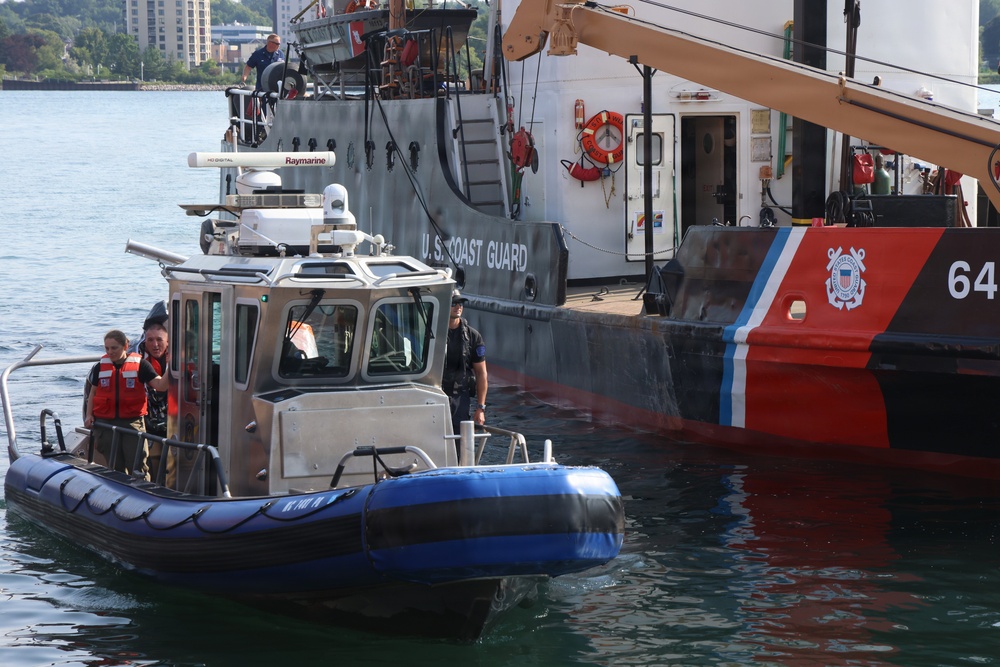
Photo By Capt. Cameron McPhail | Members of the 51st Civil Support Team, Michigan National Guard, U.S. Coast Guard, and...... read more read more
 Subscribe
Military personnel, first responders and government agencies from across the nation came together this pas week during Operation Iron Wave, a multi-day joint training exercise designed to strengthen the partnerships and coordination required to respond effectively during emergencies.
Held July 27–30 in Marquette and Sault Ste. Marie, the exercise brought together the Michigan National Guard alongside local, state and federal partners to rehearse emergency response scenarios emphasizing unified command, hazard assessment, information sharing and coordinated decision-making.
On July 30, training at the Soo Locks placed responders in the middle of a complex, multi-agency scenario. Along the St. Marys River, Civil Support Team members prepared to board a simulated vessel suspected of containing hazardous materials while U.S. Coast Guard crews maneuvered nearby. A Michigan State Police helicopter circled overhead as massive freighters continued their passage through the Soo Locks, providing a constant reminder that the exercise was unfolding around one of the nation's most important pieces of critical infrastructure.
For Brig. Gen. Ravi Wagh, Michigan Army National Guard assistant adjutant general, the exercise was about much more than practicing tactical skills. It was about strengthening the relationships and communication networks that agencies rely on when real emergencies occur.
"The last time we want to meet is when an incident has already occurred," Wagh said. "Exercises like this allow us to build those relationships beforehand so we're already operating as one team when our communities need us most."
The exercise brought together personnel from the Michigan National Guard's 51st Weapons of Mass Destruction Civil Support Team, Civil Support Teams from seven additional states and territories and numerous local, state and federal partners, including the Michigan State Police, U.S. Coast Guard, U.S. Army Corps of Engineers, Federal Bureau of Investigation, Department of Energy and regional emergency management agencies.
Along the St. Marys River, one of the exercise's most dynamic training lanes challenged Civil Support Team members to board a simulated vessel suspected of containing hazardous materials. Soldiers wearing fully encapsulated Level A protective suits prepared for a maritime reconnaissance mission while neighboring teams transitioned between radiological search operations and other specialized response tasks.
"Our primary goal is getting to that boat and determining whether there are any chemical hazards," said Sgt. 1st Class Jessica Miles, reconnaissance noncommissioned officer with the Michigan National Guard's 51st Weapons of Mass Destruction Civil Support Team. "We identify what those hazards are, assess the situation and provide emergency managers with the information they need to make informed decisions."
For Miles, one of the greatest benefits of Operation Iron Wave was the opportunity to train alongside Civil Support Teams from across the country.
"Every time I learn something from a different CST," she said. "We're able to build these relationships so if we ever have to hand off information, we've already practiced it once."
Maj. Jeff Overhulse, deputy commander of the 51st Weapons of Mass Destruction Civil Support Team, said the exercise validated the unit's readiness while strengthening partnerships across all levels of government.
"This exercise is designed to build and strengthen interoperability between our partner agencies at the local, state and federal level," Overhulse said. "Working side-by-side with our first responders and emergency management professionals ensures we can operate as a seamless team when it comes to defending our communities."
The Soo Locks provided a realistic training environment because of their importance to the nation's transportation network and critical infrastructure, allowing responders to practice coordinated emergency response in a complex operational setting.
Federal agencies also contributed specialized expertise throughout the exercise. The Department of Energy's Radiological Assistance Program supported multiple training lanes focused on radiological detection, consequence management and technical advising.
As Chris Allen, regional program manager for the Department of Energy's Radiological Assistance Program Region 5, described his team's mission, the rhythmic beeping of radiation detection instruments continued behind him while aircraft passed overhead, and emergency responders moved between training lanes.
"Our goal for RAP is to inform and advise, not to direct," Allen said. "The more opportunities we get for joint training, the better we understand each other's procedures, and the better we can tailor what we're doing to support our partners."
Allen said participants received real instrument readings from radiological training sources, allowing responders to practice interpreting measurements and building an accurate operational picture under realistic conditions.
While helicopters, vessels and hazardous materials response teams provided visible demonstrations throughout the week, Wagh said one of the most valuable aspects of the exercise occurred away from the operational scenes.
"The tactical piece was impressive," he said. "But what impressed me most was seeing representatives from local, state and federal agencies sitting together in a classroom, talking through incident management and solving communication challenges before a crisis happens. Those are the things that matter when it comes time to respond."
Operation Iron Wave also demonstrated the initiative of the 51st Civil Support Team, which coordinated a large-scale exercise bringing together regional Civil Support Teams and partner agencies to strengthen emergency response capabilities across Michigan and the Great Lakes region.
"We live and serve in the communities here," Wagh said. "When people see these types of exercises, they're seeing their citizen-Soldiers preparing for when that next worst day does come."
| Date Taken: | 07.31.2026 |
| Date Posted: | 08.04.2026 14:46 |
| Story ID: | 571530 |
| Location: | SAULT STE. MARIE, MICHIGAN, US |
| Web Views: | 19 |
| Downloads: | 0 |

This work, Operation Iron Wave Strengthens Partnerships Before Michigan's Next Emergency, by CPT Cameron McPhail, identified by DVIDS, must comply with the restrictions shown on https://www.dvidshub.net/about/copyright.


No keywords found.




