
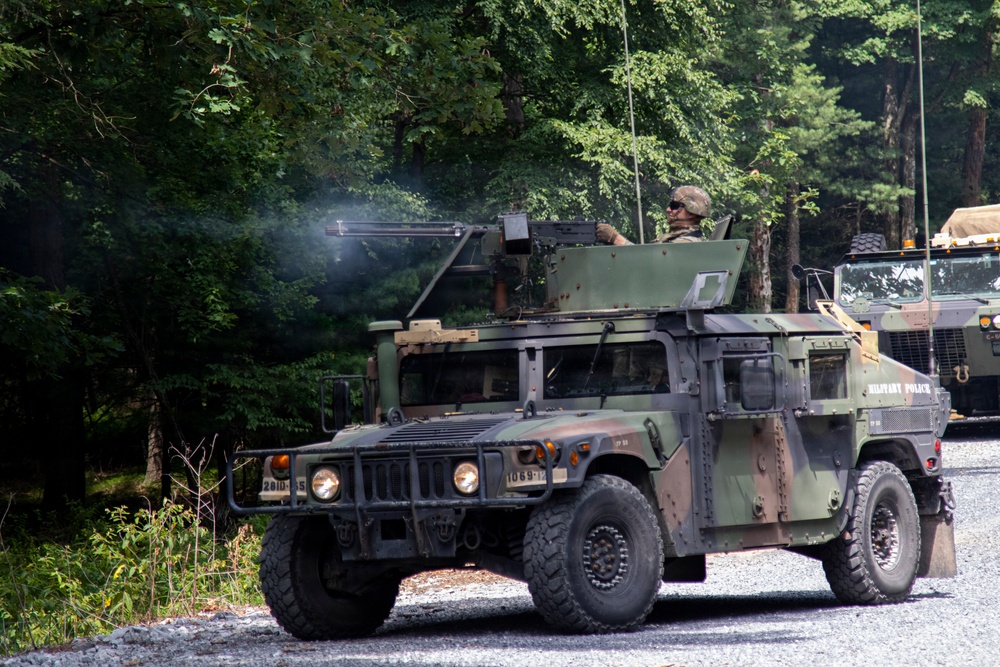
Photo By Sgt. 1st Class Shane Smith | U.S. Army Soldiers assigned to the Pennsylvania Army National Guard's 55th Maneuver...... read more read more
FORT INDIANTOWN GAP, Pa. – The modern battlefield extends beyond the front line.
Today's adversaries increasingly bypass front-line infantry and armored formations, using long-range fires, first-person-view drones, cyber capabilities and sabotage teams to strike the logistics hubs, command posts and supply routes that sustain combat operations. As a result, the Army's once-secure rear area has become a contested battlefield where sustaining the fight is just as critical as fighting it.
To prepare for that reality, approximately 1,100 Soldiers assigned to the Pennsylvania Army National Guard's 55th Maneuver Enhancement Brigade conducted the brigade's first Support Area Field Training Exercise (SAFTX) July 20–22 at Fort Indiantown Gap during annual training.
At the center of the brigade's mission is the Division Support Area, a network of command posts, logistics hubs, maintenance sites and medical facilities that keeps an Army division operating during combat. If those capabilities are disrupted, the fight at the front can quickly grind to a halt.
"In modern conflict, that area is no longer safe,” said Col. Adam Grove, commander of the 55th Maneuver Enhancement Brigade. “Ensuring that the support area is secure is essential to sustaining combat operations.”
The Army fields just 19 Maneuver Enhancement Brigades across its force structure, yet Grove said the formation remains one of its least understood.
“They're a critical part of the Division force structure,” said Grove. “In the current operating environment, a lot of the fighting is occurring in the support area, which is our battlespace.”
As the Army's designated headquarters for support area operations, the Maneuver Enhancement Brigade synchronizes security, mobility and protection across the Division Support Area. Its role is to ensure critical sustainment and command and control functions continue despite enemy interference, allowing combat forces to maintain their momentum.
Creating that training environment required more than a year of planning.
Long before Soldiers entered the field, leaders from the 55th MEB partnered with the Mission Training Complex, First Army, and an exercise design team to construct a realistic operational scenario designed to challenge the brigade staff from planning to execution.
"Training like this is a critical piece of overall operational readiness," said Greg Markert, Officer Senior Trainer with the Mission Training Complex. "You have to see it through planning, execution and assessment."
Unlike many field training exercises that focus on a single unit or mission set, the SAFTX was designed to replicate the complexity of a contested Division Support Area. Every element of the scenario was built to force the brigade staff and subordinate battalions to solve the same types of problems they could face during a real-world mobilization.
"It's tough to simulate the Division Support Area and the many missions that occur there," Grove said. "We've spent a long time building this exercise, creating our own opposing force and working alongside an exercise design cell to make the training as realistic and valuable as possible."
Supporting the exercise were 15 observer coach/trainers from First Army, whose role is to help prepare Army National Guard units for mobilization through evaluation, mentorship and coaching. The exercise marked the beginning of First Army's formal observer-coach engagement with the brigade as it enters its mobilization readiness cycle.
"This is kind of just a starting point for us," said Master Sgt. Zachary Stiles, one of the observer coach/trainers supporting the exercise. "We'll continue working with the brigade throughout the mobilization process to help make sure they're ready when the time comes."
Rather than relying on scripted events, planners built a dynamic operational environment that forced leaders to make decisions under pressure as conditions changed throughout the exercise. Simulated drone surveillance and attacks, enemy reconnaissance, commando raids, improvised explosive devices, displaced civilians, chemical attacks and ambushes against friendly convoys challenged the brigade's ability to synchronize security, mobility and sustainment across the battlespace.
The result was a constantly evolving operational environment where every decision had the potential to affect the brigade's ability to protect the Division Support Area and sustain combat operations.
Keeping the support area moving
One of the brigade's most critical responsibilities was maintaining freedom of movement throughout the Division Support Area. Even the best-equipped combat force cannot sustain operations if fuel, ammunition, food and medical supplies cannot move safely across the battlefield.
Soldiers assigned to the 337th Engineer Battalion cleared supply routes, emplaced obstacles and constructed survivability positions while military police secured convoy routes and established traffic control points.
Every route cleared and every survivability position constructed reflected a battlefield where threats can emerge well behind the forward line of troops.
By improving mobility for friendly forces while limiting enemy freedom of movement, engineers helped preserve the brigade's ability to sustain combat operations across the support area.
Protecting sustainment
To ensure personnel, equipment and supplies could continue moving across the battlespace, Soldiers assigned to the 165th Military Police Battalion secured critical movement corridors and escorted tactical convoys through contested terrain while an opposing force attempted to disrupt their progress.
As convoys advanced along dusty supply routes, dismounted opposing forces launched ambushes, raining down small arms fire from atop a shipping container archway and the surrounding wood line. Soldiers were forced to rapidly establish security, return fire and coordinate the movement of vehicles through the engagement area.
Defeating the ambush was only the beginning. During each lane iteration, planners introduced additional friction by simulating vehicle breakdowns and battlefield casualties, requiring convoy personnel to balance security with recovery operations and casualty care while maintaining momentum toward their objective.
The scenario reinforced one of the exercise's central lessons: protecting sustainment operations requires far more than defeating an enemy attack. It demands the ability to keep combat power moving despite disruption.
Responding to battlefield disruptions
Maintaining freedom of movement was only one challenge. Throughout the exercise, the brigade also confronted the persistent threats that increasingly define modern conflict: where danger can emerge from above, within the support area itself or from hazards that extend beyond conventional combat.
Small quadcopter drones regularly appeared overhead, forcing Soldiers to alter their movement, seek concealment beneath tree cover and disperse their formations to reduce their vulnerability. Though the drones posed only a simulated threat during the exercise, they represented the growing reality that even inexpensive unmanned aircraft can disrupt operations, gather intelligence or deliver lethal payloads on today's battlefield.
Enemy attacks were not limited to kinetic threats. Chemical attacks forced Soldiers to rapidly don protective masks before continuing their missions in a contaminated environment. Meanwhile, Soldiers assigned to the 128th Chemical Company established a decontamination site where personnel, vehicles and equipment could be processed following a notional large-scale chemical attack.
The exercise also challenged leaders to navigate the human dimension of modern conflict. Role players portraying displaced civilians regularly entered the support area, requiring Soldiers to distinguish between noncombatants seeking assistance and individuals who posed potential security threats. Some required redirection away from military operations, while others portrayed armed or hostile individuals who forced Soldiers to make rapid decisions balancing force protection with the rules of engagement governing interactions with civilians.
Together, the scenarios reinforced that securing the Division Support Area extends far beyond traditional security operations. Success depended on the brigade's ability to recognize emerging threats, adapt to changing conditions and continue sustaining combat operations without losing momentum.
Command and control
Behind every convoy movement, engineer mission and response to emerging threats was another critical element of the exercise: the brigade's ability to synchronize dozens of activities occurring simultaneously across the Division Support Area.
Inside the brigade Tactical Operations Center (TOC), information flowed continuously from subordinate units operating throughout the battlefield. Liaisons from each battalion relayed real-time updates as reports of enemy activity, drone sightings, convoy movements, casualty evacuations and civilian encounters converged at the brigade staff. By consolidating those reports, the brigade staff coordinated responses to emerging threats while ensuring every staff section maintained a common operational picture as conditions evolved.
As information flowed into the TOC, brigade staff analyzed incoming reports, identified emerging priorities and coordinated resources across the battlespace. A single event often generated multiple, simultaneous requirements across the Division Support Area. While Soldiers treated a simulated casualty and requested a nine-line medical evacuation, engineers might be tasked to restore mobility along a nearby route as reports of enemy drones or displaced civilians arrived from another sector of the support area. The brigade staff continuously balanced competing priorities to keep operations moving.
While engineers shaped the terrain and military police secured movement corridors, the tactical operations center served as the hub that integrated those efforts into a single operation. The exercise demonstrated that success in the Division Support Area depends not only on specialized capabilities, but on a headquarters capable of synchronizing them under the pressure of a constantly changing battlefield.
During the exercise, Brig. Gen. Reece Lutz, commanding general of the 28th Infantry Division, visited the brigade tactical operations center to observe the training and commend the Soldiers participating in the exercise.
"A brigade-level field training exercise like this is something you very rarely see," Lutz said. "This is the culmination of a long military decision making process, and it shows. Keep up the great work and learn everything you can here."
While the exercise tested the brigade's ability to operate in a contested support area, it also represented an important step in the brigade's broader readiness progression as it prepares for future mobilization requirements.
For Greg Markert, the value of the exercise extended beyond evaluating tactical tasks. It strengthened the relationships, communication and decision-making processes that headquarters rely on during large-scale operations.
"Training like this develops teamwork and synergy within the headquarters that you simply can't reproduce in a non-tactical environment," Markert said. "Those relationships and processes can't be replicated in a classroom. They have to be exercised under realistic conditions."
First Army observer coach/trainers will continue working alongside the brigade throughout its readiness progression, helping leaders refine procedures and assess mission-essential tasks as future training events build toward mobilization.
"They're figuring it out as a staff," said Master Sgt. Zachary Stiles, one of the observer coach/trainers supporting the exercise. "They'll be ready when the time comes."
By forcing the brigade staff and subordinate battalions to operate under realistic conditions, the exercise strengthened the command relationships and decision-making processes required to defend the Division Support Area during future operations.
As modern conflicts continue to blur the distinction between front lines and rear areas, exercises like the SAFTX ensure the Soldiers of the 55th Maneuver Enhancement Brigade are prepared to secure the Division Support Area and preserve the command, logistics and sustainment operations that enable the Army to fight and win.
| Date Taken: | 07.31.2026 |
| Date Posted: | 07.31.2026 12:28 |
| Story ID: | 571239 |
| Location: | FORT INDIANTOWN GAP, PENNSYLVANIA, US |
| Web Views: | 365 |
| Downloads: | 0 |

This work, The fight behind the fight: 55th MEB prepares for modern battlefield, by SFC Shane Smith, identified by DVIDS, must comply with the restrictions shown on https://www.dvidshub.net/about/copyright.


No keywords found.





