
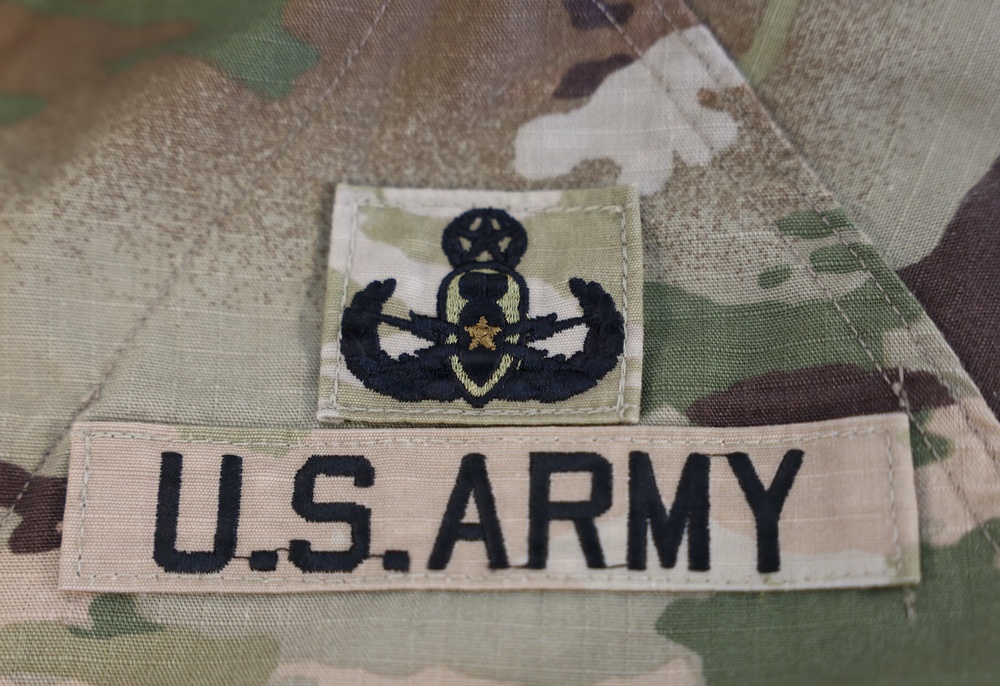
Photo By Dani Johnson | The Explosive Ordnance Disposal badge as appears today on the Army uniform. The...... read more read more
Compiled from reports by Master Sgt. Brian Meroni, U.S. Army Explosive Ordnance Disposal School
In December 1949, the Ordnance Bomb squads from World War II were changed to Explosive Ordnance Disposal (EOD) squads. Shortly after, an effort was made to design a new EOD badge.
In 1952, the EOD Division of Ordnance Board at Aberdeen Proving Ground, Maryland, requested field detachments to submit designs for a new EOD badge. Many units sent one or more designs to include even retired veterans such as Col. Thomas J. Kane, 1st Commandant of the Bomb Disposal School, and Capt. Guy Quick, key member of the badge selection.
Maj. John W. Doak, chief of Explosive Ordnance Disposal at Aberdeen, submitted his concept design for a new metal badge following a design like the existing parachutist badge worn by the Army.
In 1953, a final design composed of several recommended designs was submitted to the Department of the Army by the Ordnance Board. It wasn’t until 1956 that the Department of the Army approved the badge with a wear date of July 31, 1957.
In June 1969, the Master badge was additionally authorized. At this time the specialist badge was renamed “EOD” badge, commonly referred to as basic EOD badge. At the same time, the supervisor’s badge was renamed the senior EOD badge. The family of EOD badges are the only military specialty badges worn by all military services.
Description A silver badge, 1 3/4 inches (4.45 cm) in width, consisting of shield charged with a conventional, drop bomb, point down, from which radiates four lightning flashes, all in front of and contained within a wreath of laurel leaves.
The Senior EOD Badge is the same as the basic badge except the drop bomb bears a 7/32 inch (.56 cm) silver star.
The Master EOD Badge is the same as the Senior except a star, surrounded by a laurel wreath, is added above the shield.
Symbolism The wreath is symbolic of the achievements and laurels gained by minimizing accident potentials, through the ingenuity and devotion to duty of its members. It is in memory of the EOD personnel who have given their lives while performing EOD duties.
The bomb was copied from the design of the WWII Bomb Disposal insignia. It represents the historic and major objective of the EOD attack, the unexploded bomb. The three fins represent the major areas of nuclear, conventional and chemical/biological warfare.
The lightning bolts symbolize the potential destructive power of the bomb as well as courage and professionalism of EOD personnel in their endeavors to reduce hazards, as well as to render explosive ordnance harmless.
The shield represents the EOD mission, which is to protect personnel and property in the immediate area from an inadvertent detonation of hazardous ordnance.
Thoughts from the field on wearing the EOD badge
“From the earliest bomb disposal teams of World War II, the booby traps of Vietnam, through the IEDs of the Global War on Terror, and now onto the weaponized drones on today’s battlefield, the history of EOD is written in the quiet, relentless innovation of the EOD technician. It is that adaptive, problem-solving mindset- forged under pressure and refined across the generations- that has kept our force alive, relevant, and ready for every threat the Nation has faced and those yet to be created.” Command Sgt. Maj. David J. Silva, most senior EOD badge wearer in the EOD community still on active duty.
“EOD techs are not running to the danger; they’re running toward the problem… because they know they are the solution.” Silva
“EOD is not just a job, it’s a calling, it’s a community, and for those who are a part, it’s a Family.” Silva
“To me, the EOD badge is symbolic in many ways. Yes, we all know the meaning of each part of the badge (the wreath, lightning bolts, shield, and the bomb), but when combined it means a sense of pride, unity, division, persuasion, determination, refusal to fail, and the ability to do what most others will not or cannot. That is just the basic badge.” Sgt. 1st Class Ronald D. Pearson Jr.
“The senior badge represents a continued promise to face near certain death with more proficiency and a better understanding, a better sense of proficiency, more determination, and even more pride in self and community.” Pearson
“The master badge is what every EOD tech strives to achieve and earn! I wanted it because I thought it looked cool and everyone that I looked up to had it. When I got it, it made me realize that it symbolizes certain aspects of trust, but mostly the duty and responsibility to teach, train more, and an even bigger commitment to not only the job, but the jobs of having the master badge. The skills, knowledge, experience, lessons, patience, and willingness to pass it all down to the next generations of those who look to that badge as, ‘Ah man, I want that!’” Pearson
“The Explosive Ordnance Disposal badge is the only occupational badge shared across all four services. That unity is not symbolic, it is operational. It signals to the joint force and the world that EOD is not merely an occupation; it is a global, life-saving capability that transcends service boundaries.” Sgt. 1st Class Marcel A. Blood
“The design reinforces what the community demands. The bomb anchors us in our World War II origins. The lightning bolts represent the instantaneous, catastrophic power of the explosives we handle. They serve as a constant reminder that precision and discipline are non-negotiable. The shield declares our primary mission: protecting our brothers and sisters in arms, our fellow Americans, and our partners from explosive hazards. The laurel wreath celebrates the accomplishments of those who wear the badge and honors the fallen whose sacrifices made those accomplishments possible.” Blood
“Together, these elements reflect the non-linear, adaptable thinkers the EOD community produces. The badge does not simply identify a technician; it certifies a mindset. It promises that we will always strive for perfection and that our resolve will be unwavering. If we falter, even for a moment, the results will be instantly devastating.” Blood
“This badge is awarded to those with the utmost attention to detail and willingness to adapt and overcome. Our predecessors handed the field down to us to carry the torch. The badge reminds me I will be handing it down to the next generation and need to improve the knowledge, technology, and techniques so they fall in prepared and ready to prepare for the next threat. I take this to heart while developing the family and constantly updating problem sets to reveal current and forward trends.” Sgt. 1st Class Corey J. Rinn
“This badge is a daily reminder of what it means to be the 'one percent of the one percent.' Every technician volunteered twice—once for country, and once for the long walk. It represents an elite family bound by a shared promise: to stand between our forces and the ultimate threat, no matter the cost.” Maj. Michael C. Fancher
| Date Taken: | 07.30.2026 |
| Date Posted: | 07.30.2026 16:28 |
| Story ID: | 571163 |
| Location: | US |
| Web Views: | 31 |
| Downloads: | 0 |

This work, Birth of the EOD badge - “Initial Success, or Total Failure”, must comply with the restrictions shown on https://www.dvidshub.net/about/copyright.


No keywords found.





