Saving millions of dollars, thousands of manhours earns AM1 Rupp $25K
Photo By Robert Perry |
AM1 Micah Rupp, a quality assurance representative with Air Test and Evaluation......read moreread more
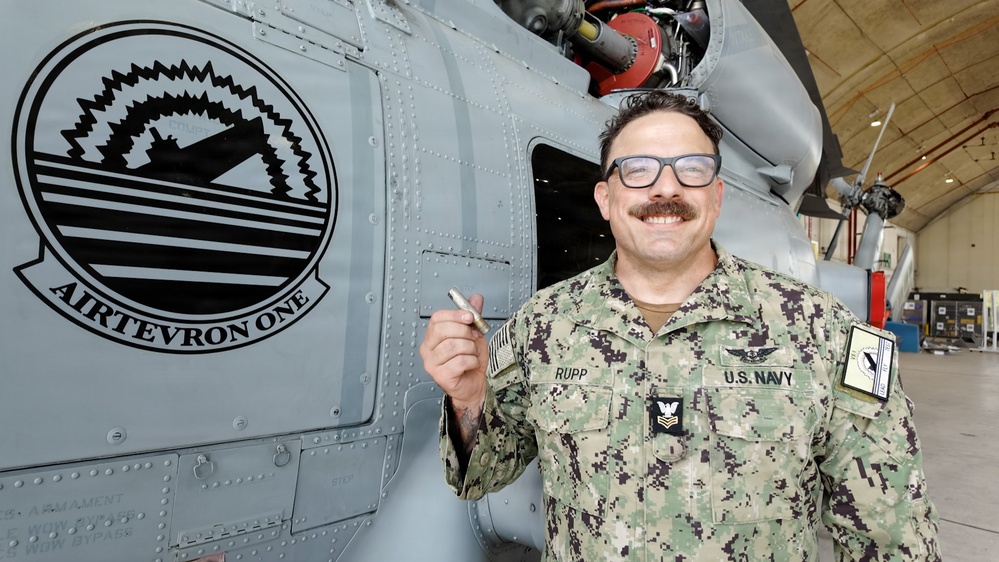
Photo By Robert Perry | AM1 Micah Rupp, a quality assurance representative with Air Test and Evaluation Squadron 1 at Naval Air Station Patuxent River, Maryland, was recently notified that he qualified for the highest payout available through the Military Cash Award Program (MILCAP): $25,000. Rupp created a tool to fix a gearbox assembly on H-60 series of helicopters. see less
| View Image Page
Saving millions of dollars, thousands of manhours earns AM1 Rupp $25K
A simple, equitable, time-saving fix that prevents costly damage to the Navy’s H-60 helicopter fleet has earned an aviation structural mechanic a $25,000 award and recognition from the Secretary of the Navy.
Aviation Structural Mechanic First Class (AM1) Micah D. Rupp, a quality assurance representative with Air Test and Evaluation Squadron (VX) 1 at Naval Air Station Patuxent River, Maryland, was recently notified that he qualified for the highest payout available through the Military Cash Award Program (MILCAP): $25,000.
MILCAP is a Navy incentive program that rewards active-duty personnel for beneficial suggestions, inventions or scientific achievements that improve efficiency, productivity or operations. According to a memo to the Chief of Naval Operations, Rupp “created a way to avoid destruction of the MH-60 bridge aft support and arm to the main gear box [MGB] by the creation of a modified alignment pin, which ensures the main mounting bolt is installed properly. Due to this, the chances of damage to the bridge aft support and arm to the MGB are significantly lowered. The cost of one of these guide pins is $17, while the associated damage without its use can cost up to $378,556 per instance. The MH-60 Fleet Support Team data has shown that AM1 Rupp’s innovation would have saved hundreds of thousands of dollars in the last few years and has potential to save millions of dollars and thousands of maintenance manhours over the MH-60 lifecycle.”
The H 60 is one of the most heavily used aircraft across the Navy, Marine Corps, Army, Air Force and Coast Guard. Preventing damage to its main gearbox assembly has immediate readiness impacts, reducing downtime and preserving aircraft availability.
Rupp enlisted in the Marine Corps in 2004 and transitioned into his Navy career after completing his Marine Corps service. He has worked on the H-60 airframe since 2013 and discovered the problem that led to his inventive fix about 10 years ago while serving at Helicopter Sea Combat Squadron (HSC) 21 in San Diego, California.
“On our flight controls, we have a component called the aft bridge,” Rupp said. “It supports a flight control bell crank. When we put it in, it doesn't always line up. And we use what are called eccentric bushings, which are two oblong bushings that we have to make perfectly fit to line up with. Well, the problem with it is it can offset and you can get kind of a false connection on that bolt. Ultimately, you strip out the fitting that’s directly on the main gearbox, which is the main transmission for the helicopter. In order to repair that, that's called a planner and estimator repair [P&E] that can cost thousands, and the [manufacturer] will have to come out and fix it. And you're sitting on downtime with lots of money and manhours lost.”
In simpler terms, the misalignment can cause a bolt to seat incorrectly, damaging a critical gearbox fitting and grounding the aircraft.
Rupp said during replacement of a new fitting, he felt what he described as a “false catch” that could have stripped the bolt, causing another repair. Instead, he cut the head off the problematic bolt, threaded it into its spot and placed the bushings around it. When he pulled the bolt out, everything lined up perfectly.
“I was, like, ‘Wow, I might be on to something,’” he said. “I talked to our quality assurance supervisor at HSC-21, and he said, ‘This is a great idea.’ He started running it up the engineering side of the H-60 community. They took it out and field tested it. That was 10 years ago, so it has been a process.”
The bolt fix is applicable to every model in the H-60 series of helicopters—Seahawk, Blackhawk, Pavehawk and Jayhawk, spanning every military branch. If something were to go wrong with this assembly, the aircraft could be grounded, or, even worse, experience a catastrophic failure.
“AM1 Rupp’s ingenuity reflects the very best of our naval aviation community. He saw a problem, engineered a fix, and delivered a solution that saves time and increases readiness. His innovation will pay dividends for the H 60 fleet for years to come,” said Vice Adm. John “Doc” Dougherty, commander, Naval Air Systems Command, and Portfolio Acquisition Executive Aviation.
Rupp said the Navy is still working on rolling out his fix, drawing up blueprints and using quality assurance teams to look at making the bolt a locally manufactured item. Rupp, who is retiring next year, said he likely will not see his fix rolled out fleetwide before he leaves service, but he feels a deep sense of satisfaction knowing it will help the fleet save lives, repair time and money.
“I think it's pretty cool, because, you know, when you watch the news, you watch movies, you always see a Blackhawk or Seahawk flying around. And not only can I say I worked on that aircraft, but I invented a tool for that aircraft. It's also pretty cool, because I do intend to work on the civilian side as [an] A&P [airframes and powerplants] mechanic on the same platform, so I'll get to continue to use that tool in my next venture.”