
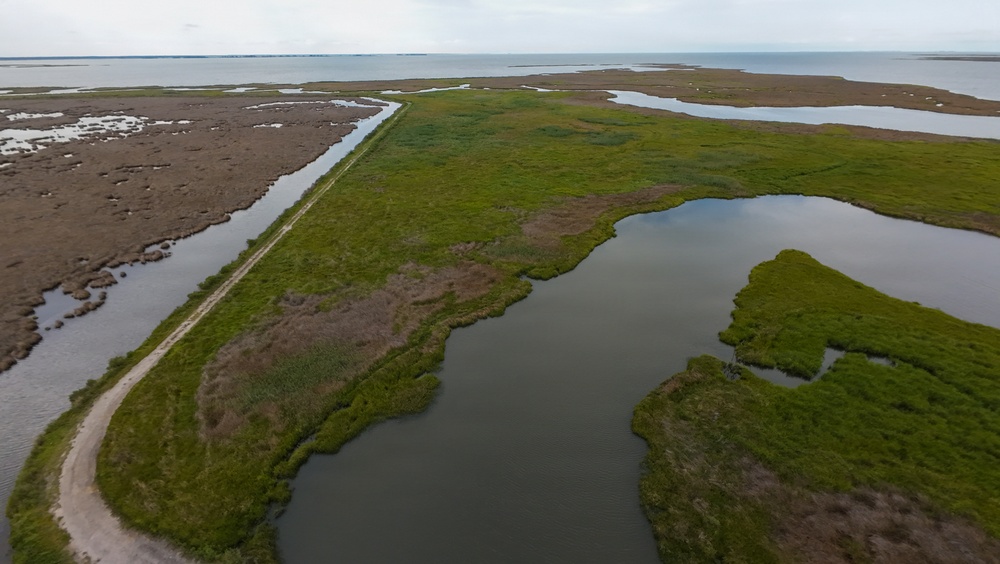
Photo By Jeremy Todd | Marsh grasses established at the Deal Island Wildlife Management Area in Somerset...... read more read more
 Subscribe
DEAL ISLAND, Md. — A U.S. Army Corps of Engineers, Baltimore District, project to restore degraded wetlands at the Deal Island Wildlife Management Area has reached completion, turning eroding marsh into critical nesting habitat for threatened bird species while keeping the Wicomico River open for commercial navigation.
The project, which began in 2021, used material dredged from the Wicomico River federal navigation channel to rebuild roughly 70 acres of failing tidal wetlands at the Deal Island Wildlife Management Area in Somerset County.
The material came from the lower half of the Wicomico River channel, about five miles from the placement site, according to Kevin Fenyak, the project's manager in USACE Baltimore District's Navigation Section.
“It’s one of our longest shallow-draft channels, used primarily for agriculture and fuel shipments up to Salisbury,” Fenyak said. “We just did the lower half this time. We took the material out with a hydraulic dredge and pumped it about five miles via pipeline to the marsh here.”
The Wicomico River is a vital federal navigation channel serving the Port of Salisbury, the second-highest commercial port in Maryland by volume, primarily supporting petroleum and grain shipments to the Delmarva Peninsula. Periodic maintenance dredging is required to keep the channel at its authorized depth of 14 feet.
Rather than disposing of the dredged sand, silt and shell material, USACE Baltimore District partnered with the Maryland Department of Natural Resources, Wicomico County, the U.S. Fish and Wildlife Service and Audubon Mid-Atlantic to beneficially reuse it, restoring wetlands that had degraded over decades.
The Corps awarded a $13.5 million contract in September 2022 for the dredging and restoration work to a local company, which sourced the native marsh grasses from local growers. Maintenance dredging began in October 2023 and continued through the winter, with approximately 166,000 cubic yards of material pumped via pipeline directly from the river to the placement site.
Fenyak said the material was contained using straw bales and tidal plugs, allowing the marsh to settle and reach its target elevation.
“Once inflow was done and the material had time to settle, we had raised the marsh by roughly a foot overall, which was part of the project objective,” Fenyak said.
Crews also repaired containment structures damaged during the 2023 hurricane season, continuing work with minimal delay to the project schedule.
Following placement, contractors drilled plugs into the new marsh surface to plant native salt marsh grasses, including Spartina alterniflora, Spartina patens, Spartina cynosuroides and Distichlis spicata, giving the vegetation a stronger foothold in its new environment.
“We had contractors come in and drill plugs so they could plant native salt marsh grasses, mostly Spartina, but a few other species too,” Fenyak said. “Drilling the holes gave the plants a better chance to take hold and adapt to the environment.”
Native marsh grasses like these hold the new sediment in place, slow shoreline erosion and filter runoff before it reaches the Chesapeake Bay. The restored marsh was specifically designed to support the saltmarsh sparrow and black rail, two bird species that depend on healthy tidal marsh for nesting. Deal Island Wildlife Management Area is also known for supporting some of the largest concentrations of herons, egrets and ibis in the state, along with one of Maryland's only breeding populations of black-necked stilts.
Planting was completed in May 2025. With that work finished, USACE's role in the project has concluded. Ongoing monitoring and long-term outcomes now rest with the Maryland Department of Natural Resources and Wicomico County, under the terms of their 2022 memorandum of understanding, which requires monitoring for up to five years to confirm vegetation survival and habitat success.
Fenyak said the project reflects a broader need to stabilize the Chesapeake Bay's eroding shorelines.
“It’s important to stabilize the coastlines of the Chesapeake Bay. They're constantly eroding from natural processes — weather, hurricanes, anything like that,” Fenyak said. “By putting the material back on these marshlands and fortifying and strengthening them, we're preserving them not only for the native species, but for people and recreation as well.”
Today, the restored marsh supports a wide range of wildlife, from nesting shorebirds to recreational crabbers drawn to the newly stabilized shoreline. For Fenyak, the project's value went beyond its engineering objectives.
“My favorite part of this project was just coming down here and being out in the marsh, at the edge of the state, enjoying the peace and quiet with the birds,” he said.
| Date Taken: | 07.13.2026 |
| Date Posted: | 07.15.2026 15:40 |
| Story ID: | 570007 |
| Location: | DEAL ISLAND, MARYLAND, US |
| Web Views: | 213 |
| Downloads: | 0 |

This work, From Dredge to Delta: USACE, Partners Restore Roughly 70 Acres of Wetlands at Deal Island Wildlife Management Area, by Jeremy Todd, identified by DVIDS, must comply with the restrictions shown on https://www.dvidshub.net/about/copyright.


No keywords found.




