
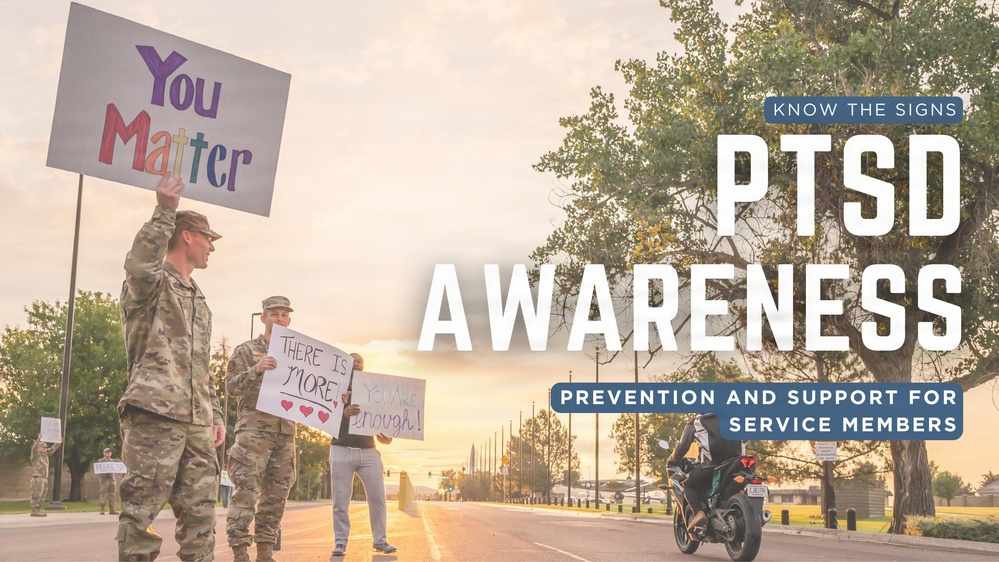
Photo By Jazmine Gutter-Robbins | Every June the Air Force Medical Service joins the services in bringing awareness to...... read more read more
For many service members, the hardest part of post-traumatic stress disorder can be acknowledging they need to seek support, and that accepting help is a form of proactive resilience.
Every June, the Air Force Medical Service brings awareness to PTSD, a mental health concern that can worsen if left untreated.
“Creating an environment that encourages help-seeking - that’s the biggest thing, then peer support and connectedness,” said Dr. Angelica Escalona, Air Force Reservist and outpatient behavioral health clinical director for the Defense Health Agency’s Behavioral Health Clinical Management Team.
Recognizing signs of PTSD
The National Center for PTSD defines PTSD as a mental health disorder that some individuals develop after experiencing or witnessing a life-threatening or traumatic event. Commons symptoms include:
If symptoms persist for more than 30 days, and the severity of symptoms begin to interfere with quality of life and ability to function through daily routines - these are indicative of PTSD, and identifying appropriate treatment and support are needed, Escalona said.
It is also important to recognize that stress reactions immediately following a traumatic event can be normal. Known as acute stress reactions, these responses typically occur close to the event and do not continue long term.
Escalona said PTSD can sometimes go unrecognized for years, particularly among service members who have pushed through difficult experiences to continue with the mission, ultimately to the detriment of their long-term health and readiness.
Building resilience before the battlefield
Escalona emphasized that resilience is not developed during a crisis - it is built beforehand through readiness trainings like iCOVER, which is a peer-based approach to address acute stress reactions during combat, and self-awareness of effective coping mechanisms.
“I think folks need to really build the resilience before the crisis occurs,” she said. “It’s a lot of realistic training, preparation and building tolerance to stress.”
She encouraged service members to understand their personal limits and recognize when they need additional support.
“Know yourself a little bit more to the point where, ‘OK, this is my threshold. This is when I need to get help,’” Escalona said.
She added that flexibility and adaptability are critical. While stress reactions are normal after difficult experiences, understanding when those reactions become more severe can help individuals seek assistance sooner.
Importance of early intervention
Early identification and treatment can significantly improve outcomes for individuals experiencing PTSD.
Quickly addressing the symptoms with a medical provider and determining the appropriate evidence-based treatment is one of the most effective steps a person can take, Escalona said.
She noted that strong social connections, supportive leadership and peer involvement also play an important role in recovery. Leaders and peers who notice changes in behavior can help guide Airmen and Guardians toward available resources before challenges become more serious.
According to Escalona, seeking help should never be viewed as weakness or a threat to a military career. Instead, addressing symptoms early helps prevent them from escalating and affecting overall readiness and quality of life.
Her message for service members is straightforward: PTSD is treatable, recovery is possible and resilience can be strengthened over time.
Escalona compared mental health recovery to physical rehabilitation after an injury.
“Someone with PTSD, you don’t necessarily see it,” she said. “The more you address it, the more you see it and the more you learn to manage the discomfort that goes with it, the stronger you get.”
By recognizing symptoms early, supporting one another and seeking help when needed - service members can build resilience, strengthen readiness and take meaningful steps toward recovery.
To review the Air Force’s spectrum of clinical and non-clinical mental health care, visit the Mental Health Overview or your local outpatient behavioral health clinic located at each military treatment facility. A variety of mental health resources are available on Military OneSource for all service members.
| Date Taken: | 06.25.2026 |
| Date Posted: | 06.25.2026 09:33 |
| Story ID: | 568537 |
| Location: | FALLS CHURCH, VIRGINIA, US |
| Web Views: | 27 |
| Downloads: | 0 |

This work, The cost of waiting: Recognizing PTSD symptoms, seeking support, by Maristela Romero, identified by DVIDS, must comply with the restrictions shown on https://www.dvidshub.net/about/copyright.


No keywords found.





