
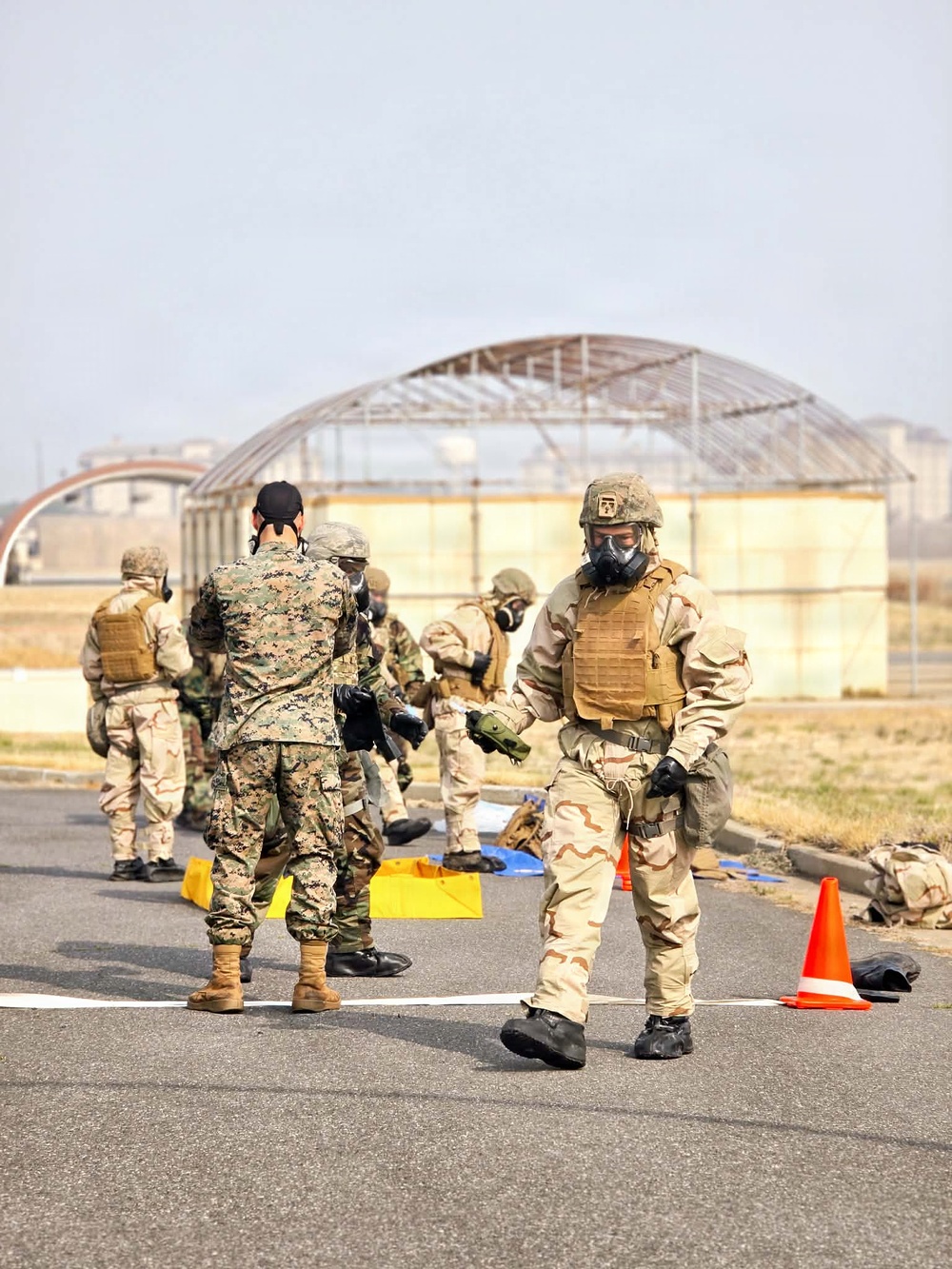
Photo By Caitlin Robinson | When Marine Corps CBRN personnel arrived at Kunsan AB, Republic of Korea, for a joint...... read more read more
 Subscribe
When Marine Corps Chemical, Biological, Radiological, and Nuclear personnel arrived at Kunsan Air Base, Republic of Korea, for a joint training exercise, they didn’t have the luxury of time. With little advance notice, Airmen from the 8th Civil Engineer Squadron were tasked with doing what they would be expected to do in a real-world contingency: integrate immediately and execute.
For Senior Airman Joseph Murphy, an emergency manager assigned to the 8th CES, that meant turning uncertainty into action and helping build a fully integrated joint response team capable of operating as one.
His leadership during the exercise earned him a Meritorious Mast from the 174th Marine Wing Support Squadron. For Murphy, the award reflected not only individual performance, but the success of the joint team and the operational partnerships built throughout the exercise.
“At Kunsan, part of our mission is ‘accept follow-on forces,’” Murphy said. “In a conflict, we’re expecting people to come onto the peninsula, and we have to fully integrate with them on the spot.”
That reality is central to operations on the Korean Peninsula. As a forward-based installation in the Indo-Pacific, Kunsan plays a critical role ensuring US and allied forces can rapidly generate combat power. In that environment, interoperability is not a future goal, it is a present requirement.
Murphy grew up surrounded by family members in the Philadelphia Fire Department, envisioning a path where he would join the Air Force as a firefighter before eventually following in their footsteps. However, the fire career field was unavailable when he enlisted, which led Murphy to explore other options, landing on Emergency Management.
While Murphy was initially unfamiliar with the CBRN side of the career field, he kept an open mind and adjusted to the demands of Emergency Management.
He credits Kunsan’s fast-paced operational environment for giving him the firsthand experience and appreciation for his new career field. “If you told me a year ago that I would have learned this much in Korea, I would have told you that you were lying,” Murphy said. “The experience I’ve gained at Kunsan will follow me throughout the rest of my career.”
At Kunsan, Murphy is responsible for training and response operations across the installation, including coordinating exercises with base augmentees, Republic of Korea Air Force partners, and US Army personnel. That mission expanded during the joint exercise. When Murphy’s noncommissioned officer in charge, Staff Sgt. Mullins, returned stateside for emergency surgery, Murphy’s role expanded.
“I had to step up and fill his role,” Murphy explained.
Marine Corps personnel arrived at Kunsan with little advance notice, leaving Murphy and his team responsible for building and executing a training plan. Murphy rose to the occasion, rapidly developing a training schedule, instructing classes, and structuring exercises to maximize learning opportunities for both Airmen and Marines. These efforts ultimately contributed to him receiving the Meritorious Mast from the 174 MWSS.
By bringing together Air Force, Marine Corps, Navy, and ROKAF Air Force personnel, the exercise strengthened interoperability and improved joint response capabilities in support of US Forces Korea Line of Effort #1: Defend the Homeland.
One challenge Murphy faced was understanding the different mission sets and operational cultures between the Air Force and Marine Corps. While Air Force emergency managers are focused primarily on defending the installation and rapidly restoring sortie generation, Marine CBRN personnel often operate in expeditionary environments where mission requirements vary depending on location and conditions.
To bridge those differences, Murphy and his team focused on repetition, shared problem solving, and deliberately integrating teams during exercises. Rather than training separately, Airmen and Marines worked side-by-side in the joint CBRN operations center, reconnaissance teams, and strike teams, learning each other’s tactics and processes in real time.
That integration became one of the defining aspects of the training.
“We didn’t want it to be a Marine team and an Air Force team,” he said. “It was a joint effort.” That collaboration became one of the exercise’s greatest strengths, enabling Airmen and Marines to exchange best practices and refine their own approaches to CBRN response.
At the foundational level, Air Force Emergency Management and Marine Corps CBRN personnel share many of the same core competencies.
“We are all the same,” Murphy said. “We all have the basic knowledge of how to be a CBRN responder.”
However, Murphy noted that implementation differs once those concepts are applied in real-world scenarios. One example was Airmen sharing chemical sampling techniques that Marines could take back to their home stations. Marines on the other hand demonstrated highly efficient decontamination procedures developed around operating with limited equipment and resources that Airmen could take back with them.
The Marines also introduced movement and building-clearing techniques designed for operating in hostile environments without relying on dedicated security forces support.
“It really showed us how to do more with less,” Murphy said.
Several of the tactics and procedures exchanged during the exercise have already been incorporated into Kunsan’s day-to-day response operations.
The exercise also provided a practical demonstration of how higher-level concepts like Agile Combat Employment and distributed operations are executed at the tactical level. For Murphy, the presence of Marine forces at Kunsan made those concepts tangible.
That concept became reality during the exercise as Airmen rapidly embedded Marine personnel into operations with minimal preparation time, establishing a joint CBRN operations center and integrated strike teams capable of responding as a single force.
“Seeing the Marines come in and fully integrate with us — that’s ACE at the lower level,” Murphy said.
The exercise also reinforced the importance of multinational partnerships, particularly between the USAF and ROKAF.
When Murphy arrived at Kunsan, strengthening relationships with ROKAF CBRN responders became one of his top priorities. With 21 ROKAF responders positioned to support real-world contingency operations at Kunsan, building familiarity and trust was critical.
Over the past year, those relationships have expanded through shared training plans, recurring exercises, and informal engagements designed to improve communication and interoperability.
“We train with them very often now,” Murphy said. “We’re basically fully embedded with them.”
While language barriers initially created challenges, repeated engagement and continuous collaboration helped both sides establish processes that made joint operations more effective.
For Murphy, the value of the exercise lies in its ability to expose gaps and drive improvement. Following each exercise, teams conduct detailed reflections to identify gaps, refine processes, and improve performance for future operations.
“Exercises aren’t ever perfect,” Murphy said. “That’s what we do them for.”
For Murphy, that constant cycle of training, evaluation, and improvement is what ultimately drives readiness across the joint force.
“It’s like building blocks,” Murphy said. “We’re just getting better and better every time we train.”
Although Murphy received individual recognition through the Meritorious Mast, he emphasized that the greatest value came from the relationships, shared learning, and operational experience gained throughout the exercise.
“The recognition is great,” Murphy said. “But the knowledge we gained and the relationships we built — that’s what really matters.”
That mindset extends far beyond a single exercise or assignment. Some of the Marines Murphy trained alongside are stationed in Hawaii, his next assignment location.
“You make connections,” Murphy said. “It’s not just understanding the mission at Kunsan. Later in your career, you have people you can reach back to and learn from.”
For Airmen across the Civil Engineer enterprise, Murphy said the exercise reinforced the value of stepping outside familiar processes and training environments to learn from sister services and multinational partners.
“Every single responder took something away from that training,” Murphy said. “If you go into it with an open mind, you’re going to come out better.”
In the Indo-Pacific – where speed, coordination, and adaptability define success – that mindset is critical. Because when the next contingency arises, readiness will depend not on what was planned, but on how quickly teams can come together and execute. At Kunsan, that work is already underway.
| Date Taken: | 06.24.2026 |
| Date Posted: | 06.24.2026 10:13 |
| Story ID: | 568458 |
| Location: | US |
| Web Views: | 30 |
| Downloads: | 0 |

This work, Accepting Follow-On Forces: Kunsan Airman Strengthens Joint CBRN Readiness, by Caitlin Robinson, identified by DVIDS, must comply with the restrictions shown on https://www.dvidshub.net/about/copyright.


No keywords found.




