
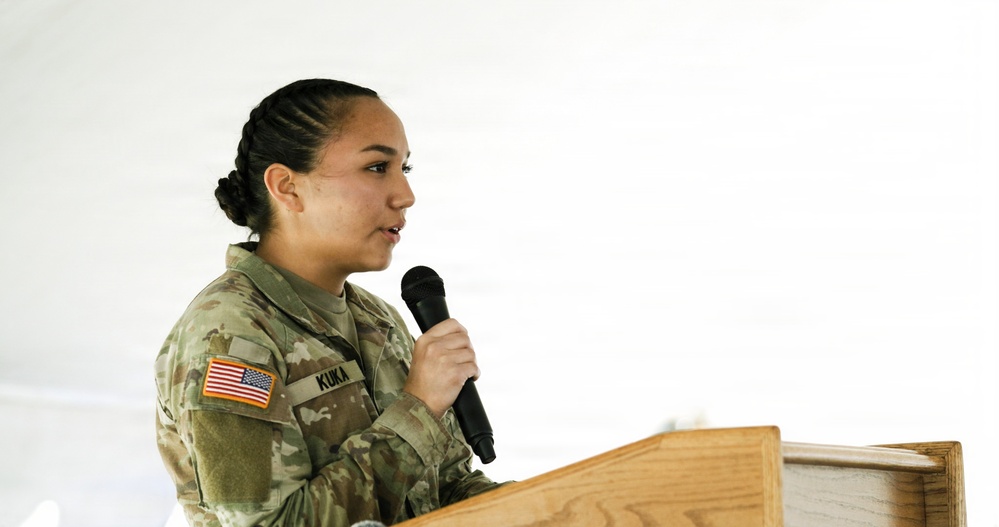
Photo By Bernhard Lashleyleidner | Pfc. Kingsley Kuka, an inpatient pharmacy technician at Landstuhl Regional Medical...... read more read more
LAMEDEER, Mont.– On June 17, Pfc. Kingsley Kuka, an inpatient pharmacy technician at Landstuhl Regional Medical Center and a member of the Northern Cheyenne Tribe, welcomed attendees to the 150th anniversary of the Battle of the Rosebud at Rosebud Battlefield State Park. The anniversary included a wreath-laying ceremony which served as a centerpiece of the event, bringing together representatives from multiple tribal nations, members of the Kobold family, Myron Red Sleeves and Kuka, who represented both the Northern Cheyenne Tribe and the U.S. Army.
To understand the significance of the occasion, one has to know some of the history of the region. Looking across the rolling ridges and sweeping grasslands of southeastern Montana, where vast buffalo herds once roamed, tribal nations returned to the land their ancestors called "Where the Girl Saved Her Brother" to commemorate the sesquicentennial of the Battle of the Rosebud.
The remote and largely undeveloped 3,052-acre park was designated a National Historic Landmark in 2008. Much of the landscape remains unchanged from 1876, preserving the terrain where one of the largest battles of the Indian Wars unfolded. The battlefield earned its traditional Northern Cheyenne name after an act of bravery by Buffalo Calf Road Woman, who rode through heavy U.S. Army gunfire to rescue her brother after his horse was shot from beneath him, carrying him to safety.
The ceremony took place on ground that witnessed a fierce struggle for survival 150 years ago. On June 17, 1876, near the headwaters of Rosebud Creek, Brig. Gen. George Crook’s forces were met by a determined coalition of Lakota and Northern Cheyenne warriors led by Crazy Horse, Two Moon, Young Two Moon, and Spotted Wolf. The eight-hour engagement involved thousands of combatants and became one of the largest battles of the Indian Wars.
The battle emerged from escalating tensions over treaty violations, gold discoveries, and contested territory. Northern Cheyenne and Lakota warriors fought to defend their homelands and preserve their traditional way of life. Their resistance halted Crook’s advance and emboldened the Native forces. Eight days later, Lakota and Northern Cheyenne warriors defeated Lt. Col. George A. Custer and elements of the 7th Cavalry at the Battle of the Little Bighorn, shocking a nation celebrating its centennial and triggering a renewed U.S. military campaign that ultimately resulted in the loss of the Black Hills by the Lakota people.
The anniversary observance that Pfc. Kuka participated in featured a full afternoon of commemorative events organized by Wallace Bear Chum, a Northern Cheyenne cultural leader and advocate for Native American history and heritage. Activities included horse rides, historical reenactment of "The Battle of Where the Girl saved her Brother," the Northern Cheyenne account of the battle, traditional victory songs led by tribal leaders, and a community feast.
The Northern Arapaho Warriors Veteran Color Guard, led by Cpl. Billy Farris, presented the colors. The gathering also welcomed noted historian Paul Hedren, author ofRosebud June 17th, 1876: Prelude to Little Big Horn, representatives from the U.S. Cavalry School, and descendants of Elmer 'Slim' and Rose Kobold, whose family preserved the battlefield before it became to state property.
“We expect several tribes to participate in the event, though the primary nation of focus is the Northern Cheyenne,” said Raymond Schell, recreation manager for Montana Fish, Wildlife and Parks. Participating nations included Northern Cheyenne, Lakota, Crow, Shoshone, and Arapaho tribes.
“Dr. Leo Killsback is the primary speaker," Schell added. "He was chosen for his expertise as a Northern Cheyenne tribal member and historian.”
Tribal Liaison Kqyn Kuka said organizers selected Pfc. Kuka to speak because of her unique perspective as a Northern Cheyenne tribal member serving in the U.S. Army.
“We wanted the warrior mindset to speak about what it means to serve both communities under one umbrella,” Kqyn Kuka said. “She is contributing to something larger than herself and carries the same warrior spirit passed down through generations, even 150 years later.”
Initially, some tribal leaders questioned whether a Soldier so early in her career could fully grasp the significance of speaking at the 150th anniversary commemoration of the Battle of the Rosebud. However, the tribal leaders ultimately recognized that Pfc. Kuka’s character, commitment to service, and warrior spirit made her uniquely qualified to represent the Northern Cheyenne people.
Standing on the very ground where her ancestors fought 150 years earlier, Kuka connected the legacy of Indigenous warriors to her service as a Soldier and health care professional.
“Today, we gather to remember those who stood here 150 years ago, and we honor the lives forever shaped by that time," Kuka said. “Honoring that history has never been just about looking to the past; it has been about building the future.”
For Kuka's mother, Kqyn, watching her daughter address the crowd was an emotional moment. “We are so proud of the woman she has become,” Kqyn said. “She is normally so quiet and reserved but seeing her stand before that audience in uniform makes me see her in a whole new light.”
That sense of pride and responsibility has guided Kuka throughout her life. After graduating from high school in 2023, she chose to join the Army and pursue a career in medicine while continuing her tribe's long tradition of service and sacrifice.
“I know that Native Americans serve in the U.S. military at higher rates than any other racial or ethnic group,” Kuka said. “Our motivations don't stem from our DNA; they are rooted deeply in who we are, where we have been, and the ancestral values that continue to guide us."
According to Department of Defense data, Native Americans account for approximately 1.7% of the total active-duty force, and more than 183,000 Native American veterans are living today. Since Sept. 11, 2001, Native Americans have served in the Armed Forces at rates higher than the national average.
Kuka said military service reflects values deeply embedded within Native communities.
"Our culture is the foundation of who I am, but Native American history often feels overlooked,” Kuka said. “We need more comprehensive education about our heritage because our people have been stewards of this land long before the nation existed."
She also reflected on her growing up as an "urban Indian" in Montana. Although her family lived outside the reservation boundaries, she said her connection to her heritage remained constant.
"We didn’t live within the boundaries of the reservation, but its heartbeat followed us into the city,” Kuka said. “I learned early on that being Indigenous wasn’t defined by where we fell asleep at night, but by how fiercely we carried our heritage, our stories, and our connection to the land."
Raised by a single mother, Kuka experienced firsthand some of the stereotypes and misconceptions often directed toward Native Americans. Her mother believes stories highlighting Native achievement deserve greater attention.
“The media often focuses on the struggles facing Native communities,” Kqyn said. “Why don’t they celebrate our triumphs? We have Native educators, leaders, representatives in Congress, and role models whose stories deserve to be told.”
Today, Kuka serves at LRMC, the Department of Defense’s largest American hospital outside the United States. While her ancestors carried weapons in defense of their people, she now supports wounded warriors through patient care and medical readiness.
“When people ask how I can serve in the same military that once fought against my ancestors, I tell them it has nothing to do with forgetting history,” Kuka said. “It comes from our identity and the values that have guided us for generations.”
Away from work, Kuka stays connected to her heritage through traditional beadwork, crafting intricate earrings and necklaces.
“It’s a meditative practice that keeps me grounded,” she said. “It allows me to carry a piece of my heritage with me, even though I’m stationed thousands of miles away from home."
Her professionalism and leadership have earned praise from leaders throughout LRMC.
“I am incredibly proud of Pfc. Kuka for being selected for this opportunity,” said Staff Sgt. Jenna Garcia, a pharmacy technician at LRMC. “It’s a tremendous honor and a reflection of her character, professionalism, and commitment to preserving and sharing history.”
Command Sgt. Maj. Michael Woolley, senior enlisted leader for the Medical Readiness Battalion-Rhineland Pfalz at LRMC, said given the history between the U.S. Army and Native American nations, this occasion beautifully shows that we are stronger together.
“Having LRMC Warfighter PFC Kuka speak will undoubtedly bring deep meaning to their family, friends, and all attendees,” said Woolley. “I am immensely proud of her achievements, and deeply grateful to everyone who helped bring this to fruition on her behalf.”
Woolley said here at LRMC, we honor our legacy. As Col. Stewart reminds us, we stand on the shoulders of our predecessors and ancestors, this is the foundation of our heritage.
“PFC Kuka is weaving her own rich heritage into the fabric of our commands history,” Woolley said. “Seeing her entire leadership team from Company to Division standing united behind her is an incredibly powerful moment that this young Warfighter will carry throughout her career.”
Reflecting on the significance of standing at Rosebud 150 years after the battle, Kuka described resilience as refusing to allow hardship define the future.
“I am a Northern Cheyenne Warrior, I am Pfc. Kuka, Matsisaipiiakii, and I carry my ancestors with me, every step of the way.”
| Date Taken: | 06.16.2026 |
| Date Posted: | 06.24.2026 08:35 |
| Story ID: | 568452 |
| Location: | LAME DEER, MONTANA, US |
| Web Views: | 70 |
| Downloads: | 0 |

This work, Where the Girl Saved Her Brother: Honoring 150 Years the Battle of the Rosebud, by Bernhard Lashleyleidner, identified by DVIDS, must comply with the restrictions shown on https://www.dvidshub.net/about/copyright.


No keywords found.





