
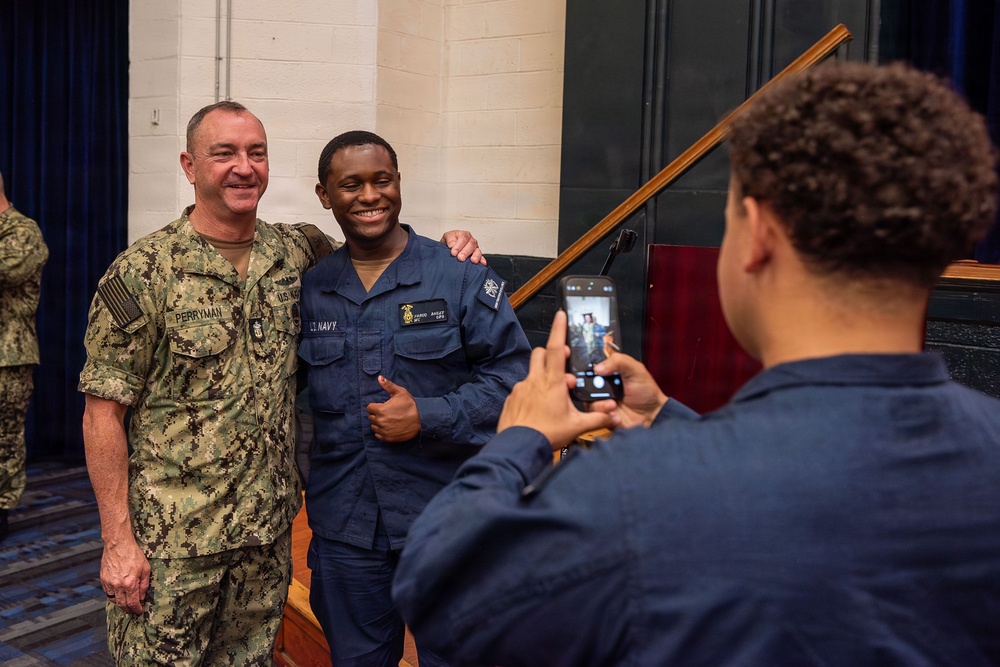
Photo By Petty Officer 1st Class Cody Beam | NORFOLK, Virginia (May 28, 2026) – Master Chief Petty Officer of the Navy (MCPON)...... read more read more
Master Chief Petty Officer of the Navy (MCPON) John Perryman visited Joint Expeditionary Base Little Creek-Fort Story and Naval Station NorfolkMay 27-29to engage directly with Sailorsand installation leadership on quality-of-service issuesimpactingreadiness across the Fleet.
During the visit, Perryman met with Capt. Katie Jacobson,commanderof Joint Expeditionary Base Little Creek-Fort Story, and Capt. Ray Glenn, commanding officer of Naval Station Norfolk, to discuss installation priorities, readiness challenges, and ongoing efforts to improve support services for Sailors and families.
The visit focused onidentifyingand reducing “friction points” affecting Sailors and families, including family housing, unaccompanied housing, child development center capacity, galley operations, Fleet and Family Support Center (FFSC) and Emergency Family Assistance Center (EFAC) support, and installation services. The engagements also examined how maintenance modernization initiatives at Mid-Atlantic Regional Maintenance Center (MARMC) and Shore Intermediate Maintenance Activity (SIMA) support Fleet readinessand warfighting capability.
“Wehave to stay connected to Sailors becausethey’ll tell you very quickly where the friction is,” said Perryman.“Ithink sometimes as leaders we convince ourselves that because a program exists, the problem is solved. But if Sailors are still struggling, thenwe’vegot more work to do.That’swhy getting out, having real conversations, and listening to honest feedback matters.”
Perrymanalsoconducted all-hands calls, working lunches, and directdeckplateengagements with Sailors across both installations,reinforcingthe Navy’s focus on supporting Sailors and families as a keycomponentof combat readiness.
“Ihear the same things pretty consistently whenIget out and talk to Sailors and theyaren’t asking for anything unrealistic,” said Perryman.“You can learn a lot walking spaces, sitting down with Sailors, and hearing directly from them aboutwhat’sworking andwhat’snot. Those conversations help leaders make better decisions, remove barriers where we can, and stay focused on the things thatactually impactreadiness. At the end of the day, strong warfighting teams are built on trust, connection, and leaders who are willing to listen.”
At Naval Station Norfolk, Perryman visited unaccompanied housing facilities, galleys, and support centers to assess current conditions and hear directly from Sailors about areas requiring improvement. Discussions included ongoing efforts aligned with the Chief of Naval Operations’“No Sailor Lives Afloat” initiative, which prioritizes safe, clean, and modern shore-based housing for Sailors in homeport.
Installation leadership also discussed challenges surrounding childcare capacity and family support services, including demand pressures within Hampton Roads Child Development Centers and FFSC programs supporting operational families.
In addition to quality-of-service engagements, Perryman visited MARMC and SIMA toobservemodernization efforts supporting the Navy’s broader “Foundry, Fleet, Fight” priorities. Discussions highlighted additive manufacturing, advanced maintenance technologies, and hands-on technical training designed to improve repair timelines and strengthen operational readiness.
The visit reinforced the Navy’s effort to rebuild technicalexpertiseand strengthen organic repair capability across the Fleet. Recent CNO guidanceidentifiedSIMA stand-up efforts in Norfolk and San Diego as critical to developing Sailor technicalproficiencywhile improving readiness generation and advanced repair capability.
“The work happening at MARMC and SIMA is helping us rebuild technical expertise across the Fleet while giving Sailors more ownership of the maintenance and repair work that directly impacts readiness,” said Perryman. “When Sailors have the tools, training, and hands-on experience to solve problems and restore capability themselves, we become a more resilient and ready force.That’sthe kind of investment that strengthens both our people and our warfighting advantage.”
During tours of additive manufacturing spaces and maintenance operations, Sailorsdemonstratedmodern repair technologies designed to reduce repair timelines, improve parts availability, and expand fleet-level maintenance capability.
Perryman also emphasized the importance of givingSailorsopportunities to gain hands-on experience and deepen technicalexpertisethroughout their careers.
Everything we looked at during this visit ties back to readiness,” said Perryman. “Whether it’s housing, childcare, technical training, or maintenance capability, these are the things that allow Sailors to stay focused, build mastery in their craft, and deliver for the Fleet when it matters most.”
| Date Taken: | 05.29.2026 |
| Date Posted: | 06.22.2026 11:35 |
| Story ID: | 568305 |
| Location: | NORFOLK, VIRGINIA, US |
| Web Views: | 72 |
| Downloads: | 0 |

This work, MCPON Visits Hampton Roads-Area Installations, Assess Quality-of-Service Friction Points, by MCPO Lori Bent, identified by DVIDS, must comply with the restrictions shown on https://www.dvidshub.net/about/copyright.


No keywords found.





