
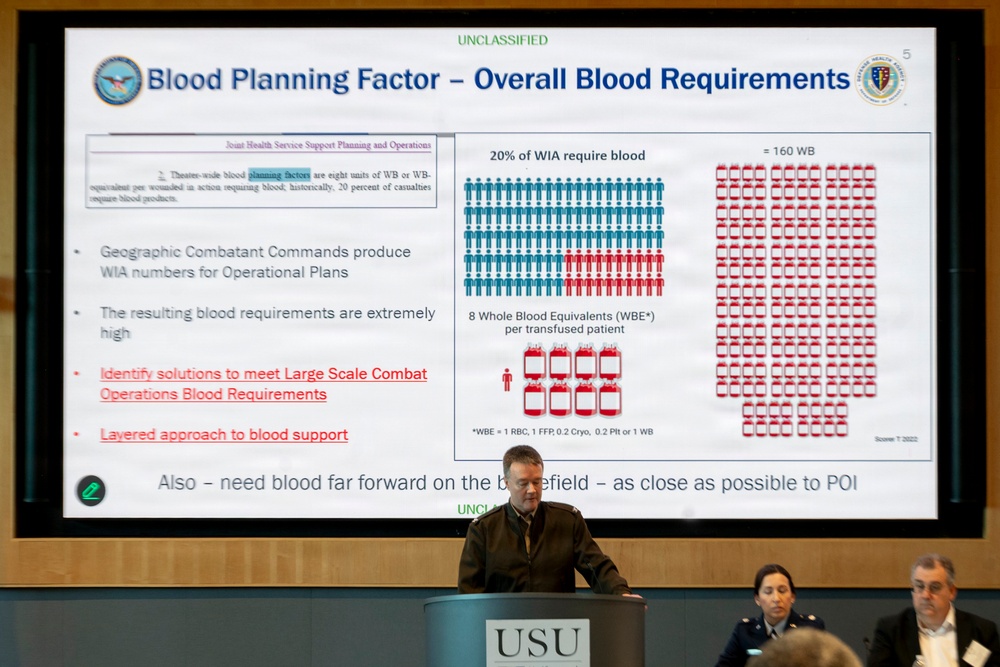
Photo By Cameron Parks | U.S. Army Col. Jason Corley, director of the Armed Services Blood Program, speaks...... read more read more
Medical logistics and prolonged field care in austere environments present significant challenges for the military health system. To address potential Large-Scale Combat Operations in remote locations across the globe, Defense Health Agency experts presented a strategy update for novel blood replacement therapies during the Strategic National Forum on Blood and Biotherapies, June 12, 2026, in Bethesda, Maryland.
Co-hosted by the Uniformed Services University of the Health Sciences and the Association for the Advancement of Blood and Biotherapies, the forum brought together civilian and military experts to examine the challenge of building a resilient blood supply chain and share best practices to strengthen coordination across the military and civilian healthcare sectors.
During the summit, DHA leaders outlined the robust organizational framework designed to accelerate the delivery of cutting-edge blood replacement therapies to U.S. Joint Forces operating across the globe. Central to DHA’s roadmap is the prioritized procurement and field-testing of Freeze-Dried Plasma and other life-saving treatments designed to extend product shelf life and eliminate the need for cumbersome refrigeration systems in forward-deployed settings, especially during LSCO.
“I can tell you in LSCO, there is going to be a requirement for a tremendous amount of blood,” said U.S. Army Col. Jason Corley, director of the Armed Services Blood Programat the Walter Reed National Military Medical Center in Bethesda. “We're talking about peer-on-peer conflicts. We're going to have land forces, we're also going to have maritime forces, and forces in the air. We expect casualty evacuation to be delayed greater than 72 hours, maybe even longer, and those casualties will get delayed further forward on the battlefield.”
To mitigate those challenges, Corley outlined a layered approach to blood procurement, replacement therapy development, and prepositioning of critical blood replacement treatments – including whole blood, Freeze-Dried Plasma and fresh frozen platelets, and “walking blood bank” processes – to enable rapid delivery of supplies in a wide-ranging regional conflict. The approach relies on multiple efforts across the Department of War and civilian sectors to identify cost-effective solutions that meet the needs of both public and private healthcare systems, and clinical and operational practices that move treatments as close to the point of injury as possible.
The forum highlighted emergency readiness, supply chains, and medical logistics as national imperatives. Focusing on the challenges of large-scale and peer-to-peer conflicts, and the solutions DHA experts are currently developing, U.S. Navy Cmdr. Russell Wier emphasized a multi-tiered approach to mitigate the challenges presented by austerity, time, and distance for potential conflicts in places like the Indo-Pacific region.
"A layered approach will be required to create a resilient blood supply in-theater and in future operating environments,” said Wier, chief of the Joint Trauma Education and Training Branch with the DoW’s Joint Trauma System. “Solutions may include sharing agreements with other partner nations, synthetic blood products and other dried plasma products, blood collection at theater-entry gateways, and emergency blood collection from walking blood banks. All of these hold a role in creating a resilient blood supply.”
DHA’s organizational strategies align with a broad-based approach by creating decentralized logistical channels and enhancing partnerships with civilian blood supply organizations and biotherapy innovators in the development industry and academia. This civil-military integration is intended to mitigate supply chain vulnerabilities during both military LSCO overseas and national emergencies at home.
For Kendra Lawrence, Ph.D., MPH, project manager with the DHA’s Operational Medical Systems Program Management Office, the focus is on opening new avenues for fulfilling the blood product needs of warfighters at and near the front lines. Developing safe, effective, and deployable medical solutions is OPMED’s primary mission, and Lawrence and her team are expert at navigating the development and regulatory landscape to deliver with the speed of relevance.
“The mission of [the Warfighter Protection and Acute Care team] is focused on taking products from concept to Food and Drug Administration approval, to fielding, and sustainment,” said Lawrence, project manager of WPAC, which manages the Freeze-Dried Plasma program.
“So, we are truly lifecycle managers of everything that's in the [WPAC] portfolio. And our vision…is to make sure that we are maximizing the lethality, strength, and combat effectiveness of the Joint Force, and that our servicemembers can go out there and take risks with confidence, and know that they will get the best possible medical care at the point of injury and all the way back to” full-scale military hospitals, Lawrence said.
Disclaimer: This information includes elements of AI-generated content, which were reviewed and edited by relevant DoW personnel to verify appropriateness and compliance with DoW policies and guidance.
| Date Taken: | 06.18.2026 |
| Date Posted: | 06.18.2026 13:19 |
| Story ID: | 568162 |
| Location: | BETHESDA, MARYLAND, US |
| Web Views: | 383 |
| Downloads: | 0 |

This work, Defense Health Agency Outlines Joint Force Blood Therapy Strategy at National Forum, by T. T. Parish, identified by DVIDS, must comply with the restrictions shown on https://www.dvidshub.net/about/copyright.


No keywords found.





