
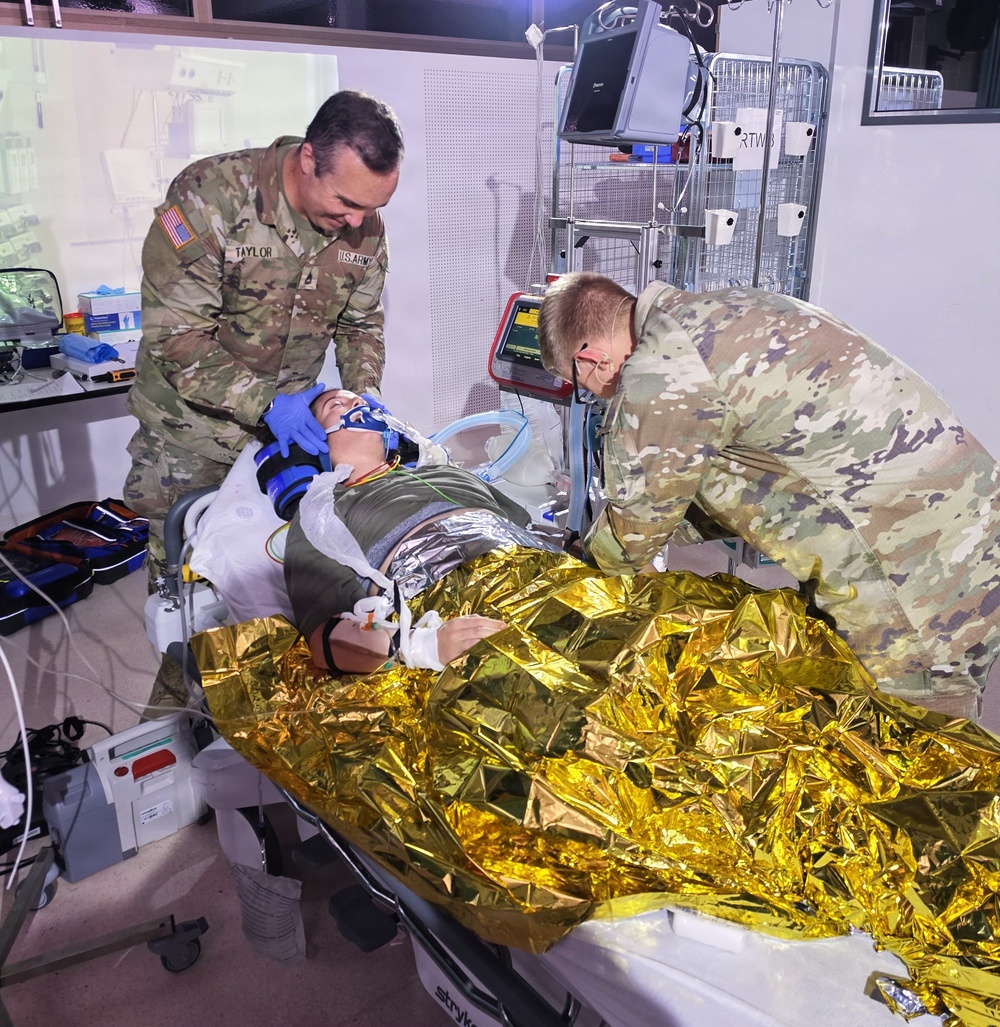
Courtesy Photo | VAIHINGEN AN DER ENZ, Germany – Two US Army Combat Medics assigned to US Army...... read more read more
VAIHINGEN AN DER ENZ, Germany – Two US Army Combat Medics assigned to US Army Medical Department Activity Bavaria participated in Emergency Room focused training alongside German Army Special Operations medics at the RKH Simulation Center in Vaihingen an der Enz, Germany June 8 - 12.
Taking part in the intense weeklong training was Sgt. 1st Class Byron Taylor and Staff Sgt. Caleb Scibbe. Both Soldiers are 68W Combat Medics - Scibbe is assigned to the US Army Health Clinic Ansbach and Taylor is assigned to US Army Health Clinic Stuttgart.
“My biggest takeaway from the training was witnessing the significant effort both nations have invested in medical interoperability,” said Sgt. 1st Class Taylor. “This shared commitment ensures we can operate effectively as a combined joint medical team, which ultimately translates to saving lives.”
This was not Taylor’s first-time training with Bundeswehr medics. His initial training interaction with German medics was more than 7 years ago while stationed at Landstuhl Regional Medical Center.
“I wanted to attend the training and work with my German counterparts to see how practices and execution of medical care have changed for them over the last seven to ten years,” added Taylor. “I was lucky enough to be stationed in Landstuhl earlier in my career and had the pleasure of participating in several training events with the German Bundeswehr. Getting another chance to integrate with them early in my current tour was an opportunity I simply could not pass up.”
Training with the Bundeswehr provided a unique opportunity for the US Soldiers to learn how their counterparts approach emergency medicine and the techniques they use.
“I volunteered for this training because it provided opportunities to improve communication and team working skills with our Bundeswehr counterparts,” said Staff Sgt. Scibbe, primary care non-commissioned officer in charge at the Stuttgart Army Health Clinic. “I am always excited to practice my emergency medical skills and learn new things, especially from those who have more advanced skills than me.”
The advanced level training focused on emergency skills that included, but were not limited to, wound packing, pressure bandages, pelvic binders, airway adjuncts, noncommunicable diseases and chest seals, etc.
“We were able to practice endotracheal intubation in both rapid and delayed sequence intubation,” added Scibbe. “This was one of my favorite parts as this skill is not typically within the normal medic’s scope of practice until you are higher in rank.”
According to German medical officials, much of the training involved non-combat related trauma and medicine that is grounded in real life experiences of trauma and emergency medicine doctors around the world.
“We also performed wound cleaning and management, septic and hypovolemic shock management, damage control resuscitation protocols, and chest tubes,” Scibbe added. “In addition, we also had the opportunity to practice advanced cardiac life support and (Focused Assessment with Sonography in Trauma) ultrasound imaging exams.”
According to senior Army medical officials, advanced life-saving skills are critical for combat medics because they directly determine whether casualties survive the “golden hour” — the first 60 minutes after injury when prompt, effective care is most likely to save lives.
“It was an incredible experience working with our Bundeswehr partners,” added Scibbe. “Having worked with Bundeswehr Soldiers several times before, every time is an absolute honor and very beneficial. They bring a wealth of knowledge and experience that we can learn from. It was also a great opportunity for them to practice their English. As we look at preparing for potential future large scale combat operations, this type of interoperability with our Bundeswehr and other NATO partners is critical.”
“Overall, it was a great event, and I would love to do it again,” said Scibbe.” I would recommend this training to anyone if it becomes available to them. Working with our partner nations is a unique and rewarding experience and one that I will never forget.”
The RKH Simulation Centre is a state-of-the-art training and further education institution for medical specialists and assistants of all disciplines. The RKH simulation center offers all professional groups involved in the medical process a comprehensive range of state-of-the-art patient simulators. The RKH Simulation Center uses a formerly fully functional operating room and covers 1,000 square meters.
“The Bundeswehr Special Operations medics were exceptional and open to learning from all sources,” added Taylor. “I will gladly seek out future opportunities for myself and my Soldiers to participate in this caliber of joint training.”
| Date Taken: | 06.16.2026 |
| Date Posted: | 06.17.2026 09:38 |
| Story ID: | 567991 |
| Location: | DE |
| Web Views: | 40 |
| Downloads: | 0 |

This work, US Army Medical Department Activity Bavaria Soldiers train with Bundeswehr Special Operations Medics on Emergency Medicine skills, by Kirk Frady, identified by DVIDS, must comply with the restrictions shown on https://www.dvidshub.net/about/copyright.


No keywords found.





