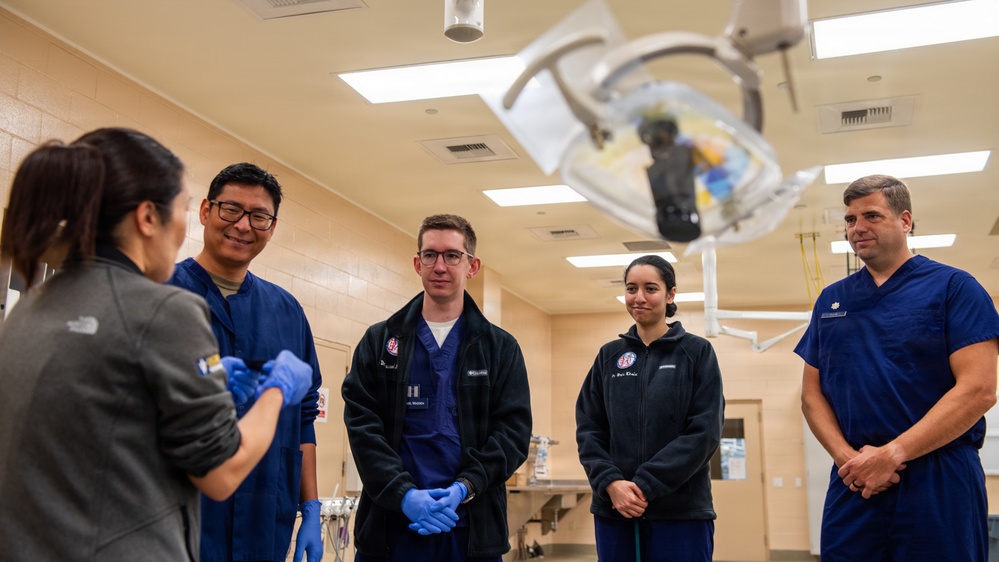
TRAVIS AIR FORCE BASE, Calif. – The 60th Dental Squadron partnered with the University of California Davis School of Veterinary Medicine during a two-day symposium May 20-21, 2026, to provide Air Force dental residents hands-on training in canine dentistry and military working dog care.
The training expanded military dental residents’ ability to identify and treat oral health conditions in MWDs, whose dental readiness directly impacts their ability to support force protection and detection operations across the Department of the Air Force.
The symposium addressed a military-specific training requirement not commonly found in civilian dental education, according to U.S. Air Force Lt. Col. Andrew W. Ellis, 60th Dental Squadron Dental Residency Flight commander and Advanced Education in General Dentistry program director.
“Air Force dentistry has unique, operational training requirements that simply do not exist in civilian dental schools or residency programs,” said Ellis. “Military dentists must be ready to sustain combat power, which includes treating active-duty service members as well as our military working dogs.”
UC Davis Weill School of Veterinary Medicine hosted and led the symposium for military health care personnel from Travis Air Force Base. Faculty from the Veterinary Medical Teaching Hospital’s Dentistry and Oral Surgery Service provided lectures, wet labs and hands-on instruction in canine dental radiography, radiographic interpretation, surgical extractions and endodontic therapy.
“Dental radiography is essential because many important dental diseases occur below the gumline and are not visible during an oral examination alone,” said Dr. Maria Soltero-Rivera, associate professor with the Dentistry and Oral Surgery Service at the Veterinary Medical Teaching Hospital, UC Davis Weill School of Veterinary Medicine. “Radiographs allow clinicians to diagnose fractured teeth, endodontic disease, periodontal bone loss, retained roots and other bone or tooth root pathology that could compromise the health, comfort and operational performance of military working dogs.”
During the two-day event, participants received instruction in canine dental radiography, surgical extraction techniques, local anesthetic nerve blocks, root canal therapy, transcoronal access, canal instrumentation, obturation and restoration of strategic working teeth.
The training also included presentations from Travis AFB personnel on bioceramic endodontic sealers and regenerative endodontics, highlighting an exchange of information between military dental providers and veterinary specialists.
Ellis said the hands-on portion gave residents an opportunity to apply human dental knowledge to a different operational environment.
“Getting hands-on, tactile experience capturing radiographs, performing complex surgical extraction techniques and conducting root canal therapy allowed our residents to translate their human clinical expertise into a completely different operational format,” said Ellis.
The symposium also brought together Air Force dental residents, veterinary clinic personnel, endodontic specialists and UC Davis veterinary dental experts. Participants included veterinary technicians from Travis AFB and Beale AFB, as well as virtual participants from the Air Force Postgraduate Dental School Endodontics Residency at Joint Base San Antonio-Lackland, Texas.
For MWDs, dental health is directly tied to performance, according to U.S. Army Sgt. Bryan Flowers, Beale Air Force Base Veterinary Treatment Facility noncommissioned officer in charge. Flowers said oral pain or infection can affect a dog’s ability to bite, search and remain focused during high-stress missions.
“An MWD relies entirely on its senses and its mouth to execute its duties,” said Flowers. “For patrol and force protection, the mouth is the dog’s primary tool for apprehension; severe dental disease compromises their grip and willingness to bite due to pain.”
Common dental issues in MWDs include fractured teeth, periodontal disease, attrition and abrasion, Flowers said. Handlers may notice subtle changes such as altered eating habits, hesitation during training, excessive drooling, swelling or foul breath.
Untreated dental conditions can affect bite function, endurance and overall ability to work. Advanced procedures, including root canals and extractions, can eliminate pain and infection while helping preserve a working dog’s operational capability.
“By removing the infected pulp and sealing the canal, we eliminate the pain and infection while preserving the tooth’s structural integrity,” said Flowers. “This allows the MWD to maintain its full operational bite capability without losing a vital asset.”
Soltero-Rivera said military working dogs are unique veterinary dental patients because their oral health directly supports their mission.
“Military working dogs are highly trained operational animals whose oral health directly affects mission capability and handler safety,” said Soltero-Rivera. “Preserving oral function through advanced dental and endodontic care is therefore especially important in this patient population.”
The symposium strengthened an ongoing partnership between Travis AFB and UC Davis by combining military dental experience with academic veterinary expertise. The collaboration allowed military providers to gain advanced training in veterinary dental techniques while giving UC Davis an opportunity to support service animal health and translational education.
“This collaboration creates a valuable exchange of knowledge between academic veterinary specialists and military medical personnel,” said Soltero-Rivera. “Military providers gain advanced training in veterinary dental techniques that support the long-term health and readiness of working dogs.”
Ellis said the training also demonstrated the value of joint-service collaboration between Air Force dental providers and Army veterinary personnel.
“Leveraging specialty capabilities through joint force collaboration, such as Army veterinary detachments working alongside Air Force dentists, is a strategic necessity,” said Ellis. “By pooling our expertise and sharing the burden of specialized care, we ensure our forces, human and canine, remain ready and capable.”
For MWDs supporting force protection and detection missions across the force, readiness extends beyond training alone. Continued collaboration between military medicine and veterinary specialists helps ensure MWD teams remain healthy, capable and ready to answer the mission when called upon.
| Date Taken: |
06.02.2026 |
| Date Posted: |
06.02.2026 19:28 |
| Story ID: |
566719 |
| Location: |
TRAVIS AIR FORCE BASE, CALIFORNIA, US |
| Web Views: |
391 |
| Downloads: |
1 |
PUBLIC DOMAIN

This work, Protecting the bite: Travis AFB, UC Davis partner to enhance MWD readiness, by Kenneth Abbate, identified by DVIDS, must comply with the restrictions shown on https://www.dvidshub.net/about/copyright.

 Subscribe






