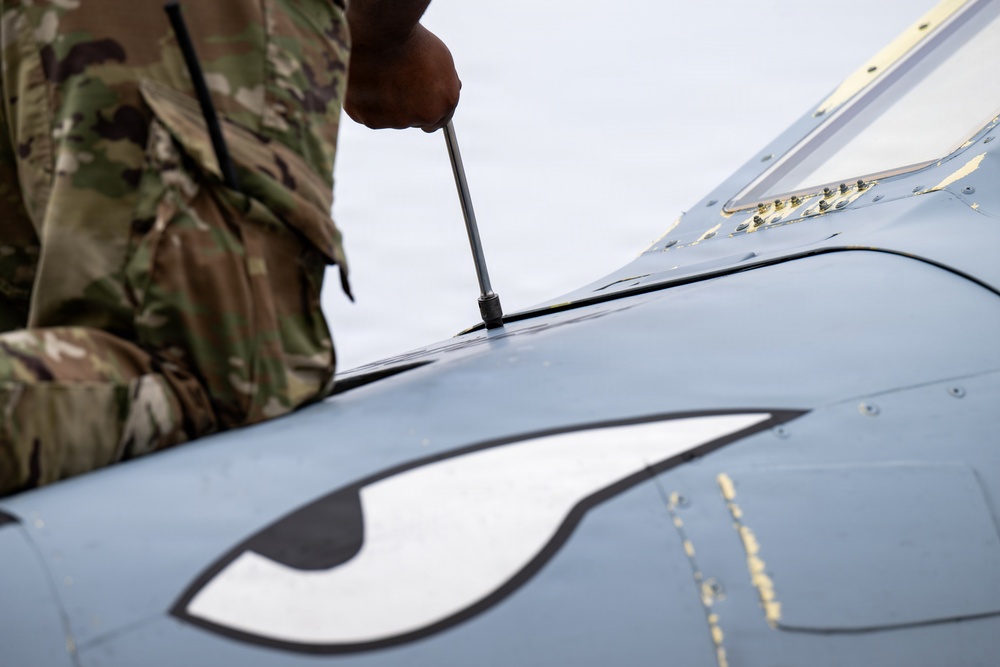
Photo By Airman 1st Class Rachel Howell | U.S. Air Force maintainer assigned to the 23d Maintenance Squadron, unscrews a bolt while installing an air refueling probe onto an A-10C Thunderbolt II at Moody Air Force Base, May 13, 2026. The refueling probe modification enhances the A-10’s ability to support combat search and rescue and close air support operations by enabling refueling from HC-130J aircraft at lower altitudes. (U.S. Air Force photo by Airman 1st Class Rachel Howell) see less
| View Image Page
Airmen at Moody Air Force Base completed the installation of the base’s first air refueling probe on an A-10C Thunderbolt II, enhancing the aircraft’s ability to support combat search and rescue and close air support operations.
The adapter allows A-10 pilots to use probe-and-drogue refueling instead of boom-only systems increasing refueling options, allowing the aircraft to refuel from HC-130J aircraft at lower altitudes, increasing operational flexibility and reducing the need for aircraft to climb to higher altitudes for refueling support.
Moody maintainers began preparing for the modification after learning in late April the probes would be delivered to the installation. According to Tech. Sgt. Brent Vargas, 23d Maintenance Squadron fuels craftsman, maintainers received the probes May 11 and began installation on the first of two aircraft May 13.
Installation typically takes approximately four hours to complete, though the team encountered challenges during the process.
“We did encounter an issue while installing the modified mount bolts that caused the nut-plates to cross thread, leading to the removal of the refueling receptacle, costing us several hours,” Vargas said.
Tech. Sgt. Wesley Zell, an A-10 refueling probe installer from Davis-Monthan Air Force Base, worked alongside Moody’s maintainers to complete the installation. Although the installation process is generally straightforward, removing existing aircraft hardware and correctly installing the mounting components proved to be one of the most difficult parts of the modification.
“There’s been a lot of issues getting these bolts removed so we can put the probe on,” Zell said. “These screws and bolts hardly ever come out anyway, so doing this is the time-consuming part of it. Once we get that part up, the install of the probe is very simple.”
Following the installation, pilots from the 74th Fighter Squadron conducted familiarization flights with the new capability. For Capt. Ron Wayman, one of the pilots involved, the flight marked a milestone for Moody’s A-10 community.
“It was a cool experience, something we’ve never done before,” Wayman said. “Getting to do it with the HC-130s from Moody was a pretty cool experience.”
The new refueling capability enables A-10s to receive fuel below 10,000 feet from HC-130J aircraft, allowing pilots to remain aligned with combat search and rescue operations while improving mission efficiency. The system also allows two A-10s to refuel simultaneously, unlike traditional refueling methods with KC-135 aircraft.
“It gives the A-10 a different way of being able to refuel with the HC-130s,” Zell said. “Now they can go low level, below 10,000 feet, refuel with the HC-130 and stay in the CSAR mission.”
Wayman said the added capability provides aircrews with greater operational flexibility for future missions and deployments.
“It’s a good capability for us,” Wayman said. “It’ll give us more options when we’re in future fights and during things as simple as moving across country or transoceanic crossings. It’s another capability that can help us.”
The installation effort also demonstrated the technical expertise and adaptability of Moody maintainers, who executed the modification at the flight-line level.
“It highlights our talents at the functional level, relying entirely on high-level capabilities of flight-line maintainers rather than specialized depot-level facilities,” Vargas said.
To prepare deploying Airmen to sustain the new capability downrange, Moody maintainers coordinated with subject matter experts from Davis-Monthan AFB during pre-deployment preparations.
“Davis-Monthan maintainers came TDY to walk us through the installation process and how to implement modular pack-out kits provided to reduce reliance on traditional supply chains,” Vargas said.
The effort reflects a broader push across the Air Force to rapidly integrate emerging capabilities and prepare Airmen to operate in evolving environments. Building on previous integrations completed downrange and at other A-10 units, teams collaborated to familiarize maintainers with the installation process and improve operational readiness.
The addition of the refueling probe marks a significant step forward in Moody Air Force Base’s combat capability, expanding the A-10C Thunderbolt II’s ability to support combat search and rescue and close air support operations. By integrating the system ahead of deployment, Moody Airmen increased operational flexibility, extended mission endurance and reinforced the Air Force’s commitment to rapidly adapting combat capabilities for future fights.

 Subscribe






