
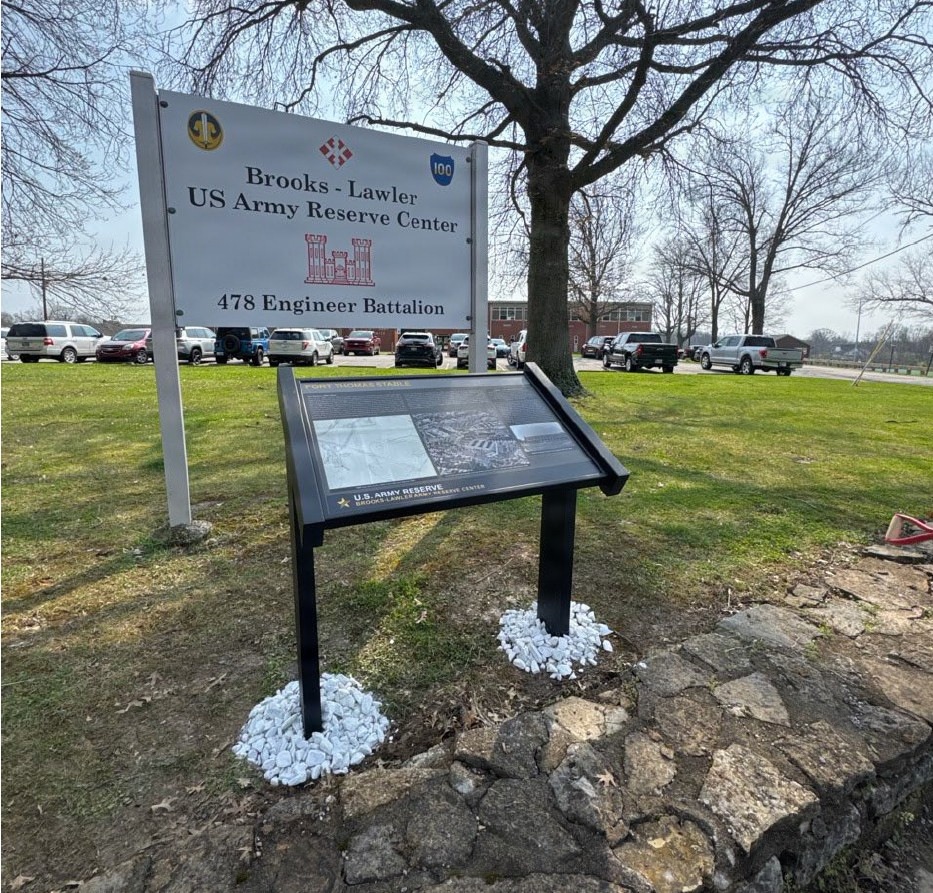
Photo By Ashley Bradford | A newly installed interpretive panel at the 81st Readiness Division’s Brooks-Lawler...... read more read more
The 81st Readiness Division (RD), headquartered at Fort Jackson, SC, installed three new interpretive panels at U.S. Army Reserve Centers in Kentucky, Florida, and Georgia, respectively. The panels capture insights into the facilities, their locations, and fascinating historical events. These panels serve as an anchor to the past as they shine a light on the legacies that shaped America and the Army Reserve.
The historical research and art design was prepared by Environmental Research Group, LLC out of Baltimore, MD. In addition to the panels, interactive presentations were developed to accompany the panels. “ERG put together some amazing presentations with old photos from their research,” shared Jason Clutter, who serves as 81st RD Senior Environmental Protection Specialist. “It includes links to Smithsonian interviews as well as interactive aerial photos to compare views throughout time. The presentations provide a lot more history than what’s on the signs themselves. We’re currently determining the best way to format these so they can be used at the sites for Soldiers, Civilians, and visitors to learn more.”
As for the future, Clutter is hoping to install more interactive panels and to keep the Army Reserve legacy a part of conversations. “These are snapshots in time that we don’t want to forget,” explained Clutter. “I hope the panels start discussions so others can learn about important parts of time so we don’t lose our knowledge. In earlier years, the Reserve was big on building in the middle of nowhere because the land was affordable and towns grew around them. They inspired a lot of our communities that we call home. Now, our strategy looks different in how we determine where to add facilities. So as years pass, we lose people who know these sorts of important details, so this research is a great foundation for future generations who will continue to preserve Army Reserve history.”
Athens Army Reserve Center Honors Beginnings as Lyons Elementary Athens Army Reserve Center, GA was originally constructed as Lyons Elementary School for African Americans during segregation in 1956. It was named after Charles H.S. Lyons, a renowned African American educator in Athens in the early twentieth century. By 1963, the school became Lyons Junior High School and integrated by accepting students from all sections of Clark County. By 1974, the school became Lyons Middle School.
In 1979, a local paving contractor proposed the construction of an asphalt plant a mere 500 feet from the school. The Clarke County Board of Commissioners denied the request citing potential exposure to cancer-causing agents to children. In response to the denial, one board member then raised concern over the school’s location in an industrial area. Ultimately, against the wishes of the Lyons PTO and the community who valued the benefits provided by smaller class sizes, 400 students were sent to nearby schools, and Lyons closed its doors in 1982.
After the school’s closure, Clark County exchanged the complex (in the same year) with the Army Reserve for the original Athens Army Reserve Center at Franklin and Dearing Streets. Over the years, the buildings have been used for training and light maintenance activities. The original Lyons school building was determined eligible for listing in the National Register of Historic Places in 2018 under Criteria A and C for its association with education during segregation.
Brooks-Lawler Army Reserve Center’s Commemorates Fort Thomas Stable Between the 1880s and 1890s, the U.S. Army consolidated troops at larger permanent posts during the westward expansion. Fort Thomas, KY replaced Newport Barracks which was a relocation of Fort Washington located across the river in Cincinnati, OH. Fort Thomas was constructed between 1890-1901 and served as a mobilization point during the Spanish-American War.
According to an 1891 news article, plans to build a new stable in the spring were announced. While no calvary unit was stationed at Fort Thomas, stables were integral to the mission and operation of Army posts prior to World War II, as horses were essential for transporting military supplies. The stable was first depicted on a map in 1909. In 1945, an aerial photo depicted the rectangular brick structure with a gable roof and clerestory along the ridge, and a hipped-roof addition on the building’s southeast elevation. The first story originally held 26 horse stalls and the second story was used as a hayloft. The building has kept much of its original appearance and was added to the National Register of Historic Places in 1986. It now serves as a storage facility for Brooks-Lawler Army Reserve Center, which was established in 1962.
McCoy Army Reserve Center McCoy Army Reserve Center, FL has supported numerous wartime efforts throughout its history. It’s location in Orlando can be traced back to 1940 when the U.S. Army Air Corps took over the Orlando Municipal Airport, renaming it the Orlando Army Air Field. Expansion after World War II led the site to be renamed Pinecastle Air Force Base in 1942.
In 1957, a B-47 aircraft piloted by Colonel Michael McCoy crashed shortly after takeoff, killing all four crew members. McCoy is credited with steering the aircraft away from populated areas, sacrificing his life and those of the crew members to prevent further casualties. In recognition, Pinecastle Air Force Base was renamed to McCoy Air Force Base in 1958.
In response to rising tensions with Cuba during 1959, the base maintained a heightened alert status and additional facilities were constructed, including a SAC Crew Readiness or Alert Facility (Building 571). Due to its proximity to Cuba, McCoy played a key role during the Cuban Missile Crisis, experiencing a major surge of aircraft and serving as a primary tactical base for U.S. military buildup. McCoy later supported Vietnam War operations and provided nuclear deterrence for the homeland. The base officially deactivated in 1974 with much of its infrastructure repurposed for Civilian and Army Reserve use by 1976. Building 571 serves as McCoy Army Reserve Center.
(Released by MAJ Long Pham)
| Date Taken: | 05.21.2026 |
| Date Posted: | 05.21.2026 14:59 |
| Story ID: | 565919 |
| Location: | FORT JACKSON, SOUTH CAROLINA, US |
| Web Views: | 87 |
| Downloads: | 0 |

This work, Preserving the Past: New Interpretive Panels Highlight U.S. Army Reserve History, by Ashley Bradford, identified by DVIDS, must comply with the restrictions shown on https://www.dvidshub.net/about/copyright.


No keywords found.





