
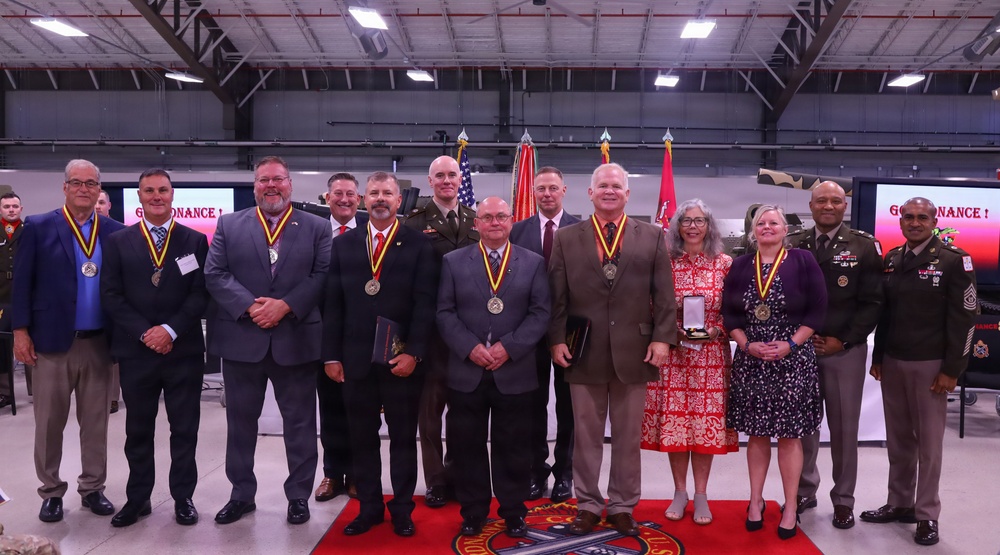
Photo By Dani Johnson | U.S. Army Ordnance Corps inducted 10 individuals into the 2026 Hall of Fame in a...... read more read more
FORT LEE, Va. – U.S. Army Ordnance Corps inducted 10 individuals into the 2026 Hall of Fame in a ceremony May 15 at the Ordnance Training Support Facility.
The Ordnance Corps Hall of Fame was established on May 9, 1969 to recognize and honor persons who have made a significant contribution to the U.S. Army Ordnance Corps. Its members are honored with a permanent display inside Hatcher Hall's Ball Auditorium located on the Ordnance School Campus, Fort Lee, Virginia.
“The individuals selected for this honor exemplify what a member of the Ordnance Corps is about,” said Col. Robin Montgomery, U.S. Army’s 45th Chief of Ordnance and Commandant, Ordnance School. “It’s an honor to induct these amazing people to the Ordnance Hall of Fame roster.”
Individuals are chosen solely on their merits and significant contributions to the U.S. Army Ordnance Corps. Each selectee's nomination is reviewed by a board composed of members of the Ordnance Corps and Ordnance Corps Hall of Fame.
Inductees for 2026 are:
Master Sgt. (retired) David T. Crockett dedicated over four decades to the U.S. Army and its logistical readiness, beginning with his entry into active duty in 1980 as a wheeled vehicle/power generator mechanic. His career spanned roles as a Soldier, recruiter, noncommissioned officer, contractor, and Department of the Army civilian, consistently earning accolades for dedication, technical expertise, and leadership.
Col. (retired) Phillip G. Deaton was recognized for a distinguished 32-year career of unparalleled service as an Ordnance Corps officer, multifunctional logistician, and Acquisition Corps officer, making immense contributions to the U.S. Army Ordnance Corps. A veteran of Operations Desert Shield/Desert Storm, Iraqi Freedom, and Enduring Freedom, Deaton's career mirrored the Ordnance Corps' mission of supporting the development, production, acquisition, and sustainment of Army equipment.
Master Sgt. (retired) Christopher R. DeCosta completed a distinguished 26-year career in the U.S. Army Reserve, demonstrating exceptional expertise and leadership within the logistics community. Culminating in his role as the Army Reserve Senior Ground Maintenance Non-Commissioned Officer, DeCosta spearheaded a transformative overhaul of the Army Reserve Maintenance Program, re-establishing a maintenance-first culture crucial to readiness. His efforts directly impacted on the readiness of over 300,000 pieces of equipment across more than 4,500 units.
Chief Warrant Officer 5 (retired) Robert E. Garrison dedicated 52 years of combined military and civilian service to the Ordnance Corps, retiring in February 2025. Enlisting in 1972, his career spanned technical expertise, leadership, and impactful contributions to training and modernization.
Chief Warrant Officer 4 (retired) Joseph Karmazyn dedicated a remarkable 47-year career to Army maintenance, beginning his service in 1977 and retiring in 1998 after 21 years of active duty, followed by 20 years of civilian service. Throughout his career, he mastered all levels of maintenance – organization, direct support, and general support – and served as a skilled observer, controller/trainer.
Rene Kiebler dedicated his career to advancing U.S. Army artillery and mortar capabilities, serving as a pivotal leader in munitions development, production, and fielding for more than a decade. From 1998 to 2014, he held increasingly responsible positions within the Program Office for Ammunition, culminating in significant contributions to technologies that directly enhanced Warfighter effectiveness.
Lucinda (Cindy) Lenger was recognized for her 32 years of dedicated service managing and distributing munitions for the Army and joint forces. Lenger's expertise was instrumental in developing and implementing the Centralized Ammunition Management system, revolutionizing ammunition logistics across the Army and enhancing support to joint agencies.
Chief Warrant Officer 5 (retired) Alberto Morrison served the U.S. Army with exceptional distinction for 29 years, culminating in his assignment as the senior communication and electronic maintenance warrant officer for the Network Enterprise Technology Command. Despite his Ordnance background, Morrison's career was largely defined by impactful contributions to the Signal Corps. Morrison was posthumously inducted into the Hall of Fame.
Col. (retired) Herman T. Palmer held a career that exemplifies transformational leadership and sustained excellence in Army logistics and ordnance operations. Throughout over three decades of service, he consistently delivered enhanced readiness, efficiency, and cost-effectiveness across multiple global deployments and complex logistical challenges. Palmer was posthumously inducted into the Hall of Fame.
Master Sgt. (retired) Julie M. Peer-Talley had a distinguished 22-year career as an Ordnance Soldier that embodied the spirit of the profession and a commitment to advancing the Corps' mission. Enlisting during the buildup to Operation Desert Storm, she boldly chose the 63B Light Wheeled Vehicle Mechanic military occupational series, a nontraditional path for women at the time, and quickly distinguished herself as a technical expert and leader. Peer-Talley retired from the Army in August 2013.
The Ordnance Branch is one of the oldest branches of the U.S. Army with its establishment on May 14th, 1812. However, the duties and responsibilities of the profession date back to the colonial era with the appointment of Samuel Sharpe as the first Master Gunner of Ordnance for the Massachusetts Bay Colony in 1629.
| Date Taken: | 05.15.2026 |
| Date Posted: | 05.15.2026 14:01 |
| Story ID: | 565417 |
| Location: | US |
| Web Views: | 22 |
| Downloads: | 0 |

This work, Ordnance Inducts 2026 Hall of Fame Members, by Dani Johnson, identified by DVIDS, must comply with the restrictions shown on https://www.dvidshub.net/about/copyright.


No keywords found.





