
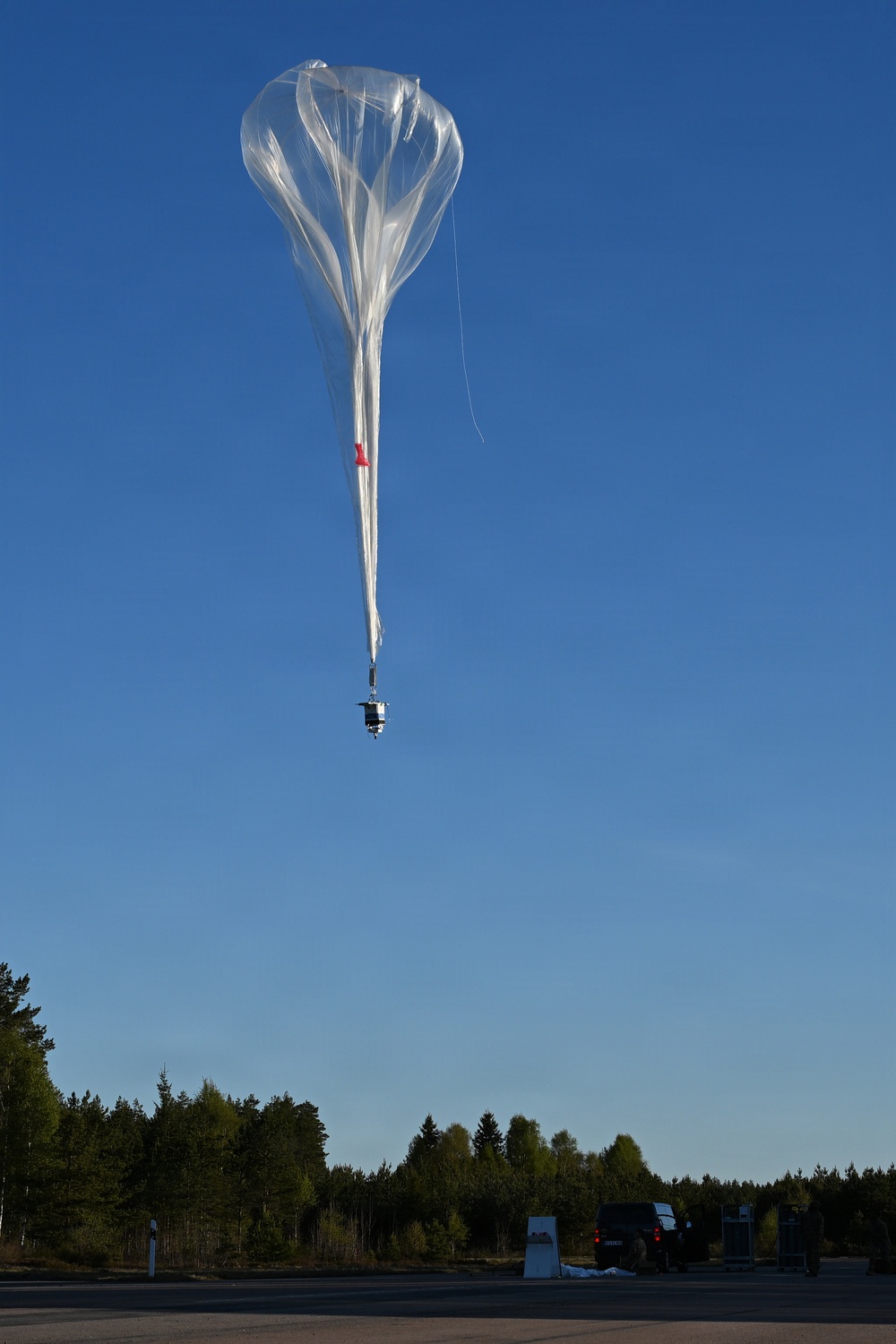
Photo By Master Sgt. John Healy | Soldiers from Multi-Domain Command - Europe launch Micro High Altitude Balloons (HABs)...... read more read more
WIESBADEN, Germany — U.S. Army Soldiers assigned to Multi-Domain Command – Europe conducted a series of Micro High-Altitude Balloon launches from Sweden on May 9, 2026, as part of multinational training tied to Sword 26 and Swedish exercise Aurora.
The launches allowed Soldiers to validate procedures for operating high-altitude balloon platforms in a European environment while coordinating closely with Swedish authorities and NATO Allies across the Baltic region.
Operating in the stratosphere at altitudes between approximately 60,000 and 70,000 feet, the micro high-altitude balloons, or Micro-HABs, carried experimental payloads designed to test sensing and communications capabilities supporting multi-domain operations. The platforms remained airborne for approximately 12 hours while operators monitored flight performance, communications, and recovery procedures.
“This event allows our Soldiers to experiment with emerging technologies while working closely with our NATO Allies,” said U.S. Army Col. Jeffrey Pickler, commander of 2nd Multi-Domain Task Force. “Testing capabilities like high-altitude platforms helps us better understand how these technologies operate and how they might contribute to future operations in support of regional security.”
Swedish officials also highlighted the cooperative nature of the activity and the opportunity to strengthen interoperability between allied forces during the training event.
“Coordinating and supporting the launch together with the U.S. Army strengthens allied interoperability and provides an opportunity to share knowledge on emerging technologies and unmanned systems to improve our joint domain awareness,” said Rear Admiral Jonas Wikström, Exercise Director of Swedish exercise Aurora 26.
The training was conducted in approved airspace and coordinated with host-nation authorities throughout the operation. According to the Army, the activity supported ongoing experimentation with technologies that could improve operational awareness, communications extension, and interoperability across the European theater.
During one flight, operators identified an issue with a balloon platform and safely terminated the flight over water near the Swedish island of Gotland in accordance with established safety procedures. Swedish recovery teams, working in coordination with U.S. personnel, successfully recovered both the balloon and payload.
MDC-E officials said the operation demonstrated the importance of transparency, coordination, and allied cooperation when conducting experimentation with emerging technologies in the Baltic region.
The launches come as NATO countries increasingly monitor the use of unconventional aerial platforms in the region, including balloons and small unmanned systems employed for surveillance, infrastructure monitoring, and hybrid activities. Army planners say experimentation with high-altitude platforms helps U.S. and allied forces better understand how emerging aerial technologies operate in complex operational environments.
The activity also supported the Eastern Flank Deterrence Initiative by improving the ability of U.S. and allied forces to understand and respond to evolving technologies affecting regional security.
| Date Taken: | 05.12.2026 |
| Date Posted: | 05.13.2026 08:12 |
| Story ID: | 565119 |
| Location: | WIESBADEN, DE |
| Web Views: | 222 |
| Downloads: | 0 |

This work, Multi-Domain Command – Europe Test Stratospheric Balloons in Baltic Exercise, by Clinton Carroll, identified by DVIDS, must comply with the restrictions shown on https://www.dvidshub.net/about/copyright.


No keywords found.





