
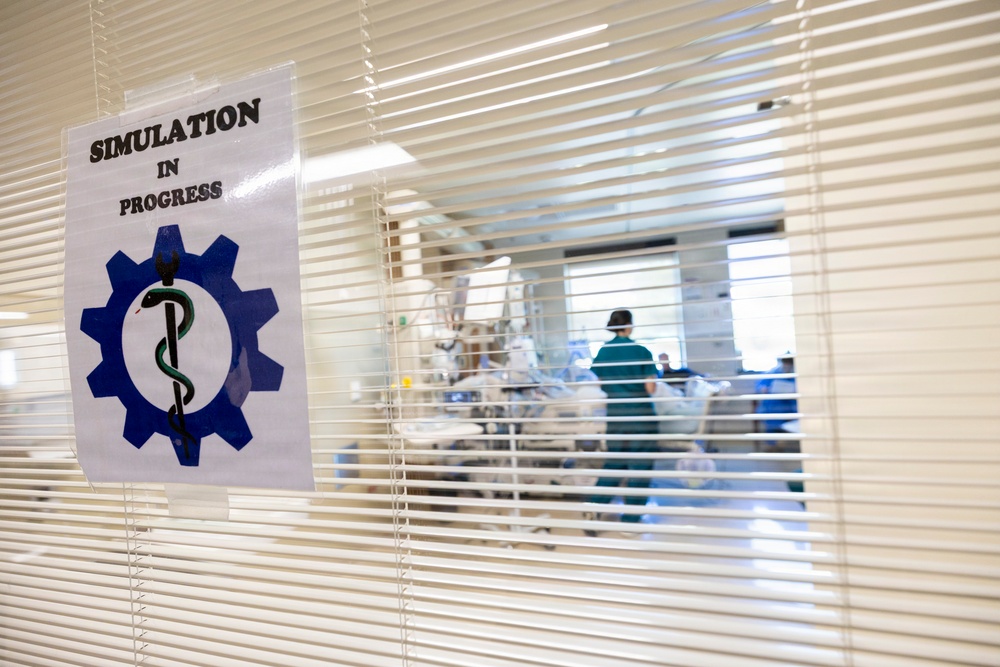
Photo By Ricardo Reyes-Guevara | A "Simulation in Progress" sign marks the entrance to an ICU room as U.S. Navy Lt....... read more read more
 Subscribe
BETHESDA, Md. — An intensive care unit (ICU) patient was crashing. Blood pressure dropping, oxygen levels falling, the ventilator struggling to keep pace. The monitors were going off. A nurse cut through the room, adjusting drips, troubleshooting equipment, calling for backup.
The situation looked bleak.
But the patient was never in danger. The scenario was a simulation, the final evaluation standing between four Navy nurses and graduation from the inaugural Navy Critical Care Course at Walter Reed National Military Medical Center.
Walter Reed is the host site for the U.S. Navy’s first standardized critical care nursing course, offered across the Defense Health Agency. The 90-day curriculum combines approximately 408 hours of clinical training, 126 hours of didactic instruction, and 78 hours of online coursework, giving nurses the tools to manage the sickest patients in any environment, from a stateside hospital to a forward operating base.
“[Critical care nurses] treat the sickest of the sick,” said Lt. David Taylor, a clinical nurse specialist who helped develop the course. “They can be the triage nurse, the pre-op nurse, the post-op nurse, and sometimes they have to fly with patients. We have to be able to do a little bit of everything.”
Before this course existed, Navy nurses assigned to the ICU received on-the-job training that varied widely from hospital to hospital. A nurse would be paired with a preceptor, complete an online orientation module, log a set number of shifts, and then go off on their own. The new course changed that equation.
“Every ICU nurse will have had the same training,” Taylor said. “When they go to their next duty station, we’re all starting with the same base level of knowledge, and that’s something you couldn’t guarantee with 25 hospitals each doing it differently.”
The course was built using a flipped classroom model, grounded in evidence-based research developed in partnership with the Tri-Service Nursing Research Program. Students completed online modules at home, then applied that knowledge in person through case studies, skills training, and three progressive simulation exercises: a baseline assessment, a midterm, and a final.
Lt. Cmdr. Wade Miller, a clinical nurse specialist and co-developer of the course, described the simulation as the culmination of everything students have worked toward. “We have a grading rubric with key metrics and key tasks,” he said. “This is the third phase of our verification and validation, demonstrating what the students have learned before they go and practice on their own.”
For Lt. j.g. Mathew Rasmussen, the course was the fulfillment of a long-held goal. Rasmussen, a former Navy corpsman who spent his first enlistment working in an ICU at Naval Medical Center San Diego, later commissioned as a nurse through the Medical Enlisted Commissioning Program — a path that took three application attempts and four straight semesters of nursing school.
“I fell in love with critical care,” Rasmussen said. “And I always knew I wanted to do it.”
Like all four students, Rasmussen spent at least a year on a medical-surgical floor before being selected for the course, a requirement designed to build foundational nursing skills before the step up to intensive care. He said the course’s pace was the biggest challenge. “I was here nine out of 11 days,” Rasmussen said. “You have a day off, then come back for class, then three shifts in a row. It was definitely some work.”
The simulation, he said, validated the instincts he had been building throughout his career. “It’s about getting down the systematic approach, how you enter the room, how you look at the patient, the drips, the vent, the monitor,” he said. “It’s easy to get overwhelmed with everything going on. The sim helps validate that you’re ready.”
“From the beginning to now, the change is quite remarkable,” Miller said, watching the students progress over 90 days. He told the students he and the other instructors would trust them to care for their own families.
All four graduated.
Walter Reed, Naval Medical Center Portsmouth and Naval Medical Center San Diego serve as the three permanent host sites for the Navy Critical Care Course, drawing nurses from medical facilities around the force. The inaugural cohort reflects that vision, with two students from Alexander T. Augusta Military Medical Center and two from Walter Reed, the two premier military medical facilities serving the National Capital Region.
What began with four students at Walter Reed will, in time, mean that every Navy ICU nurse — at every duty station, in every environment — starts from the same baseline of proficiency.
| Date Taken: | 05.12.2026 |
| Date Posted: | 05.12.2026 13:25 |
| Story ID: | 565025 |
| Location: | BETHESDA, MARYLAND, US |
| Web Views: | 227 |
| Downloads: | 0 |

This work, Walter Reed Launches First Navy-Wide Critical Care Nursing Course, by Ricardo Reyes-Guevara, identified by DVIDS, must comply with the restrictions shown on https://www.dvidshub.net/about/copyright.


No keywords found.




