
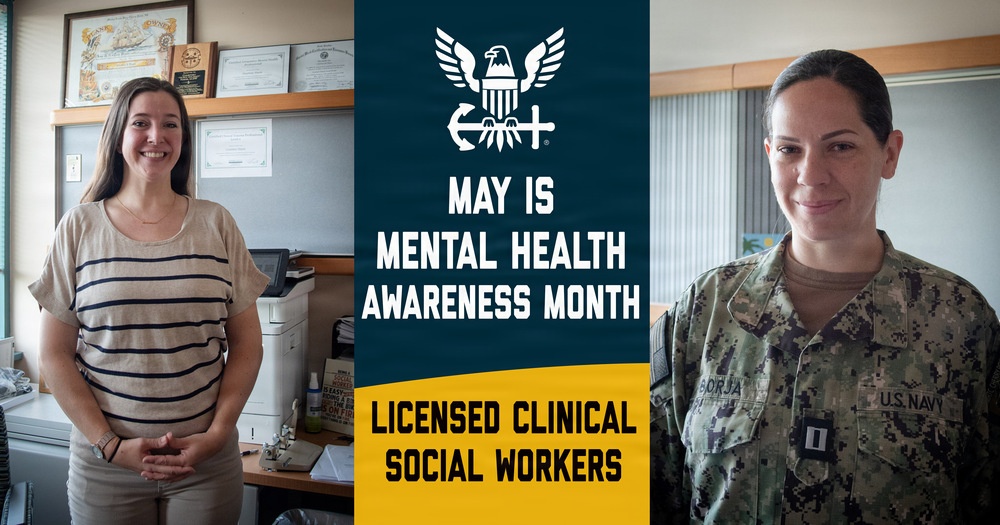
Photo By Thomas Cieslak | Courtney Hayes and Lt. Joelle Borja serve as Licensed Clinic Social Workers aboard...... read more read more
Aboard Marine Corps Air Station Cherry Point, Navy Lieutenant Joelle Borja and Courtney Hayes share the same goal, ensuring the mental wellness and deployment suitability of Marines and Sailors.
As a Licensed Clinical Social Worker, Borja serves as the Department Head for the Mental Health Department at Navy Medicine Readiness and Training Command Cherry Point, where she also provides direct patient care.
Hayes, a Licensed Clinical Social Worker and a team member of the Intensive Outpatient Program, provides group and individual treatment options while engaging with a patient’s command.
“Mental Health directly correlates to overall health”
Borja and Hayes are components of a multifaceted approach to ensure the mental health of MCAS Cherry Point’s Marines and Sailors and their ability to deploy in support of extended training and operations and to reintegrate with their communities and families upon their return.
“Good mental health supports mission readiness through resiliency, adaptability and typically leads to improved sleep outcomes and judgement,” said Hayes. “Poor mental health impacts resiliency, judgement, understanding, adaptability and capacity, which can pose a risk to the mission.
“Mental Health directly correlates to overall health,” said Borja, a native of Pittsburgh, Pennsylvania. “It impacts the ability to tolerate and navigate stressors, how we interpret our circumstances and interact with our environment.”
Part of the Mental Health team’s job is to assess whether a Marine or Sailor can deploy to conduct their mission or if they need a period of treatment before returning to duty, said Borja. The team’s overall goal is to ensure a service member has the support they need to return to full duty and have a meaningful career.
While serving towards the same goal of readiness, Borja and Hayes’ treatment methods differ to address the specific needs of their patients.
"My treatment aims to help [service members] understand their symptoms"
Borja’s methodology centers around talk therapy and referrals to resources to further the service member’s care. During her treatment, patients are taught to remain accountable for their own actions and emotions while learning skills for coping and self-advocacy.
Hayes’ approach focuses on how the body holds trauma. She uses somatic, polyvagal, attachment-based methods to assist patients’ efforts to regulate their nervous systems and process difficult experiences.
“My treatment aims to help [service members] understand their symptoms, know how to identify both the mental and physical presentation of symptoms, and provide tangible skills that can be used in various settings to reduce and/or eliminate their symptoms,” said Hayes. “I help [service members] understand through psychoeducation. If someone can have insight, they can start to accept. Once they accept, they can make the improvement.”
By providing a comprehensive and diverse range of care and treatment, Borja and Hayes ensure when MCAS Cherry Point’s Marines and Sailors answer the call to deploy, their mind is prepared to execute the mission with focus and resilience.
| Date Taken: | 05.12.2026 |
| Date Posted: | 05.12.2026 07:22 |
| Story ID: | 564986 |
| Location: | CHERRY POINT, NORTH CAROLINA, US |
| Hometown: | PITTSBURGH, PENNSYLVANIA, US |
| Web Views: | 147 |
| Downloads: | 0 |

This work, We Keep the Warfighter’s Mind in the Fight: Cherry Point Licensed Clinical Social Workers, by Thomas Cieslak, identified by DVIDS, must comply with the restrictions shown on https://www.dvidshub.net/about/copyright.


No keywords found.





