
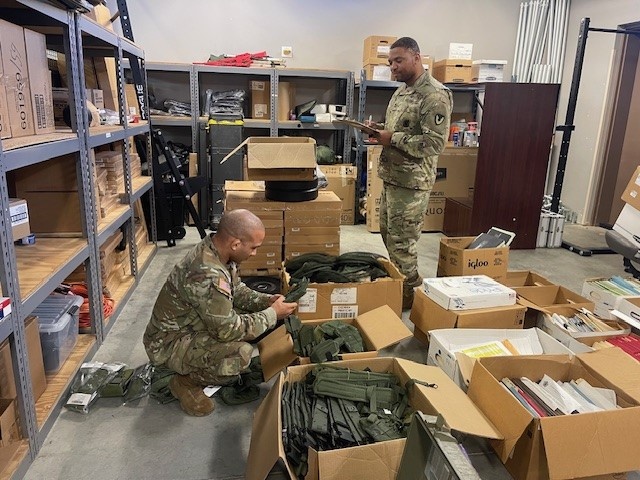
Courtesy Photo | Security Assistance Training Company Spc. 1st Class Christopher Hollins and Spc. 1st...... read more read more
 Subscribe
By: Lt. Gen. Gavin Lawrence, deputy commanding general of Army Materiel Command; Maj. Gen. Eric Shirley, commanding general of Army Sustainment Command
The dust settles on Fort Campbell as the last AH-64 Apache lifts off, signaling the inactivation of an air cavalry squadron. But the mission isn’t over. Hundreds of pieces of aviation equipment – from sophisticated targeting systems to specialized maintenance tools – remain, representing a significant logistical challenge.
Traditionally, this would trigger a lengthy process of documentation, coordination and potential delays, diverting valuable resources from the remaining units. Now, a different scene unfolds: a dedicated Equipment Redistribution and Divestiture Site, or ERDS, team arrives. The team establishes a streamlined process to rapidly assess, redistribute or divest the squadron’s equipment, ensuring a seamless transition and maximizing the recovery of vital assets.
In 2025, the Army Transformation Initiative and force structure adjustments created significant equipment imbalances across the force, as hundreds of units were marked for conversion, relocation or inactivation. These conversions inevitably result in the possession of major end items and other equipment that are no longer aligned with new missions. Managing the divestiture or redistribution of this equipment not only presents a logistical challenge but also places a burden on Soldiers who conduct maintenance and inventory.
ERDS is Army Materiel Command’s enterprise solution to the growing challenge of maintaining operational readiness in a dynamic environment. This new capability is one of many efforts by AMC to streamline equipment management, free up resources for units impacted by ATI and refocus Soldiers on their core mission: to be agile, lethal and ready.
AMC and Army Sustainment Command have been at the heart of alleviating the burden of excess equipment on Soldiers – from running 14 Modernization Displacement and Repair Sites that provided a centralized location supporting equipment turn-in, to launching the Rapid Removal of Excess, or R2E, initiative that freed up valuable storage space from obsolete equipment and reduced maintenance burdens on units.
Since the inception of MDRS in 2016, units have transferred more than six million pieces of equipment to the Army at sites located around Army installations in the U.S. The R2E business rules introduced in 2024 enabled the Army to reduce over one million pieces of equipment from unit property books over 18 months.
While they proved to be successful efforts, R2E and MDRS were designed to support a different Army structure and presented unsustainable funding challenges. A new approach is needed to manage equipment redistribution as the Army enters an age of Continuous Transformation.
Equipment Redistribution and Divestiture Sites
ERDS represents an evolution in Army equipment management – it is aflexiblecapability, deploying directly to impacted installations and units when they need it most. A dedicated team of logistics professionals establishes a temporary site to assist units in clearing their property books of equipment slated for divestiture or redistribution within one business day of turn-in. Where MDRS was an enduring expense for the Army, ERDS is an agile capability that the Army can strategically fund and deploy when units enter modernization windows.
Excess equipment from inactivating units often surpasses the capacity of local Supply Support Activities. ERDS returns time to Soldiers, allowing them to stay focused on their warfighting mission, by streamlining the property accountability process through its year-long focus sites at Fort Bragg, Fort Hood and Fort Carson, and three mobile ERDS teams available to support installations across the Army.
At the senior commander’s discretion, ERDS can support units across all components within a 150-mile radius of each site and provides a scalable solution for Class II non-expendables, Class VII major end items and Class IX repair parts.
An enticing draw for units is the ability for ERDS to accept Class IX items, which can be quickly accepted by ERDS representatives and redistributed back into the Army’s supply chain.
ERDS Basics
Unlike MDRS, ERDS sites and teams do not conduct any maintenance or repair. ERDS teams will only confirm that equipment is transportable and up to the directed maintenance standard. If not, that end item remains the unit’s responsibility to repair, and the ERDS representative will not accept the equipment until it is reconciled.
To further simplify the process and increase turn-in velocity, ERDS also reduced the number of documents for accountability relief. Additionally, an exception to policy was signed by Lt. Gen. Michelle Donahue, Army deputy chief of staff, G-4, to further unburden units by designating top-down vetting of Proposed Sourcing Decisions and “as-is” acceptance status for all equipment. This ETP removed the requirement for time-consuming technical inspections and refinement of bills of material listings.
By nature, ERDS sites are not designed to be permanent, but to be responsive. For fiscal year 2026, the Army approved and funded operations for three focused sites at Forts Bragg, Hood and Carson. The Army also funded three separate mobile teams that are able to lift and shift to support other heavily impacted installations.
Best practices for divesting units
Beyond the ERDS operational framework, the process’s efficiency relies on unit-level discipline and chain of command involvement. One of the most important factors in a smooth divestment is early, consistent focus on documentation.
A successful divestment begins long before equipment reaches an ERDS site. Maintaining property book integrity early in the process is essential, as even small discrepancies can halt progress. Ensuring that every asset is accurately reflected on accountability records creates the foundation for a smooth, uninterrupted flow of equipment through the system.
Sustaining momentum throughout the divestment process requires active engagement with the Decision Support Tool. Developing a plan, regularly monitoring DST status and incorporating updates into routine battle rhythm events helps prevent vetting delays and keeps actions aligned across the formation. Tools like the Vantage ERDS dashboard, which draws data directly from DST and Global Combat Support System-Army provide leaders with a clear, real‑time picture of where equipment stands in the process.
Unit personnel must verify the routing identifier code and PSD, ensuring the pass-through UIC is designated as ERDS and that the “second leg” (or the equipment’s final destination) of the PSD must be validated and approved. This acts as the connecting order that moves equipment from the ERDS holding to the gaining unit or depot.
Looking ahead
ERDS teams have been met with buzz as they’ve arrived to assist Air Cavalry Squads with inactivations and Mobile Brigade Combat Teams with conversions. AMC and ASC leadership continue to receive positive feedback from supply sergeants, property accountability officers and senior commanders as the Army works together to prepare these units for their next mission.
When ERDS went to Fort Hood to assist the 1st Air Cavalry Brigade with divestiture of their equipment, Maj. Michael Satterwhite, 1st Air Cavalry Brigade S4, said: “By giving us accurate, real-time visibility of every item on our books, ERDS has streamlined the entire excess equipment process. Our units are turning in rolling stock and Class II/IX faster and with far fewer discrepancies than ever before.”
While ERDS is slated to end its mission Sept. 30, 2026, it represents a fundamental shift toward a more agile and responsive Army sustainment system, capable of adapting to evolving force structure and operational requirements. By optimizing equipment management, ERDS will free up resources for Army units, enhance operational readiness and enable the Army to maintain a decisive advantage on the battlefield.
| Date Taken: | 05.08.2026 |
| Date Posted: | 05.08.2026 15:18 |
| Story ID: | 564842 |
| Location: | US |
| Web Views: | 27 |
| Downloads: | 0 |

This work, Freeing Units to Fight: The ERDS Approach to Equipment Management, must comply with the restrictions shown on https://www.dvidshub.net/about/copyright.


No keywords found.




