
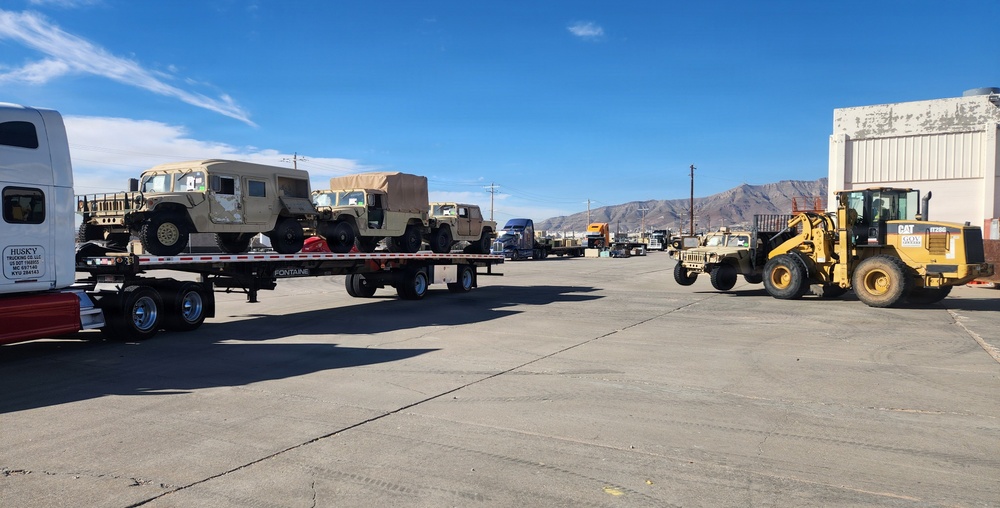
Photo By Greg Wilson | Workers at Army Field Support Battalion–Bliss, Texas, support the U.S. Army Materiel...... read more read more
Greg Wilson, ASC Public Affairs
ROCK ISLAND ARSENAL, Ill. – The Army’s push for rapid modernization is reshaping logistics operations across installations. At Fort Bliss, Texas, that initiated a major divestiture effort to clear room for an Equipment Redistribution Divestiture Site operation, which begins in May.
ERDS is a capability allowing units to bring excess or outdated equipment to be quickly processed, redistributed, or turned in. Designed to support seamless redistribution and turn‑in for units affected by Army structure changes, ERDS accelerates the removal of legacy gear so formations can modernize faster and maintain mission readiness.
For Army Field Support Battalion-Bliss, part of the 407th Army Field Support Brigade, the challenge was immense. Storage areas had become so congested that ERDS operations could not begin without a significant clearing effort. The battalion was tasked with removing more than 6,800 pieces of excess equipment to restore maneuverability and prepare the installation for future requirements.
“The transition is essential because modernization at this level requires space, speed, and property accountability,” said Maj. Herman Bardouille, Support Operations Officer for the 407th AFSB. “Our yard was saturated with equipment, and we assessed that ERDS operations could not succeed unless we created that space during the transition.”
Over a three‑month push ending last July, the battalion divested about half of its legacy equipment. The cleared yard enabled ERDS induction, improved equipment flow, and restored the installation’s ability to support III Armored Corps and 1st Armored Division readiness requirements. The effort set the conditions for the ERDS launch and highlighted how important organized divestiture is to meeting Army timelines.
“The push to clear nearly 4,000 pieces of legacy equipment significantly improved our readiness posture for ERDS operations slated to begin in May,” Bardouille said.
Executing the mission required close coordination with Defense Logistics Agency Disposition Services in Tucson, Arizona, which is responsible for managing, redistributing and disposing of excess military property; Tobyhanna Army Depot, Pennsylvania; and multiple commercial transportation companies.
“The teamwork between AFSBn-Bliss, 1AD Soldiers, and DLA DS was exceptional,” Bardouille added. “What stood out most was the discipline and urgency. Everyone understood the importance of freeing up space to support the Army’s transformation initiatives at Fort Bliss.”
ERDS locations were established to streamline turn‑in operations, accelerate divestiture, and keep vital efforts on schedule. Their success is essential to ensuring the Army can field new equipment at the speed required. The Fort Bliss divestiture mission reshaped the installation’s logistics footprint and demonstrated how the U.S. Army Sustainment Command, a major subordinate command of Army Materiel Command, enables readiness at the installation level.
As AMC’s operational arm, ASC synchronizes sustainment and manages equipment to ensure units have the materiel readiness required to train, deploy, fight, and win. As change accelerates across the Army, ASC’s ability to rapidly clear, redistribute, and divest legacy equipment has become increasingly vital to maintaining installation agility.
The mission was executed entirely by the battalion’s Soldiers and Army Civilians. Among them was Special Operations Plans & Operations Specialist Brenda Teruel, recently recognized by the 407th AFSB for her initiative, technical proficiency, and commitment to mission readiness.
“ERDS couldn’t move forward unless we created the space,” Teruel said. “That meant moving thousands of pieces quickly, safely, and accurately.”
The battalion conducted nine military convoys and four commercial depot shipments, maintaining accountability for more than $100 million in equipment.
Soldiers from the 1AD played a key role in preparing vehicles for DLA acceptance, removing sensitive items, draining fluids, disabling systems, and ensuring each piece met turn‑in standards.
The scale and pace of the effort drew attention from Army leaders who visited the yard to observe operations firsthand. “At the beginning I thought it wasn’t a big deal, just identifying equipment and getting it ready,” Teruel said. “Then visitors and leaders started to show up, and I understood how important this process is for the Army.”
AFSBn-Bliss showcases ASC’s mission by delivering the materiel readiness required to support III Armored Corps and the 1AD. The battalion’s ability to clear thousands of pieces of equipment reflects ASC’s strengths: disciplined processes, agile sustainment operations, and a workforce capable of adapting to evolving Army needs.
The divestiture also demonstrated how ASC’s installation‑level presence enables the Army to maintain momentum in transformation timelines. By reclaiming critical space, AFSBn‑Bliss directly supported ERDS activation, improved equipment flow, and ensured the installation could receive and field new equipment without delay.
As ERDS capacity expands and AMC refines redistribution processes, the work at Fort Bliss offers a successful model for installations across the Army. It reinforces ASC’s central role in sustaining combat power and preparing the force for future operations in contested environments, where speed, accuracy, and flexibility directly affect readiness.
| Date Taken: | 05.01.2026 |
| Date Posted: | 05.05.2026 12:41 |
| Story ID: | 564414 |
| Location: | US |
| Web Views: | 112 |
| Downloads: | 0 |

This work, ERDS: streamlining and accelerating Army readiness, by Greg Wilson, identified by DVIDS, must comply with the restrictions shown on https://www.dvidshub.net/about/copyright.


No keywords found.





