The Fort McCoy History Center recently received a pair of historic postcards that offer a rare visual glimpse into the early history and development of Camp McCoy during the years leading into World War II.
The donated artifacts — one featuring the iconic Chapel Spire at Camp McCoy and another showing a historic stone entrance sign constructed by the Works Progress Administration (WPA) in the late 1930s — help preserve the story of the installation’s transformation from a modest training site into one of the Army’s most important mobilization and training centers.
The postcards, though small in size, represent tangible pieces of Fort McCoy history. Their worn edges, aging photographic surfaces, and period printing styles reflect an era when postcards served as a primary way Soldiers and visitors documented military life and shared their experiences with families back home.
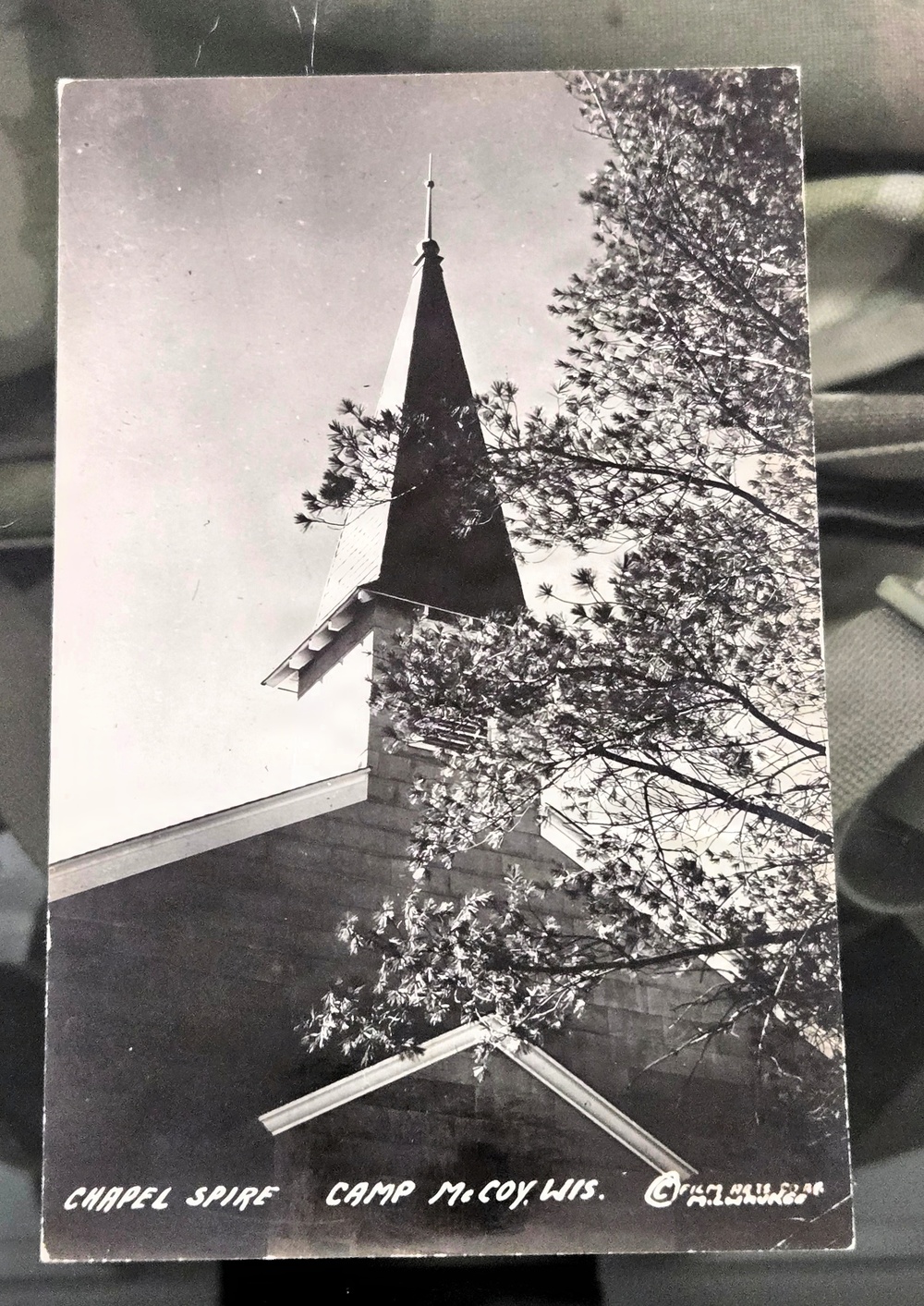
One postcard prominently features the sharp steeple and towering spire of a Camp McCoy chapel framed by pine branches. The black-and-white real photo postcard, believed to date to the World War II era, captures both the simplicity and importance of spiritual life at the installation during a time when tens of thousands of Soldiers trained at Camp McCoy before deploying across the globe.
The image highlights the chapel’s steep roofline and narrow spire rising above the cantonment area, symbolizing a place of reflection and comfort during wartime service. Chapels at Camp McCoy played a critical role throughout the mobilization years of the 1940s, supporting Soldiers from across the nation as they prepared for uncertain futures overseas.
The postcard itself is considered a “real photo postcard,” or RPPC, a popular photographic postcard format used extensively during the 1930s and 1940s. The artifact includes period lettering reading “Chapel Spire — Camp McCoy, Wis.” and carries a photographer’s studio mark from Milwaukee, further connecting the piece to Wisconsin history.
The second donated postcard depicts one of Camp McCoy’s historic stone signs constructed through WPA labor during the Great Depression era. Built in the late 1930s, the stone entrance features the rugged craftsmanship and native stonework commonly associated with WPA construction projects throughout the United States.
The WPA, established as part of President Franklin D. Roosevelt’s New Deal programs, provided employment for millions of Americans while completing infrastructure and public works projects nationwide.
At Camp McCoy, WPA workers helped build roads, bridges, stone structures, and training infrastructure that supported the installation’s rapid growth prior to World War II.
The stone sign postcard captures more than a physical structure — it reflects an important chapter in both Army and American history. The handcrafted masonry and rustic appearance represented the enduring style of Depression-era federal projects, many of which still remain at Fort McCoy today.
Together, the postcards help document two distinct but connected aspects of Camp McCoy history — the human side of military service represented by the chapel, and the installation’s physical development represented by the WPA stonework.
Officials with the Fort McCoy Public Affairs Office said artifacts such as these are important because they preserve everyday visual history that might otherwise be lost to time. While official reports and military records document major events, postcards and photographs often capture the atmosphere, architecture, and personal experiences associated with an installation’s past.
The postcards also complement the growing collection of Fort McCoy historical artifacts preserved within the Fort McCoy Commemorative Area and History Center. The museum contains exhibits and memorabilia spanning the installation’s history from its founding in 1909 through World War I, World War II, the Cold War era, Operation Desert Storm, and modern-day training missions supporting the Army Reserve and National Guard.
As Fort McCoy continues preserving its heritage, artifacts like these postcards provide a direct visual connection to generations of Soldiers, civilians, and workers who shaped the installation over more than a century of service.
Though modest in appearance, the postcards stand as enduring historical artifacts — small windows into the history, architecture, and daily life of Camp McCoy during some of the most transformative years in American military history.
Fort McCoy’s motto beginning in 2026 is “Training the Total Force and Shaping the Future since 1909.”
The installation’s mission: “Fort McCoy strengthens Total Force Readiness by serving as a training center, Mobilization Force Generation Installation, and Strategic Support Area enabling warfighter lethality to deploy, fight, and win our nation’s wars.”
And Fort McCoy’s vision is, “To be the premier training center supporting the most capable, combat-ready, and lethal armed forces.”
Located in the heart of the upper Midwest, Fort McCoy is the only U.S. Army installation in Wisconsin. The installation has provided support and facilities for the field and classroom training of more than 100,000 military personnel from all services nearly every year since 1984.
Learn more about Fort McCoy online at https://home.army.mil/mccoy, on Facebook by searching “ftmccoy,” on Flickr at https://www.flickr.com/photos/fortmccoywi, and on X (formerly Twitter) by searching “usagmccoy.” Also try downloading the My Army Post app to your smartphone and set “Fort McCoy” or another installation as your preferred base. Fort McCoy is also part of Army’s Installation Management Command where “We Are The Army’s Home.”
| Date Taken: |
05.08.2026 |
| Date Posted: |
05.08.2026 01:49 |
| Story ID: |
564752 |
| Location: |
FORT MCCOY, WISCONSIN, US |
| Web Views: |
65 |
| Downloads: |
0 |
PUBLIC DOMAIN

This work, Historic Camp McCoy postcards added to Fort McCoy History Center collection, by Scott Sturkol, identified by DVIDS, must comply with the restrictions shown on https://www.dvidshub.net/about/copyright.

 Subscribe






